
Root canal instruments cover every stage of endodontic treatment: isolation, access, cleaning and shaping, measurement, disinfection and obturation. Also, some are simple stainless steel hand instruments; others are electronic devices or nickel-titanium rotary systems. This list brings together the 10 instruments and devices most general dentists and endodontists rely on, grouped in the order clinicians typically use them.
Key takeaways
- Rubber dam isolation is the first step in root canal treatment.
- Hand files and rotary nickel-titanium (NiTi) files work together: hand files negotiate, rotary files shape.
- An electronic apex locator, confirmed with radiographs, helps establish working length.
- Obturation needs matched paper points, cones, spreaders or pluggers, and often a heat source.
The top 10 root canal instruments
1. Rubber dam kit
Rubber dam isolation keeps the field dry, protects the patient from swallowing or inhaling small instruments and irrigants, and reduces contamination of the canal system. A kit includes a punch, clamp forceps, frame, clamps and dam sheets.
See our guide to choosing rubber dam clamps by tooth for help selecting clamps.
2. DG16 endodontic explorer
Once you gain access, the DG16 explorer locates canal orifices on the pulp chamber floor. In addition, its long, sharp tips can find small or partly calcified orifices and show the direction of the canal.
3. Hand files
Stainless steel K-files and H-files negotiate canals, confirm patency, measure working length and create a glide path before rotary shaping. Generally, standard ISO files follow a color code by size and have a 0.02 taper.
Tip: Small hand files (sizes 08–15) are the most heavily used. Furthermore, keep generous stock and replace them as soon as you see unwinding or bending.
4. Rotary or reciprocating NiTi files and endo motor
Nickel-titanium files are more flexible than stainless steel files, which helps them follow curved canals. In practice, they are driven by an endodontic motor with torque and speed control, in continuous rotation or reciprocation depending on the system.
Use the motor settings and sequence recommended by the file manufacturer, and discard files according to their IFU or sooner if they show deformation.
5. Electronic apex locator
An apex locator uses the electrical properties of tissues and fluids in and around the canal to indicate when the file approaches the apical terminus. Moreover, it usually works together with radiographs to determine working length.
6. Irrigation syringe and needles
Irrigation flushes debris and delivers disinfecting solutions into the canal. Also, side-vented or closed-end needles commonly reduce the risk of forcing irrigant beyond the apex.
Tip: Keep the needle loose in the canal and never bind or wedge it while irrigating.
7. Paper points
Absorbent paper points dry the canal before obturation. In addition, their sizes match the final file or taper. Locking pliers hold the point securely while you place it.
8. Spreaders and pluggers
Spreaders compact gutta-percha laterally in cold lateral condensation; pluggers compact it vertically. Generally, hand versions are stainless steel; finger versions may be stainless steel or NiTi for flexibility in curved canals.
9. Heated plugger and backfill device
For warm vertical obturation, a heat source with heated pluggers softens and compacts gutta-percha in the apical portion (downpack), and a backfill device fills the rest of the canal with thermoplasticized gutta-percha.
These devices need regular checking of tips and temperature settings according to the manufacturer’s instructions.
10. Endodontic locking pliers
Locking pliers with grooved tips hold paper points and gutta-percha cones firmly, so you can transfer them to the canal without dropping or bending. Furthermore, they are a small instrument that saves a lot of frustration.
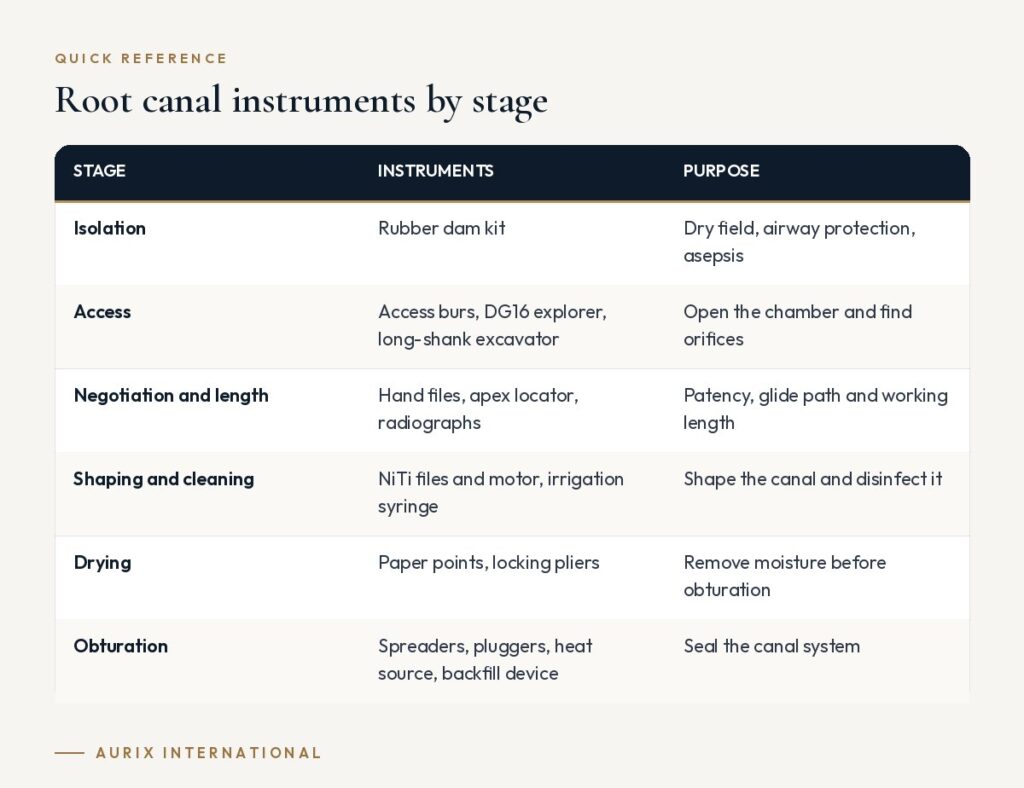
Root canal instruments by stage
| Stage | Instruments | Purpose |
|---|---|---|
| Isolation | Rubber dam kit | Dry field, airway protection, asepsis |
| Access | Access burs, DG16 explorer, long-shank excavator | Open the chamber and find orifices |
| Negotiation and length | Hand files, apex locator, radiographs | Patency, glide path and working length |
| Shaping and cleaning | NiTi files and motor, irrigation syringe | Shape the canal and disinfect it |
| Drying | Paper points, locking pliers | Remove moisture before obturation |
| Obturation | Spreaders, pluggers, heat source, backfill device | Seal the canal system |
How to choose root canal instruments
- Pick one obturation technique and equip for it fully. Lateral condensation, warm vertical and single-cone techniques need different instruments.
- Match consumables to your file system. Paper points and gutta-percha cones should correspond to your final file size and taper.
- Protect fine tips. Explorers, spreaders and pluggers bend easily. In practice, store them in a dedicated endodontic cassette.
- Plan for single-use items. Broaches, many files, irrigation needles and paper points are single-use. Moreover, budget and stock accordingly.
- Train the team. Assistants who know the sequence can prepare irrigants, measure points and pass instruments without prompting.
For more detail on the stainless steel hand instruments in this list, see the top 10 endodontic hand instruments and our guide to spreaders, pluggers and locking pliers. For isolation, the top 10 rubber dam instruments and clamps covers the kit in detail. Also, aurix International supplies many of the stainless steel hand instruments used in endodontic trays.
Care and handling tips
- Count and check files before and after use, and look for unwinding, bending or shiny spots on the flutes, which can signal fatigue.
- Keep fine hand instruments in a file stand or cassette so tips are not bent during reprocessing.
- Wipe debris from file flutes during treatment with a moist gauze or sponge to keep them cutting efficiently.
Frequently asked questions
Do I still need hand files if I use rotary files?
Yes. Hand files typically negotiate the canal, confirm patency and create a glide path before rotary shaping, and to manage difficult anatomy.
Is an apex locator enough to measure working length?
Apex locators are common and helpful, but most clinicians confirm length with radiographs as well.
Why is rubber dam essential for root canals?
It protects the airway from small instruments and irrigants, keeps saliva out of the canal and improves visibility. In addition, it counts as standard of care for endodontic treatment.
How are root canal instruments sterilized?
Reusable instruments should be cleaned, inspected, packaged and sterilized according to the manufacturer’s IFU and CDC guidance. Discard items labeled single-use after one patient.
Stock your endodontic trays with reliable hand instruments. Aurix can help you assemble explorers, excavators, locking pliers, spreaders and pluggers into a complete endo kit. Build your endo kit →