
Orthodontic pliers are the core instruments of any orthodontic practice, used to place and remove archwires, bend wire, cut ligatures and remove bands and brackets. Also, each pattern targets a specific job, and using the wrong plier on the wrong wire is one of the quickest ways to damage the instrument. In addition, this guide covers the 10 orthodontic pliers found in most clinics, what each is for and how to keep them working well.
Key takeaways
- Holding and placing pliers (Weingart, How) are used at almost every appointment.
- Bending pliers such as bird-beak and three-prong pliers are made for specific wire sizes; check the rated capacity.
- Cutters should never be used on wire heavier than they target.
- Regular cleaning, lubrication and inspection of the joint and tips extend plier life.

The top 10 orthodontic pliers
1. Weingart utility pliers
Weingart pliers have long, tapered, serrated tips that are angled for access. Generally, they guide archwires into brackets and molar tubes, remove archwires and make small adjustments.
Tip: Weingarts often help with many tasks, but avoid using them to bend heavy wire, which can spring the tips.
2. How pliers
How pliers have round, serrated pads at the tips and come in straight and curved versions. Furthermore, they help with placing and removing archwires and ligatures, and for holding small parts.
3. Bird-beak pliers
Bird-beak pliers (often referred to as the 139 pattern) have one round, conical beak and one pyramidal beak. In practice, they bend loops, springs and clasps in round wire, often for removable appliances.
Use the round beak for curves and the flat beak for sharp angles. Moreover, check the maximum wire diameter the manufacturer recommends.
4. Three-prong pliers
Three-prong pliers have one beak with a single prong and the other with two prongs. Squeezing the wire between them creates bends and adjusts clasps and springs, especially on removable appliances.
5. Distal end cutter
The distal end cutter trims the excess archwire extending distally from the last molar tube while holding the cut piece, so it does not fall into the patient’s mouth. Also, it is one of the most frequently used pliers at archwire changes.
Tip: Always confirm the safety-hold feature is working, and do not exceed the cutter’s rated wire size.
6. Ligature cutter
Ligature cutters have small, fine, sharp tips designed to cut stainless steel ligature wires close to the bracket. In addition, they are delicate instruments; using them on archwires dulls or chips the cutting edges.
7. Hard wire cutter
Hard wire cutters are heavier pliers designed to cut thicker stainless steel wire, for example when fabricating appliances. Generally, their stronger jaws and longer handles provide the leverage that fine cutters lack.
8. Band removing pliers
Posterior band removing pliers have one beak with a cutting or gripping edge that engages the gingival edge of the band and a padded beak that rests on the occlusal surface. Squeezing lifts the band off the tooth.
Tip: Replace worn pads promptly; they protect the tooth and improve control.
9. Bracket removing pliers
Bracket removing (debonding) pliers have sharp jaws that grip the bracket base to break the adhesive bond at debond. Different designs suit metal and ceramic brackets, so check that the plier matches the brackets used in your practice.
10. Tweed arch-bending pliers
Tweed arch-bending pliers have flat, rectangular beaks used to place torque and bends in rectangular archwires. Furthermore, they are a key plier in practices that do detailed wire bending.
Use them in pairs for controlled torque bends, and keep the beak surfaces smooth and unmarked.
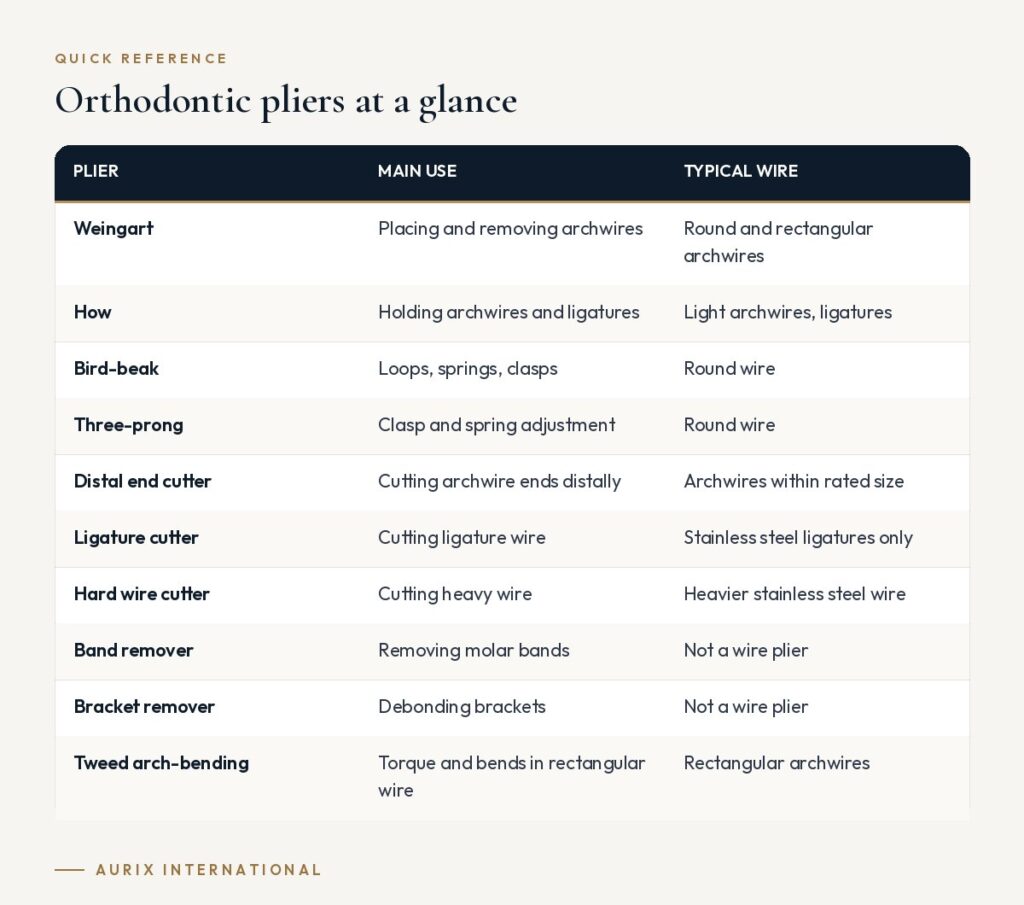
Orthodontic pliers at a glance
| Plier | Main use | Typical wire |
|---|---|---|
| Weingart | Used when placing and removing archwires | Round and rectangular archwires |
| How | Used when holding archwires and ligatures | Light archwires, ligatures |
| Bird-beak | Loops, springs, clasps | Round wire |
| Three-prong | Clasp and spring adjustment | Round wire |
| Distal end cutter | Used when cutting archwire ends distally | Archwires within rated size |
| Ligature cutter | Cutting ligature wire | Stainless steel ligatures only |
| Hard wire cutter | Cutting heavy wire | Heavier stainless steel wire |
| Band remover | Removing molar bands | Not a wire plier |
| Bracket remover | Debonding brackets | Not a wire plier |
| Tweed arch-bending | Torque and bends in rectangular wire | Rectangular archwires |
How to choose orthodontic pliers
- Check joint quality. A smooth box or lap joint with no side-to-side play gives precise, consistent control.
- Look at tip alignment. Tips should meet evenly; misaligned tips mark wires and make bends inaccurate.
- Check cutter capacity. Every cutter should state the maximum wire size it can cut. Respecting it prevents chipped edges.
- Consider tungsten carbide inserts. Some cutters use carbide inserts for longer-lasting edges; check whether they can be replaced.
- Maintain the joints. Lubricate hinges as recommended by the manufacturer. Our guide to lubricating hinged instruments explains why and how.
For a deeper look at the patterns, see our practical orthodontic pliers guide and our overview of ligature instruments and wire cutters. Aurix International offers orthodontic pliers individually and in kit form, including the Orthodontic Wire Control System.
Care and maintenance
Orthodontic pliers are precision hinged instruments, and most problems come from residue left in the joint, wire cut beyond a cutter’s capacity, or instruments dropped on hard surfaces. In practice, clean pliers promptly after use, open them fully during cleaning so the joint is reached, dry them thoroughly and lubricate the hinge before sterilization if the manufacturer recommends it. Moreover, inspect tips and cutting edges regularly; a chipped cutter or misaligned tip is a sign to repair or replace the plier rather than keep using it.
Frequently asked questions
What is the most used orthodontic plier?
The Weingart utility plier and the distal end cutter are among the most frequently used, since they are needed at most archwire changes.
Can I cut archwires with a ligature cutter?
No. Ligature cutters are made for fine ligature wire. Cutting archwires with them can chip or dull the edges.
How do I keep orthodontic pliers from rusting or stiffening?
Clean them promptly after use, dry them thoroughly, lubricate the joints with a suitable instrument lubricant, and sterilize according to the manufacturer’s IFU.
What does “139” mean on bird-beak pliers?
It is a long-established pattern number commonly used for bird-beak or light wire pliers. Exact designs can vary slightly between manufacturers.
Equip your orthodontic team with dependable pliers. Aurix supplies orthodontic pliers and cutters for clinics, distributors and private label partners. Ask about orthodontic pliers →