Ligatures hold the archwire in the bracket slot. Placing and removing them is one of the most repeated tasks in orthodontics, so the right instruments save significant chair time over a year.
Ligature types
- Elastomeric ligatures (O-rings) — quick to place, available in colours, but lose force over time.
- Stainless steel wire ligatures — provide firm, consistent engagement, especially for rotations and space closure.
Instruments for elastomeric ligatures
- Mathieu pliers — locking pliers that hold an O-ring while it is stretched over the bracket wings.
- Ligature placers/guns — dispense and place O-rings quickly.
- Scalers or explorers — remove elastomerics by lifting them from the bracket.
Instruments for wire ligatures
- Ligature tying pliers (Coon type) — twist wire ligatures tightly around the bracket.
- Ligature director/tucker — guides the ligature under the archwire and tucks the twisted end away from the lip.
- Ligature cutters — fine, sharp tips cut wire ligatures close to the twist.
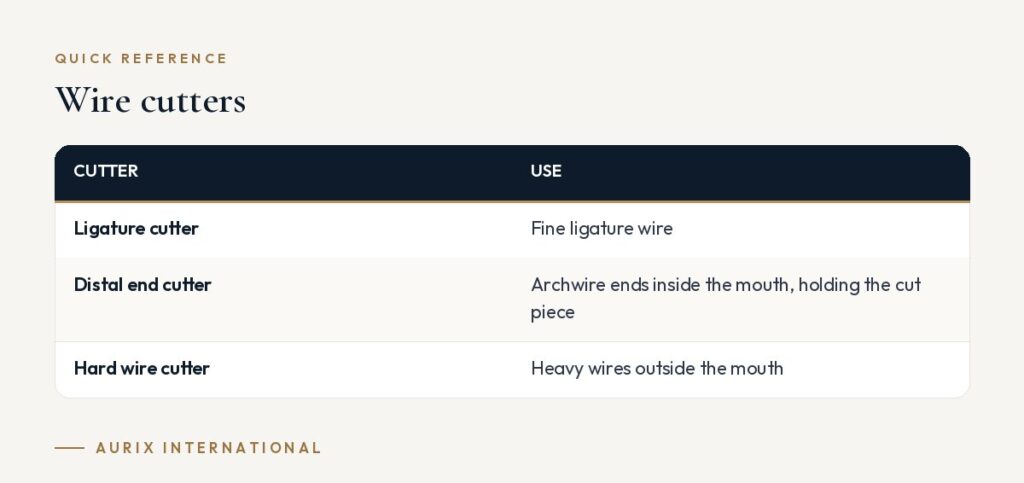
Wire cutters
| Cutter | Use |
|---|---|
| Ligature cutter | Fine ligature wire |
| Distal end cutter | Archwire ends inside the mouth, holding the cut piece |
| Hard wire cutter | Heavy wires outside the mouth |
Safety tips
- Always use cutters that hold the cut end, or cover the area with gauze, to prevent wire pieces falling into the mouth.
- Tuck all wire ligature ends to avoid soft-tissue irritation.
- Never cut wires heavier than the cutter’s rating; it damages the edges.
Care
Keep cutting edges sharp and aligned. Tungsten carbide inserts last longer. Lubricate joints after sterilisation.
Ligature instruments are part of the Aurix Orthodontic Wire Control System.