A well-planned oral surgery kit lets you move from incision to closure without hunting for instruments. Whether you are handling surgical extractions, impacted teeth or alveoloplasty, the same core items appear on nearly every tray. This list covers the ten instrument groups every oral surgery kit should include, with typical patterns and practical tips on setting them up.
Key takeaways
- A complete oral surgery kit covers access, elevation, extraction, bone management and closure.
- Standard patterns such as the Molt No. 9, Minnesota retractor, Cryer elevators and Lucas curette form a reliable core.
- Forceps selection depends on the teeth you treat most; universals cover many cases.
- Organize the kit in the order of use, ideally in a cassette, to speed setup and reduce errors.
- Inspect and maintain hinged and sharp instruments after every cycle.
The top 10 items for an oral surgery kit
1. Scalpel handle and blades
A No. 3 scalpel handle with No. 15 blades is the standard for intraoral incisions. A 15C gives more precision around papillae, and a 12 or 12B helps with distal incisions behind the last molar.
Tip: mount and remove blades with a hemostat or needle holder, never with fingers, and dispose of them in a sharps container.
2. Periosteal elevator
The Molt No. 9 is the most common periosteal elevator in oral surgery kits. Its pointed end reflects papillae and its broad end lifts the full-thickness flap. Some surgeons add a Woodson or Seldin elevator for specific uses.
3. Retractors
A Minnesota retractor protects the cheek and tongue and holds the flap; a Seldin retractor can double as a flap retractor and periosteal elevator. A Weider tongue retractor helps in the lower arch. Add a mouth prop or bite block so the patient can rest comfortably during longer procedures.
4. Straight elevators
Straight elevators such as the 301 (narrow) and 34S (wider) are the first elevators most surgeons reach for. They are used to sever the ligament and luxate teeth and roots with controlled rotation and wedging.
5. Angled and specialty elevators
Cryer elevators (30/31, also called East-West elevators) are triangular, paired elevators for removing a remaining root of a lower molar using the empty socket as a fulcrum. Root tip picks and luxating elevators round out the elevator selection for fragile roots and atraumatic work.
6. Extraction forceps
The forceps set depends on your caseload, but many kits include upper and lower universals (150 and 151), upper molar forceps (88R/88L or 53R/53L), a lower cowhorn (23) and root forceps. Pediatric forceps are needed if you treat children.
Our dental extraction forceps buyer’s guide explains the patterns in detail.
7. Rongeur
A rongeur trims sharp bony edges after extraction and during alveoloplasty. A side- and end-cutting pattern such as the Blumenthal is versatile for intraoral use.
8. Bone file
A double-ended bone file such as the Miller style smooths the ridge after rongeur use so no sharp spicules remain under the flap. Use it with a pull stroke for most designs.
9. Surgical curette
A Lucas or Molt surgical curette removes granulation tissue, cyst lining remnants and debris from the socket before closure or grafting. Choose two sizes to suit different sockets.
10. Suturing and holding instruments
A Mayo-Hegar needle holder, Adson 1×2 tissue forceps, suture scissors (such as Dean) and a curved mosquito hemostat cover closure and small retrieval tasks. Add a surgical aspirator tip, irrigation syringe and gauze to complete the setup.
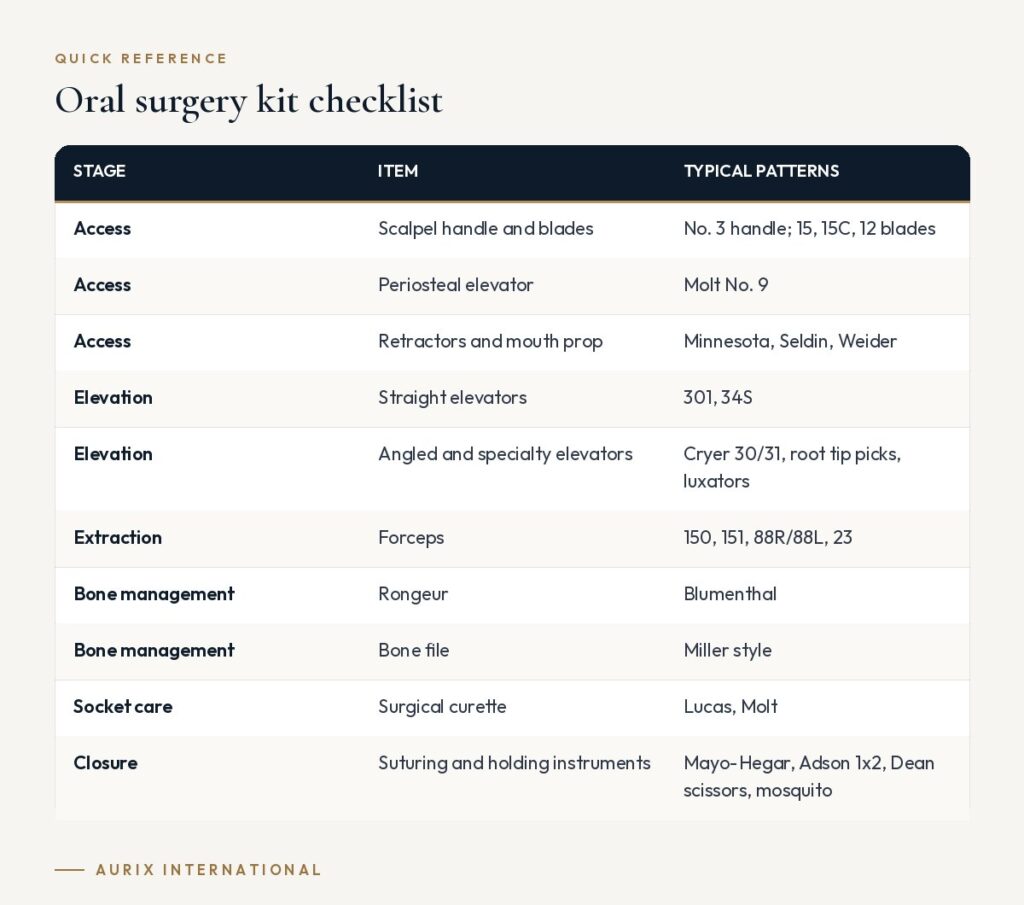
Oral surgery kit checklist
| Stage | Item | Typical patterns |
|---|---|---|
| Access | Scalpel handle and blades | No. 3 handle; 15, 15C, 12 blades |
| Access | Periosteal elevator | Molt No. 9 |
| Access | Retractors and mouth prop | Minnesota, Seldin, Weider |
| Elevation | Straight elevators | 301, 34S |
| Elevation | Angled and specialty elevators | Cryer 30/31, root tip picks, luxators |
| Extraction | Forceps | 150, 151, 88R/88L, 23 |
| Bone management | Rongeur | Blumenthal |
| Bone management | Bone file | Miller style |
| Socket care | Surgical curette | Lucas, Molt |
| Closure | Suturing and holding instruments | Mayo-Hegar, Adson 1×2, Dean scissors, mosquito |
How to build an oral surgery kit
- Arrange by sequence of use. Lay instruments out from left to right in the order they are used: access, elevation, extraction, bone work, closure. Our step-by-step guide to setting up an extraction tray shows a practical layout.
- Use a cassette. Cassettes keep instruments together through cleaning, sterilization and storage, reducing handling and loss. See why instrument cassettes and trays matter.
- Tailor forceps to your caseload. Rather than carrying every pattern, include the forceps you use most and keep others available in pouches.
- Standardize across rooms. Identical kits in every operatory make it easier for assistants and reduce setup errors.
- Maintain the kit. Check elevator tips, forceps beaks, rongeur jaws and needle holder inserts regularly, and lubricate hinged instruments as the IFU directs.
For a broader list that includes specialty instruments, see the top 15 oral surgery instruments.
Frequently asked questions
What is included in a basic oral surgery kit?
Typically a scalpel handle and blades, periosteal elevator, retractors, straight and angled elevators, extraction forceps, rongeur, bone file, surgical curette and suturing instruments.
Which elevators should an oral surgery kit have?
At minimum, a narrow and a wide straight elevator (such as 301 and 34S) and a pair of Cryer elevators (30/31). Many kits add root tip picks and luxating elevators.
Should every kit include a full forceps set?
Not necessarily. Many practices keep universals and the most-used patterns in the kit and store the rest separately to keep cassettes manageable.
Is a pre-assembled or custom oral surgery kit better?
Pre-assembled kits are quick to adopt; custom kits match your exact patterns and sequence. Many practices start from a standard kit and adjust it over time.
Get an oral surgery kit that matches the way you work. Aurix International offers pre-assembled surgical kits and a custom kit builder for choosing your own instruments in surgical-grade stainless steel. Build your oral surgery kit →