Pediatric dentistry instruments are adapted to smaller mouths, primary teeth and patients who may not tolerate long appointments. Many are smaller versions of adult instruments, while others, such as crown crimping pliers and mouth props, are especially important in children’s dentistry. This list covers ten instruments that make pediatric treatment safer, faster and more comfortable.
Key takeaways
- Smaller working ends and lighter instruments improve access and comfort in children’s mouths.
- Pediatric extraction forceps such as the 150S and 151S are scaled for primary teeth.
- Stainless steel crown work needs crown scissors and contouring or crimping pliers.
- Efficient, well-organized trays help keep appointments short, which matters for young patients.
The top 10 pediatric dentistry instruments
1. Small mouth mirror
Mirrors with smaller head diameters fit more comfortably in a child’s mouth and are easier to position around primary molars. A lightweight handle also helps.
Tip: keep a few standard-size mirrors on pediatric trays as well for older children with mixed dentition.
2. Explorer and periodontal probe
A fine explorer is used to check sealants, restorations and margins, and a probe for periodontal screening in older children and adolescents. Use a light touch; visual examination and radiographs are the main tools for caries assessment.
3. Mouth props and bite blocks
Mouth props keep the mouth open so the child does not have to hold it open for the entire procedure, which reduces fatigue and helps protect the operator’s fingers. They come in several sizes and in autoclavable or single-use versions.
Tip: attach floss to small props so they can be retrieved easily if dislodged, and follow the manufacturer’s IFU for reprocessing.
4. Aspirating syringe
A standard aspirating syringe is used for local anesthesia in children. Many clinicians prefer shorter needles for pediatric injections. Keep the syringe out of the child’s line of sight during transfer.
5. Small spoon excavators
Smaller spoon excavators fit primary teeth and are useful for removing soft caries, including in minimally invasive approaches where caries is removed with hand instruments.
6. Crown scissors
Curved crown and collar scissors trim preformed stainless steel crowns to the correct height before contouring. They are a standard part of a pediatric crown kit.
7. Crown contouring and crimping pliers
Contouring pliers shape the crown to follow the tooth’s contours, and crimping pliers bend the cervical margin inward so the crown fits snugly at the gingival margin. Johnson contouring pliers and dedicated crimping pliers are widely used patterns.
Tip: check that plier tips are smooth and free of nicks, which can mark crown surfaces.
8. Pediatric extraction forceps
Pediatric forceps such as the 150S (upper) and 151S (lower) are smaller versions of the universal 150 and 151, scaled for primary teeth and small mouths. Their smaller size also makes them less intimidating.
Tip: primary molar roots are thin and divergent and may surround the developing premolar, so use controlled movements. See our extraction forceps buyer’s guide for more on beak design.
9. Small elevators
Small straight elevators, such as the 301, and fine luxating elevators help loosen primary teeth and retained roots with minimal force. They are particularly useful for fractured primary molar roots.
10. Rubber dam frame, punch and clamps
Rubber dam isolation is widely recommended for pulp therapy and helpful for many restorations in children. Stock clamps suited to primary molars and erupting permanent molars, along with a frame, punch and clamp forceps. Our guide to choosing rubber dam clamps by tooth explains the options.
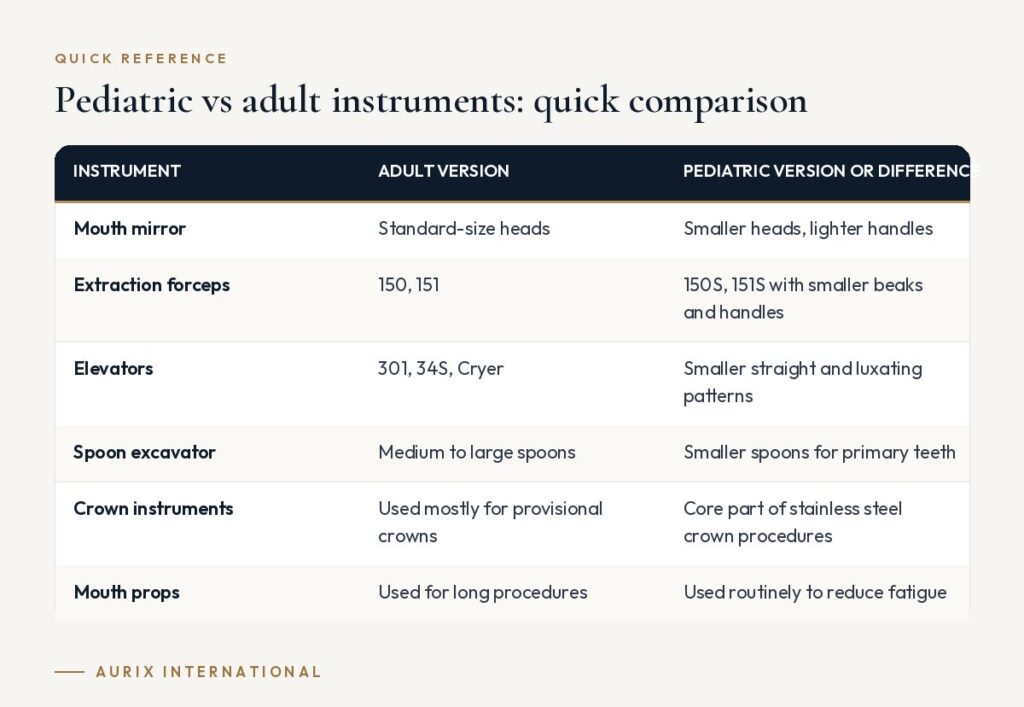
Pediatric vs adult instruments: quick comparison
| Instrument | Adult version | Pediatric version or difference |
|---|---|---|
| Mouth mirror | Standard-size heads | Smaller heads, lighter handles |
| Extraction forceps | 150, 151 | 150S, 151S with smaller beaks and handles |
| Elevators | 301, 34S, Cryer | Smaller straight and luxating patterns |
| Spoon excavator | Medium to large spoons | Smaller spoons for primary teeth |
| Crown instruments | Used mostly for provisional crowns | Core part of stainless steel crown procedures |
| Mouth props | Used for long procedures | Used routinely to reduce fatigue |
Keeping pediatric appointments efficient
Children often tolerate shorter appointments best, so tray organization has a direct effect on how treatment goes. Lay out instruments in the order they will be used, keep the syringe and sharp instruments out of the child’s line of sight, and have everything for the procedure on the tray before the child sits down. Many pediatric teams use a tell-show-do approach, so having a mirror or a gentle instrument ready to show the child can help build trust before treatment begins.
How to choose pediatric dentistry instruments
- Prioritize size and weight. Smaller working ends and lighter instruments improve access and reduce the sense of bulk in a child’s mouth.
- Build dedicated trays. Separate pediatric cassettes for exams, restorations, crowns and extractions save time and keep appointments short. Our article on designing custom instrument kits can help.
- Check plier and scissor quality. Crown pliers and scissors must have smooth, well-aligned jaws to shape crowns accurately without marking them.
- Consider colored or friendly handles. Some practices use colored handles or cassettes to identify pediatric trays quickly, as long as the materials tolerate sterilization.
- Follow the IFU. Small instruments and mouth props can trap debris; make sure cleaning and sterilization follow CDC guidance and the manufacturer’s instructions.
Frequently asked questions
Do pediatric dentists use different instruments from general dentists?
Many instruments are the same, but pediatric versions are often smaller or lighter. Pediatric practices also rely more on stainless steel crown instruments, mouth props and pediatric-sized forceps such as the 150S and 151S.
What instruments are needed for a stainless steel crown?
Typically crown scissors to trim the crown, contouring pliers to shape it, crimping pliers to adapt the margin, and a basic setup with an explorer and a plastic instrument or band seater, plus cementation materials.
Can adult extraction forceps be used on children?
Adult forceps can be used in some cases, especially for older children, but pediatric forceps fit primary teeth and small mouths better and are often preferred for comfort and control.
Why are mouth props used in pediatric dentistry?
They help keep the mouth open without the child having to hold it, reducing jaw fatigue, helping the operator work efficiently and protecting the operator’s fingers.
Equipping a pediatric practice? Aurix International can assemble custom kits of surgical-grade stainless steel instruments sized for children’s dentistry. Create a pediatric kit →