Equipping a new dental clinic means making many purchasing decisions at once, and hand instruments are easy to underestimate. Instruments are used at every appointment, so having the right patterns in sufficient numbers affects daily flow from the first week. This list covers the ten instrument groups to buy first, with notes on what each group should include and how to plan quantities.
Key takeaways
- Plan instruments by procedure and tray, not as a long list of individual items.
- Quantities depend on chairs, appointments per day and how long a full cleaning and sterilization cycle takes.
- Diagnostic setups are needed in the largest numbers; surgical instruments in smaller numbers but with careful pattern choice.
- Cassettes, consistent tray layouts and good-quality steel save time and money over the life of the clinic.
The top 10 instruments to buy for a new dental clinic
1. Diagnostic setups
Mirror, explorer, periodontal probe and cotton pliers. These are on almost every tray, so buy them in the largest quantity. Count the appointments each chair handles in the time it takes to process an instrument set, and add spares for breakdowns and busy days.
2. Hand scalers and curettes
A typical hygiene set includes a sickle scaler (such as H6/H7 or 204S), a universal curette (such as Columbia 13/14) and Gracey curettes, at minimum 11/12 and 13/14, often with 1/2 or 5/6 and 7/8. Include implant scalers if you maintain implants.
Tip: buy enough to rotate sets out for sharpening without running short.
3. Restorative hand instruments
Spoon excavators, plastic filling instruments, composite instruments, condensers, burnishers and carvers. Ask each dentist which patterns they prefer before ordering, since restorative instruments are very personal.
4. Matrix systems
Tofflemire retainers and bands, plus a sectional matrix system with rings if your clinicians use them for posterior composites. Our guide to Tofflemire vs sectional matrix systems explains the trade-offs.
5. Extraction forceps
A core set usually includes 150 and 151 universals, a 23 cowhorn for lower molars and an upper molar pair such as 88R/88L or 53R/53L. Add root forceps and pediatric patterns according to your patient base.
6. Elevators
A straight elevator (301 and a larger 34S or similar), a pair of Cryer elevators and, if you do atraumatic extractions, luxating elevators or periotomes.
7. Basic surgical instruments
Scalpel handles, a periosteal elevator such as the Molt 9, a Minnesota retractor, a surgical curette, a needle holder, tissue forceps and suture scissors. These support flap procedures, surgical extractions and suturing.
8. Rubber dam kit
A frame, punch, clamp forceps and an assortment of clamps for molars, premolars and anteriors. Rubber dam isolation is widely recommended for endodontic treatment and helpful for many restorations.
9. Anesthetic syringes
Reusable aspirating syringes for every operatory, plus spares. Include a safe recapping device or follow your sharps safety protocol.
10. Cassettes and trays
Instrument cassettes hold a complete procedure set through cleaning, sterilization, storage and use. Choose sizes that fit your ultrasonic cleaner and sterilizer chamber, and decide early whether you will use cassettes for every procedure or only for the most common trays. They reduce handling of sharp instruments, protect tips and make it easy to see when something is missing. Color coding by procedure helps staff choose the right cassette quickly.
How to plan quantities
The most reliable way to plan instrument quantities is to work backward from your schedule. Estimate how many appointments of each type will take place per chair per day, then find out how long it takes to process a set from the moment it leaves the operatory until it is sterile, dry and back on the shelf. The number of sets you need for each tray is roughly the number of those appointments that happen within one processing cycle, plus a margin for spares, sharpening rotation and the occasional dropped or damaged instrument.
It is usually better to start with a solid core of the instruments you know you will use daily than to buy every pattern in a catalog. Track which trays run short in the first months and add sets where the bottlenecks appear. Keep a simple inventory list so reorders are quick and consistent.
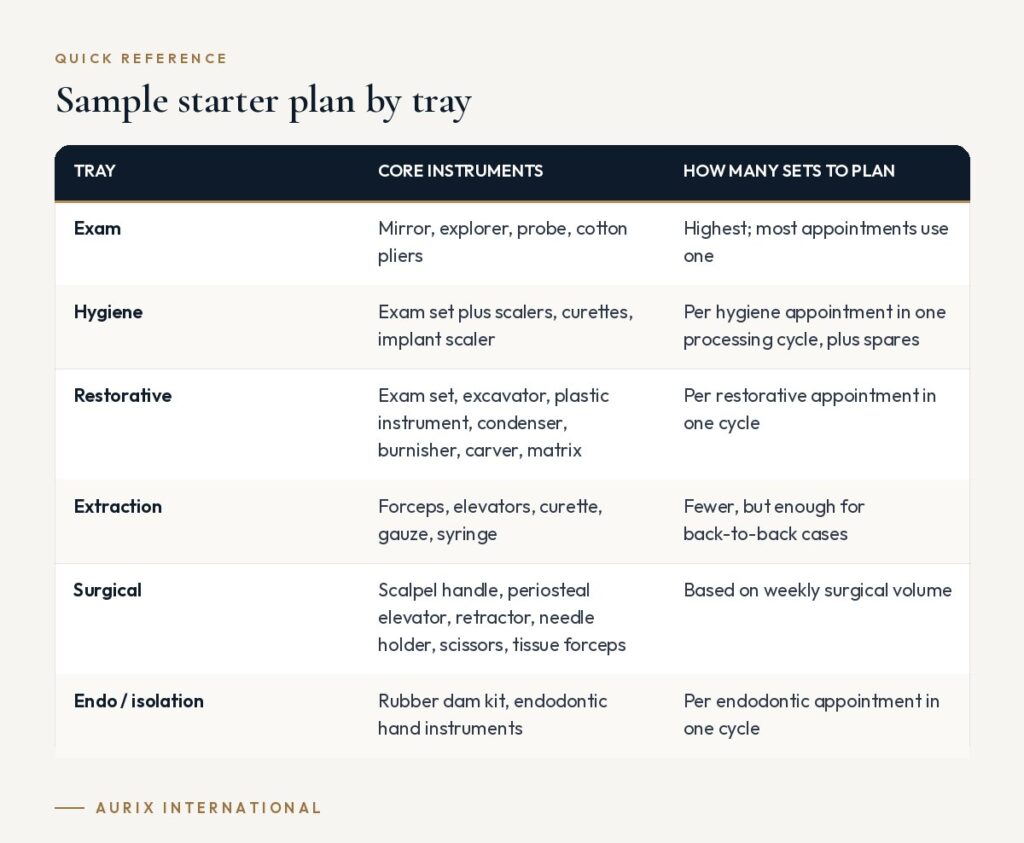
Sample starter plan by tray
| Tray | Core instruments | How many sets to plan |
|---|---|---|
| Exam | Mirror, explorer, probe, cotton pliers | Highest; most appointments use one |
| Hygiene | Exam set plus scalers, curettes, implant scaler | Per hygiene appointment in one processing cycle, plus spares |
| Restorative | Exam set, excavator, plastic instrument, condenser, burnisher, carver, matrix | Per restorative appointment in one cycle |
| Extraction | Forceps, elevators, curette, gauze, syringe | Fewer, but enough for back-to-back cases |
| Surgical | Scalpel handle, periosteal elevator, retractor, needle holder, scissors, tissue forceps | Based on weekly surgical volume |
| Endo / isolation | Rubber dam kit, endodontic hand instruments | Per endodontic appointment in one cycle |
Buying tips for a new clinic
- Standardize patterns. Using the same instruments in every operatory makes setup, training and reordering simpler.
- Buy in kits where possible. Pre-assembled or custom kits make it easier to equip several chairs identically. See our comparison of pre-assembled kits vs individual instruments.
- Check quality on arrival. Inspect tips, joints, markings and finish before instruments go into circulation.
- Match your reprocessing equipment. Confirm that instruments and cassettes fit your ultrasonic cleaner and autoclave chamber and that the IFU matches your cycles.
- Plan for replacement. Budget for sharpening, repairs and replacement from the start. Our new clinic instrument checklist goes into more detail.
Frequently asked questions
How many instrument sets does a new dental clinic need?
It depends on the number of chairs, how many appointments each chair sees, and how long it takes to clean, sterilize and dry a set. As a rule, you need enough sets to cover every appointment that occurs during one full processing cycle, plus spares.
Should a new clinic buy instruments individually or in kits?
Kits are efficient for standard procedures and ensure consistency across operatories. Individual instruments let clinicians add preferred patterns. Most clinics use both.
What is often forgotten when equipping a new clinic?
Spares, cassettes, rubber dam clamps for different teeth, sharpening equipment and instruments for implant maintenance are commonly overlooked.
Is it worth paying more for instruments?
Well-made instruments hold an edge longer, resist corrosion and keep their alignment, which can lower the cost of replacement over time. Compare total cost of ownership, not just unit price.
Opening a new clinic? Aurix International can help you plan and supply instruments for every tray, from individual items to pre-assembled and custom kits. Plan your instrument order →