Dental bur manufacturers supply the carbide burs, diamonds, finishing and polishing instruments that do most of the cutting in restorative, prosthetic and surgical dentistry. However, a small number of specialist companies dominate this category, alongside handpiece makers that produce the rotary systems burs run in. This list introduces 10 notable bur and rotary instrument manufacturers.
Key takeaways
- We list the 10 companies in no particular order, so they are not ranked.
- In fact, most are bur and diamond specialists; one is included for handpieces and motors that drive rotary instruments.
- Shank type, head shape and size, grit and blade design determine how a bur performs.
- Above all, follow each manufacturer’s IFU for reuse, cleaning and sterilization of burs.
How we chose these manufacturers
We selected manufacturers whose main focus includes burs and rotary instruments, chosen for breadth of range, specialization and market presence. When a manufacturer has a US subsidiary, we list the company once and mention the US arm in its entry. The list is in no particular order and is not a ranking by revenue or quality. Also, the full, searchable list is in the Aurix supplier directory.
The top 10 dental bur and rotary instrument manufacturers
1. Komet Dental (Gebr. Brasseler)
Komet Dental is a German maker of rotary instruments and burs based in Lemgo, with endodontic products in its range. In the US, Komet USA in Rock Hill, South Carolina, supplies its burs and rotary instruments.
2. Hager & Meisinger
Hager & Meisinger of Neuss, Germany, makes burs and surgical instruments, with implant-related products in its focus. Also, its US arm, Meisinger USA, is based in Centennial, Colorado.
3. Brasseler USA
Brasseler USA, based in Savannah, Georgia, makes rotary instruments, burs, endodontic and hand instruments.
4. Microcopy Dental
Microcopy Dental of Kennesaw, Georgia, is a US maker of dental burs and diamonds.
5. SS White Dental
SS White Dental, based in Lakewood, New Jersey, makes dental burs and rotary instruments.
6. Prima Dental
Prima Dental is a UK maker of dental burs and rotary instruments based in Gloucester.
7. Shofu
Shofu of Kyoto, Japan, makes dental materials and finishing products, and its focus includes burs and rotary instruments. In addition, its US arm, Shofu Dental Corporation, is based in San Marcos, California. Shofu is often considered for finishing and polishing steps after composite or ceramic work.
8. Mani
Mani, based in Utsunomiya, Japan, makes endodontic files, burs and surgical needles.
9. NSK (Nakanishi)
NSK of Kanuma, Japan, makes dental handpieces, with burs and rotary instruments in its focus. Meanwhile, NSK America, in Hoffman Estates, Illinois, serves as its US arm.
10. Bien-Air Dental
Bien-Air Dental, based in Biel/Bienne, Switzerland, makes dental handpieces and motors, the rotary systems that drive burs. It is included for practices reviewing their whole rotary setup rather than burs alone.
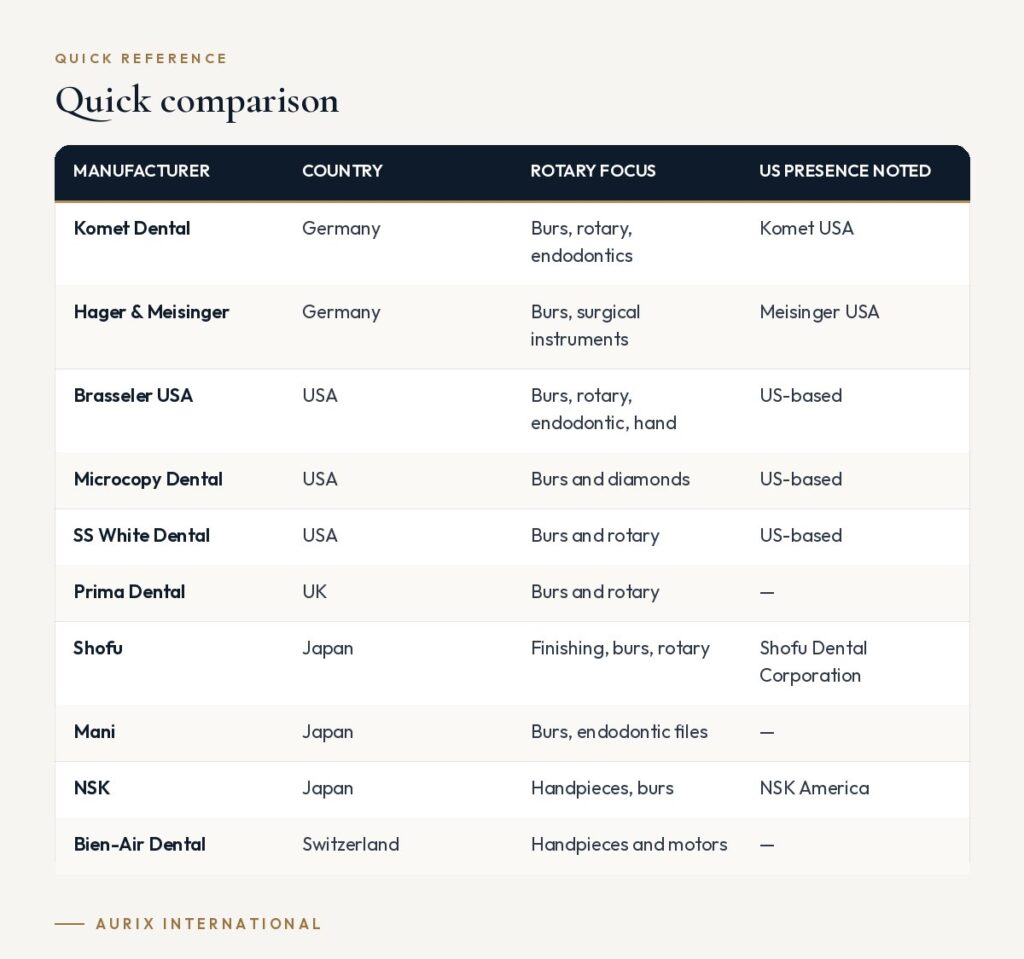
Quick comparison
| Manufacturer | Country | Rotary focus | US presence noted |
|---|---|---|---|
| Komet Dental | Germany | Burs, rotary, endodontics | Komet USA |
| Hager & Meisinger | Germany | Burs, surgical instruments | Meisinger USA |
| Brasseler USA | USA | Burs, rotary, endodontic, hand | US-based |
| Microcopy Dental | USA | Burs and diamonds | US-based |
| SS White Dental | USA | Burs and rotary | US-based |
| Prima Dental | UK | Burs and rotary | — |
| Shofu | Japan | Finishing, burs, rotary | Shofu Dental Corporation |
| Mani | Japan | Burs, endodontic files | — |
| NSK | Japan | Handpieces, burs | NSK America |
| Bien-Air Dental | Switzerland | Handpieces and motors | — |
Carbide, diamond and finishing specialists
Bur manufacturers tend to have particular strengths. Komet, Hager & Meisinger, Brasseler USA, SS White, Prima Dental and Microcopy all produce carbide and diamond rotary instruments used for cavity and crown preparation, while Shofu is often associated with finishing and polishing systems. Mani adds endodontic files to its bur range, and Meisinger also supplies surgical instruments.
Handpiece makers such as NSK and Bien-Air complete the rotary picture. Generally, speed, torque, concentricity and maintenance of the handpiece all influence how a bur cuts, how much heat it produces and how long it lasts. Reviewing burs and handpieces together, especially when you add new procedures such as zirconia preparation or surgical sectioning, gives better results than changing one without the other.
How to choose burs and a bur supplier
- Match the shank to the handpiece. Friction grip (FG) burs fit high-speed handpieces; latch-type (RA) burs fit contra-angles; straight handpiece (HP) burs help with laboratory and some surgical work.
- Choose the right cutting design. Carbide burs suit cutting tooth structure and removing old restorations, while diamonds suit crown preparation and ceramics. Grit color codes indicate coarseness, so check each maker’s chart.
- Standardize shapes and sizes. Round, pear, inverted cone, fissure and flame shapes cover most procedures. A short standard list reduces stock and confusion on the tray.
- Single-use or reusable. Some burs are sold as single-use; reusable burs must be cleaned and sterilized per the manufacturer’s IFU, typically in a bur block. Our guide to ultrasonic cleaning do’s and don’ts covers safe cleaning.
- Replace dull burs promptly. A dull bur increases heat and vibration. Track usage so worn burs are retired.
- Compare total cost. Price per bur matters less than cutting life and consistency. See total cost of ownership of dental instruments for a practical approach.
Rotary instruments work alongside hand instruments on every restorative tray; our guide to setting up a restorative tray shows how they fit together.
Frequently asked questions
What is the difference between carbide and diamond burs?
Carbide burs have bladed heads that cut by shearing, while diamond burs are coated with abrasive diamond particles that grind. Furthermore, each suits different materials and steps.
Can dental burs be sterilized and reused?
Only burs labeled as reusable, and only according to the manufacturer’s IFU. Single-use burs should be discarded after one patient.
Why is a handpiece maker on a bur list?
Burs are only one half of the rotary system. Bien-Air and NSK make the handpieces and motors that drive them, which affects speed, torque and bur performance.
How many bur suppliers should a practice use?
Many practices use one main supplier for everyday shapes and add a specialist for surgical, finishing or endodontic access burs.
Completing your restorative and surgical trays? Aurix International supplies the surgical-grade hand instruments that work alongside your rotary setup, individually or as pre-assembled and custom kits. Browse oral instruments →