Veterinary dental instruments share a lot with human dentistry, but patient size, tooth anatomy and anesthesia change which instruments matter most. Also, dogs and cats have long, curved roots, thin alveolar bone in places and a wide range of jaw sizes, from toy breeds to giant breeds. This list covers the ten instruments most veterinary practices rely on for assessment, cleaning and extractions.
Key takeaways
- Thorough periodontal assessment under anesthesia starts with a probe and explorer.
- Hand scalers and curettes remain essential alongside powered scalers, especially subgingivally.
- Winged and luxating elevators, used gently, are central to safe extractions in dogs and cats.
- Instrument sizes should match the patient; small and feline sizes are a must for many practices.
The top 10 veterinary dental instruments
1. Periodontal probe
A graduated periodontal probe measures pocket depth, gingival recession and furcation involvement. In addition, the team records readings on a dental chart for every tooth under anesthesia. Probes with clear millimeter markings (such as Williams-style markings) are common. Small patients, especially cats, have shallow normal sulcus depths, so gentle technique and precise markings matter.
2. Dental explorer
An explorer, such as a shepherd’s hook design, detects calculus, resorptive lesions, enamel defects and pulp exposure in fractured teeth. Many veterinary clinics use double-ended probe/explorer combinations so both tools are always at hand. Use a light touch so the tip can transmit the feel of the surface.
3. Sickle scaler
Sickle scalers have a pointed tip and triangular cross-section and remove supragingival calculus, particularly from narrow interproximal spaces and the crowns of small teeth. Because the pointed tip can damage soft tissue, avoid using sickles subgingivally.
4. Curettes
Curettes have a rounded toe and back, which makes them suitable for subgingival scaling and root planing and for removing debris from periodontal pockets. Universal curettes such as Columbia patterns and area-specific Gracey curettes are both used in veterinary practice. After powered scaling, hand curettes help clean root surfaces that ultrasonic tips cannot reach well. Our universal vs area-specific curettes guide explains the differences.
5. Winged elevators
Winged elevators have a thin, concave blade with sharp edges that curve to match root surfaces. Generally, you insert them into the periodontal ligament space and apply gentle, sustained rotational pressure to fatigue the ligament. They come in several widths so the blade can match the root diameter, from small feline teeth to large canine roots.
Practical tip: use a short finger stop on the blade to limit slippage, and hold each position for several seconds rather than levering forcefully.
6. Luxating elevators
Luxating elevators have very thin, sharp blades designed to cut and sever the periodontal ligament as you work them apically. Furthermore, they are delicate, so never use them as levers, which can bend or chip the blade. Many veterinary dentists use luxators to start and winged or conventional elevators to complete the elevation. For a comparison, see luxating vs traditional elevators.
7. Small extraction forceps
Once a tooth is mobile, extraction forceps grasp and remove it with gentle rotation and traction. Small-breed and feline forceps, often with narrow or serrated beaks, are the most frequently used because they suit small crowns and fractured roots. Only apply forceps when the tooth is already loose to avoid root fracture.
8. Root tip picks
Root tip picks are fine, pointed instruments used to tease out fractured root tips from the socket. They are especially valuable in cats, whose slender roots fracture easily. Because they are delicate, they are meant for gentle elevation of small fragments, not for heavy luxation.
9. Periosteal elevator
Surgical extractions of multi-rooted teeth and canines often require a mucoperiosteal flap. A periosteal elevator, such as a Molt-style instrument, reflects the gingiva and periosteum to expose bone so that the clinician can remove alveolar bone and section the tooth. Flaps are then closed with absorbable sutures. Our periosteal elevators guide covers widths and handle options.
10. Suturing instruments
Closing extraction sites requires a small needle holder, fine tissue forceps (such as Adson-type forceps) and suture scissors. In practice, small, fine-tipped instruments make it easier to handle thin oral tissues and small-gauge sutures in toy breeds and cats.
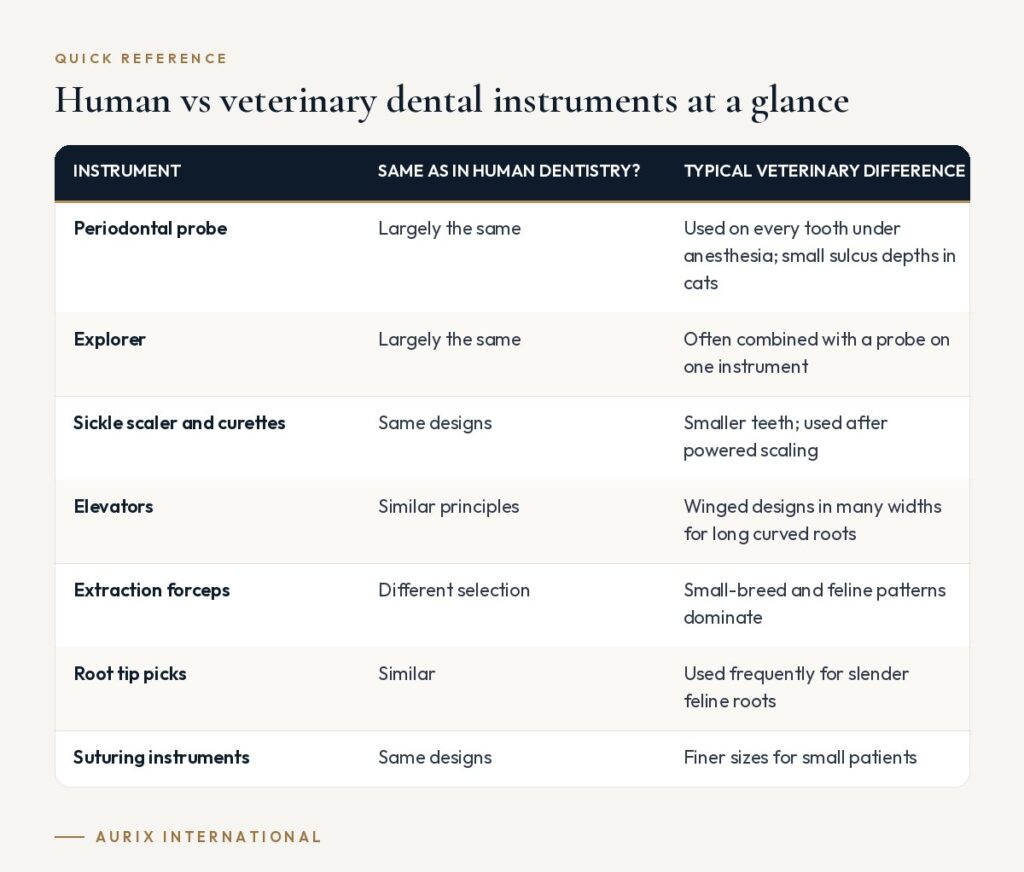
Human vs veterinary dental instruments at a glance
| Instrument | Same as in human dentistry? | Typical veterinary difference |
|---|---|---|
| Periodontal probe | Largely the same | Used on every tooth under anesthesia; small sulcus depths in cats |
| Explorer | Largely the same | Often combined with a probe on one instrument |
| Sickle scaler and curettes | Same designs | Smaller teeth; used after powered scaling |
| Elevators | Similar principles | Winged designs in many widths for long curved roots |
| Extraction forceps | Different selection | Small-breed and feline patterns dominate |
| Root tip picks | Similar | Used frequently for slender feline roots |
| Suturing instruments | Same designs | Finer sizes for small patients |
How to choose veterinary dental instruments
- Match sizes to your caseload. A practice seeing many cats and toy breeds needs a full range of small elevators, forceps and root tip picks.
- Prioritize sharpness. Elevators, luxators, scalers and curettes work best and most safely when sharp. Moreover, plan for regular sharpening with the correct technique.
- Look at handle comfort. Extractions require sustained controlled pressure; comfortable handles reduce fatigue.
- Choose quality steel. Thin luxator and elevator blades need well-heat-treated stainless steel to resist bending and chipping.
- Reprocess correctly. Clean, inspect and sterilize instruments according to the manufacturer’s IFU, as in human dentistry.
- Consider a dedicated kit. A standard dental cassette for each procedure saves time during anesthesia. For more on the overlaps, see veterinary dentistry instruments: overlaps and differences.
Frequently asked questions
Can human dental instruments be used in veterinary dentistry?
Many can, particularly probes, explorers, scalers, curettes, periosteal elevators and suturing instruments. Also, elevators and forceps are often chosen in veterinary-specific sizes and shapes to suit animal tooth anatomy.
Are mouth gags recommended for cats?
Many veterinary dentists advise against spring-loaded mouth gags in cats, because holding the jaw wide open may compromise blood flow and cause complications. If you need a mouth prop, most clinicians prefer a short, non-spring prop for brief periods. Follow current veterinary guidance.
How often should veterinary dental instruments be sharpened?
It depends on use. Check edges regularly, for example with a test stick, and sharpen whenever an instrument feels dull or slips. Sharp instruments require less force and are safer.
What is the difference between a winged elevator and a luxator?
Winged elevators have a curved blade used with rotational pressure to fatigue the periodontal ligament. In addition, luxators have thinner, sharper blades that cut the ligament, so never use them as levers.
Equip your veterinary dental suite with dependable steel. Aurix International supplies surgical-grade stainless steel elevators, scalers, curettes and suturing instruments, plus custom kits for veterinary practices and distributors. Ask about veterinary instruments →