Pre-assembled instrument kits group the instruments needed for a specific procedure, such as an extraction, a hygiene appointment or a composite restoration, into one ready-made set. Instead of picking instruments one by one from drawers and catalogs, you buy and manage the kit as a unit. For many clinics, schools and groups, that simple change brings practical benefits across the whole practice.
Key takeaways
- Kits save time in ordering, tray setup and sterilization.
- Every operatory gets the same instruments, which supports consistent care and training.
- Kits make missing or damaged instruments easy to spot.
- Custom kits combine the convenience of a set with your own instrument preferences.
The top 10 benefits of pre-assembled instrument kits
1. Faster tray setup
When every procedure has a defined kit, setting up a room becomes a matter of selecting the right cassette or pouch set rather than assembling instruments from scratch. That saves minutes on every appointment and reduces the chance of a clinician waiting for a missing instrument mid-procedure.
2. Consistency across operatories and locations
Kits mean every room has the same instruments in the same arrangement. Clinicians moving between operatories, or between sites in a multi-location group, know exactly what they will find. That consistency supports predictable procedures and smoother teamwork.
3. Simpler ordering
Ordering one kit is easier than ordering ten or fifteen separate items, each with its own pattern number. It reduces errors such as ordering the wrong forceps variant or the wrong Gracey pair, and makes purchasing faster for practice managers.
4. Instruments chosen to work together
A well-designed kit contains instruments selected for the procedure as a whole. An extraction kit, for example, typically pairs elevators, forceps, a periosteal elevator, a curette and supporting instruments that complement each other. Our article on setting up an extraction tray shows how those instruments fit into a workflow.
5. Easier training for new staff
New assistants learn faster when each procedure has a standard set with a fixed layout. A kit is effectively a visual checklist: they learn the instruments, their order of use and how to reset the tray. That makes onboarding more efficient and reduces mistakes during busy days.
6. Quick identification of missing or damaged items
When a cassette has a defined slot for each instrument, a gap is obvious immediately. Missing or damaged instruments are noticed during reprocessing rather than in the middle of a procedure. That supports better inventory control and fewer losses.
7. A smoother sterilization workflow
Kits that are processed together in a cassette reduce handling of individual instruments, which can lower the risk of sharps injuries and damage. Staff can clean, inspect, package and sterilize a complete set as a unit, following the IFUs for the instruments and the cassette. Our guide to instrument cassettes and trays explains why this matters.
8. Better cost control
Knowing exactly what each procedure requires helps prevent over-buying and duplicate patterns. Budgeting becomes simpler too: the practice can plan how many kits it needs for its appointment volume and replace them on a predictable schedule.
9. Matched quality and appearance
Instruments in a kit usually come from the same source, with consistent steel, finish and handle style. That uniformity makes trays look professional and avoids the mismatched feel of instruments collected from many suppliers over the years.
10. Easy to customize when you need to
Standard kits suit many practices, but custom kits let you specify the exact instruments for your workflow. Clinicians can keep their preferred patterns while still enjoying the benefits of a defined set. Our article on designing custom instrument kits explains how to plan one.
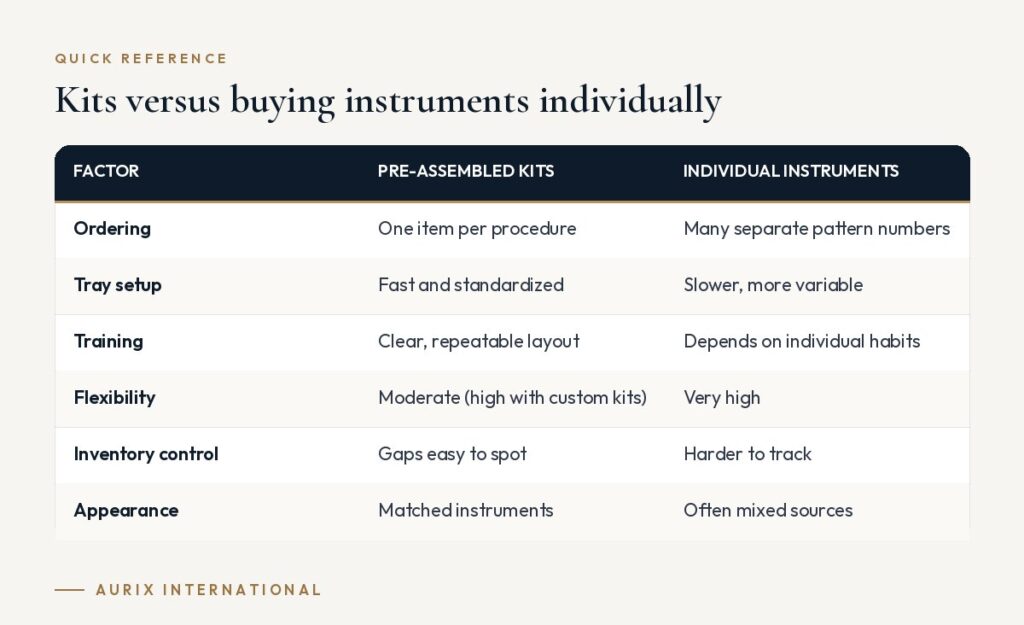
Kits versus buying instruments individually
| Factor | Pre-assembled kits | Individual instruments |
|---|---|---|
| Ordering | One item per procedure | Many separate pattern numbers |
| Tray setup | Fast and standardized | Slower, more variable |
| Training | Clear, repeatable layout | Depends on individual habits |
| Flexibility | Moderate (high with custom kits) | Very high |
| Inventory control | Gaps easy to spot | Harder to track |
| Appearance | Matched instruments | Often mixed sources |
For a deeper comparison, see pre-assembled procedure kits versus individual instruments.
How to choose the right kits
- Start with your most common procedures. Hygiene, examination, restorative and extraction kits typically deliver the biggest time savings.
- Check the contents list against how your clinicians actually work. Remove items nobody uses and add anything consistently requested.
- Match kits to your cassette system so instruments are held securely during reprocessing.
- Consider quantity: you need enough kits to cover appointments while others are being reprocessed.
- Evaluate quality of every instrument in the kit, not just the headline items.
Frequently asked questions
Are pre-assembled kits more expensive than buying instruments separately?
Not necessarily. Kits can be priced competitively, and the savings in setup time, lost instruments and ordering errors often outweigh small differences in unit cost.
Can I replace one instrument in a kit?
Yes. Individual instruments wear or get damaged at different rates, so you should be able to buy replacements for single items without replacing the whole kit.
What is the difference between a standard kit and a custom kit?
A standard kit has a fixed list of instruments chosen for a procedure. A custom kit is built to your specification, so you choose each instrument and quantity to suit your workflow.
Build a kit around the way you work. Aurix International offers pre-assembled kits and an online kit builder for creating custom instrument sets. Design your custom kit →