Endodontic hand instruments remain essential in root canal treatment, even in practices that shape most canals with rotary or reciprocating files. Hand instruments locate orifices, negotiate and gauge canals, create a glide path and condense obturation materials. Also, this list covers the 10 hand instruments found in most endodontic setups, what each does and how to get the best from them.
Key takeaways
- Hand files (K-files, H-files and reamers) follow ISO sizing and color coding, which makes them easy to identify.
- The DG16 explorer and a long-shank excavator are the key access instruments.
- Spreaders and pluggers are chosen to match your obturation technique.
- Many clinics treat small files as single-use; always follow the manufacturer’s instructions for use (IFU).
The top 10 endodontic hand instruments
1. DG16 endodontic explorer
The DG16 is a double-ended explorer with long, straight, sharply pointed working ends set at different angles. It locates canal orifices on the pulp chamber floor and to check the direction of canal entry.
Tip: Keep the DG16 tips sharp and undamaged. In addition, a blunted tip can miss a calcified orifice that a sharp tip would catch.
2. Long-shank endodontic excavator
The endodontic spoon excavator has a longer shank than a restorative excavator, so it can reach deep into the pulp chamber. It removes pulp tissue from the chamber, caries, and temporary filling material during re-entry.
3. K-files
K-files are the most widely used endodontic hand files. Generally, they are made by twisting a square or triangular blank into a tight spiral, giving them good strength. They negotiate canals, establish working length and create a glide path, typically with watch-winding or balanced-force motions.
Standard ISO hand files have a 0.02 taper and a 16 mm cutting portion, and are commonly available in 21, 25 and 31 mm lengths.
4. Hedström files (H-files)
H-files are machined from a round blank into a series of cones, creating sharp cutting edges that cut efficiently on the pulling (withdrawal) stroke. Furthermore, they are useful for shaping and for removing gutta-percha or debris.
Tip: Do not rotate an H-file in the canal. Its design makes it prone to binding and fracture if turned.
5. Reamers
Reamers look similar to K-files but have fewer flutes per unit length, which makes them better suited to a rotating, cutting motion. In practice, many clinicians use them less often today, but they remain part of traditional hand instrumentation.
6. Barbed broaches
Barbed broaches have small barbs projecting from the shaft and remove (extirpate) pulp tissue in canals that are wide enough. They are not shaping instruments.
Use a broach only in canals where it fits loosely. If it binds, the barbs can break off. Broaches are generally single-use.
7. Spreaders
Spreaders are smooth, tapered, pointed instruments used in lateral condensation to compact gutta-percha laterally and make space for accessory cones. Long-handled spreaders such as the D11T are common, as are finger spreaders, which offer more tactile control and can reduce the force applied.
8. Pluggers
Pluggers have flat ends and compact gutta-percha vertically. Moreover, they come in graded diameters so the clinician can work from coronal to deeper levels of the canal. Some double-ended instruments, such as the Glick No. 1, combine a paddle for placing temporary material with a plugger.
Tip: Pre-fit pluggers in the canal before obturation and mark the depth with a stop, so you know how far each one should go.
9. Endodontic locking pliers
Endodontic locking pliers are cotton-plier-style instruments with a lock and often a groove in the tips. Also, they hold paper points and gutta-percha cones securely while transferring them into the canal.
10. Endodontic ruler
An endodontic ruler or measuring gauge sets rubber stops on files at the working length and to measure gutta-percha cones and paper points. Some designs also include a gauge for checking cone tip sizes.
Accurate measuring is a small step that prevents over- or under-instrumentation, so a clear, easy-to-read scale matters.
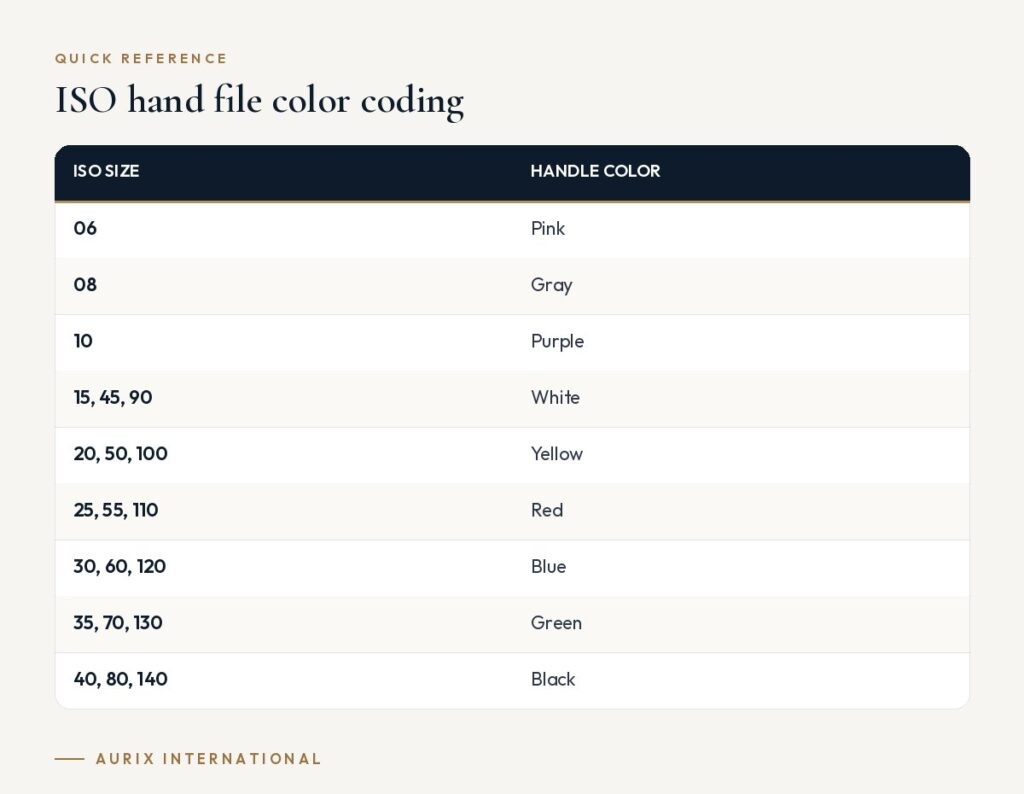
ISO hand file color coding
| ISO size | Handle color |
|---|---|
| 06 | Pink |
| 08 | Gray |
| 10 | Purple |
| 15, 45, 90 | White |
| 20, 50, 100 | Yellow |
| 25, 55, 110 | Red |
| 30, 60, 120 | Blue |
| 35, 70, 130 | Green |
| 40, 80, 140 | Black |
The ISO number corresponds to the tip diameter in hundredths of a millimeter, so a size 25 file has a tip diameter of 0.25 mm.
How to choose endodontic hand instruments
- Match instruments to your technique. A practice using lateral condensation needs a range of spreaders; one using warm vertical techniques needs graded pluggers.
- Plan file stock carefully. Small files (06–15) are used most for negotiation and glide paths and often run out first.
- Check working-end quality. Explorer and spreader tips should be sharp and true; plugger faces should be flat and smooth.
- Consider single-use policies. Small files are difficult to clean thoroughly. Follow the IFU and your infection-control policy on reuse.
- Keep the endo set together. A dedicated cassette protects fine tips and keeps everything in one place. Our guide to endodontic hand instruments covers spreaders, pluggers and locking pliers in more depth.
Endodontic treatment is normally carried out under rubber dam isolation, so the hand instruments work alongside a rubber dam kit. For the full procedure picture, including rotary files and apex locators, see our list of the top 10 root canal instruments. Aurix International supplies stainless steel endodontic hand instruments such as explorers, excavators, spreaders, pluggers and locking pliers.
Frequently asked questions
What is the difference between a K-file and an H-file?
A K-file is twisted from a square or triangular blank and cuts with both rotating and filing motions. In addition, an H-file is machined from a round blank, cuts mainly on the pull stroke and should not be rotated in the canal.
Are endodontic files reusable?
Some files are marketed as reusable and others as single-use. Small files are hard to clean and can fatigue, so many clinics discard them after one patient. Always follow the IFU and your infection-control policy.
What is the DG16 used for?
The DG16 is a double-ended endodontic explorer used to locate canal orifices and judge the angle of canal entry.
Spreader or plugger: which do I need?
Spreaders are pointed and used for lateral condensation; pluggers are flat-ended and used for vertical compaction. Generally, many clinicians keep both.
Equip your endodontic cassette with the right hand instruments. Aurix can supply explorers, excavators, spreaders, pluggers and locking pliers individually or as a kit. Talk to our team →