Scaling and root planing instruments are the tools used to remove calculus and biofilm from root surfaces below the gumline as part of nonsurgical periodontal therapy. Scaling and root planing (SRP) asks more of the instrument kit than a routine prophylaxis: deeper pockets, furcations, concavities and tenacious deposits all need instruments with the right reach and blade design. Here are the ten instruments that make up an effective SRP setup, from assessment through finishing.
Key takeaways
- SRP starts and ends with assessment: a probe and a subgingival explorer confirm what needs treating and when the surface is clean.
- Gracey curettes are the core hand instruments, supported by extended-shank and mini-bladed versions for deep and narrow sites.
- Ultrasonic scalers with slim tips are commonly used alongside hand instruments.
- Furcations and root concavities often need specialized instruments such as Nabers probes and mini blades.
The top 10 scaling and root planing instruments
1. Periodontal probe (UNC-15 or Williams)
A full six-point chart defines which sites need treatment and gives a baseline for re-evaluation. A UNC-15 is useful in deep pockets because it measures every millimeter to 15 mm.
SRP tip: probe again at re-evaluation with the same probe design so changes in depth and bleeding are directly comparable.
2. Nabers furcation probe
A curved Nabers probe assesses horizontal furcation involvement on multi-rooted teeth. Knowing the extent of furcation involvement helps you choose instruments and plan how much access you will have.
3. ODU 11/12 explorer
The ODU 11/12 explorer detects subgingival calculus before, during and after instrumentation. Its long, curved shank reaches the base of posterior pockets and wraps around line angles.
SRP tip: explore after each section is complete. A smooth, glassy feel suggests the surface is free of detectable deposits; roughness or a “catch” means more work is needed.
4. Ultrasonic scaler with slim periodontal tips
Many clinicians begin SRP with an ultrasonic scaler to remove the bulk of deposits and flush pockets. Slim, periodontal-style tips reach deep pockets and furcations with less tissue distension than hand instruments, and right and left curved tips help with furcation access.
SRP tip: use light pressure and keep the tip moving with overlapping strokes, then finish with hand instruments where tactile feedback is needed.
5. Standard Gracey curettes
The standard Gracey series is the backbone of SRP. A practical SRP set typically includes 1/2 or 5/6 for anteriors, 7/8 for posterior facial and lingual surfaces, 11/12 for posterior mesials and 13/14 for posterior distals. The single cutting edge and 70-degree blade offset allow close adaptation to root surfaces.
For a refresher on technique, see our top tips for using Gracey curettes.
6. Gracey 15/16 and 17/18
The 15/16 (a modified 11/12 with a more acute shank) improves access to posterior mesial surfaces, and the 17/18 (a modified 13/14 with a longer, more angled terminal shank and a smaller blade) improves access to posterior distal surfaces, especially on second and third molars.
7. Extended-shank Gracey curettes
Extended-shank Graceys have a terminal shank about 3 mm longer than standard and a thinned blade. They are designed for pockets deeper than about 5 mm and for root surfaces that standard Graceys cannot reach.
SRP tip: extended-shank 11/12 and 13/14 cover many deep posterior pockets; add other numbers as your case mix requires.
8. Mini-bladed Gracey curettes
Mini-bladed Graceys combine an extended shank with a blade about half the length of a standard Gracey. The short blade adapts to narrow, deep pockets, furcations, line angles and root concavities, and is useful in tight anterior pockets where a standard blade would distend the tissue.
9. Langer curettes
Langer curettes combine Gracey-style shanks with a universal blade (two cutting edges, face at 90 degrees to the terminal shank). Common versions are the Langer 1/2 for mandibular posterior teeth, 3/4 for maxillary posterior teeth and 5/6 for anterior teeth. Because each end works both mesial and distal surfaces, they can reduce instrument changes during SRP.
10. Periodontal files
Files such as the Hirschfeld and Orban types have several small cutting edges on a base. They are used to crush or roughen burnished calculus that a curette blade slides over, after which a curette removes the remaining deposit.
SRP tip: files are not finishing instruments. Always follow them with a curette to leave a smooth root surface.
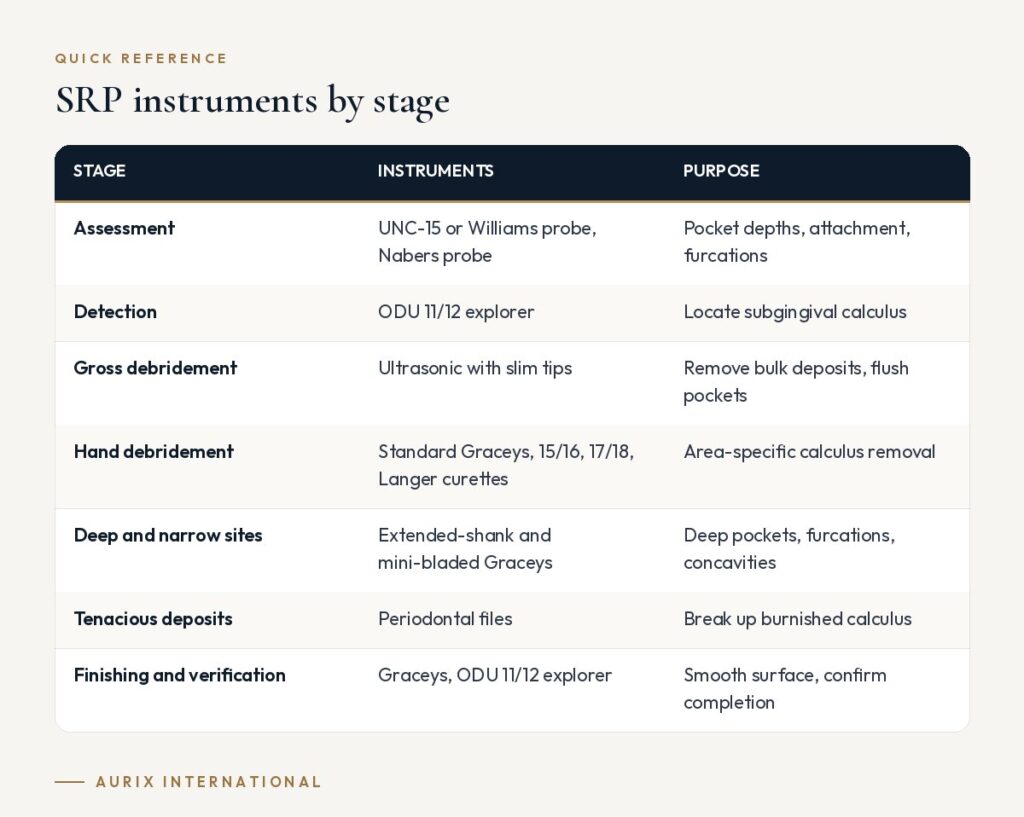
SRP instruments by stage
| Stage | Instruments | Purpose |
|---|---|---|
| Assessment | UNC-15 or Williams probe, Nabers probe | Pocket depths, attachment, furcations |
| Detection | ODU 11/12 explorer | Locate subgingival calculus |
| Gross debridement | Ultrasonic with slim tips | Remove bulk deposits, flush pockets |
| Hand debridement | Standard Graceys, 15/16, 17/18, Langer curettes | Area-specific calculus removal |
| Deep and narrow sites | Extended-shank and mini-bladed Graceys | Deep pockets, furcations, concavities |
| Tenacious deposits | Periodontal files | Break up burnished calculus |
| Finishing and verification | Graceys, ODU 11/12 explorer | Smooth surface, confirm completion |
How to choose scaling and root planing instruments
- Build a dedicated SRP cassette. Keeping SRP instruments in their own cassette, separate from the routine hygiene tray, saves setup time. Our guide to building a periodontal kit offers a complete example.
- Match instruments to anatomy. Patients with deep pockets, furcations or narrow roots need extended-shank and mini-bladed options; others may need only the standard series.
- Prioritize sharpness. SRP depends on sharp blades. Keep a stone and test stick close to hand and sharpen regularly.
- Think about ergonomics. SRP appointments are long. Lightweight, larger-diameter handles reduce pinch force and fatigue.
- Combine hand and powered instruments. Most clinicians find a combined approach efficient. See our comparison of ultrasonic scalers and Gracey curettes.
Aurix International supplies Gracey curettes and other periodontal instruments individually or as custom SRP kits configured to a practice’s instrument list.
Frequently asked questions
What is the difference between scaling and root planing?
Scaling removes calculus and biofilm from tooth and root surfaces. Root planing refers to the instrumentation that leaves the root surface smooth and free of deposits. In practice, the two are performed together.
Are hand instruments or ultrasonics better for SRP?
Both are used, and many clinicians combine them. Ultrasonics are efficient for bulk removal and deep areas, while hand instruments give tactile feedback for detection and finishing.
Which curettes are best for furcations?
Mini-bladed Graceys and slim ultrasonic tips are commonly used in furcations because they fit the narrow entrance. A Nabers probe helps assess how far the furcation extends.
How should SRP instruments be reprocessed?
Clean instruments promptly, inspect them for damage and dull edges, then package and sterilize them following CDC guidance for dental settings and the manufacturer’s instructions for use (IFU).
Put together an SRP kit your team can rely on. Aurix can build a custom periodontal kit with the Graceys, probes and explorers your protocol calls for. Start your custom SRP kit →