
Ultrasonic and piezoelectric scalers have transformed periodontal debridement, removing heavy calculus quickly and with less hand effort. Some ask whether they will shrink the Gracey curette market. Market forecasts of close to 10% annual growth suggest not — and clinical practice explains why.
Key takeaways
- Ultrasonics excel at heavy calculus and biofilm disruption.
- Gracey curettes excel at tactile root planing and fine deposits.
- Most clinicians combine both in the same appointment.
- Market forecasts still show strong Gracey growth.

Strengths of ultrasonic scalers
- Fast removal of heavy, tenacious calculus.
- Less hand force and repetitive motion.
- Lavage and cavitation that disrupt biofilm.
- Slim tips for some deep and furcation sites.
Strengths of Gracey curettes
- Tactile feedback to detect residual deposits and root irregularities.
- Precise adaptation to root surfaces in area-specific designs.
- No aerosol generation from the instrument itself.
- Usable where ultrasonics are contraindicated or impractical.
- No power, water or tip-wear dependencies.
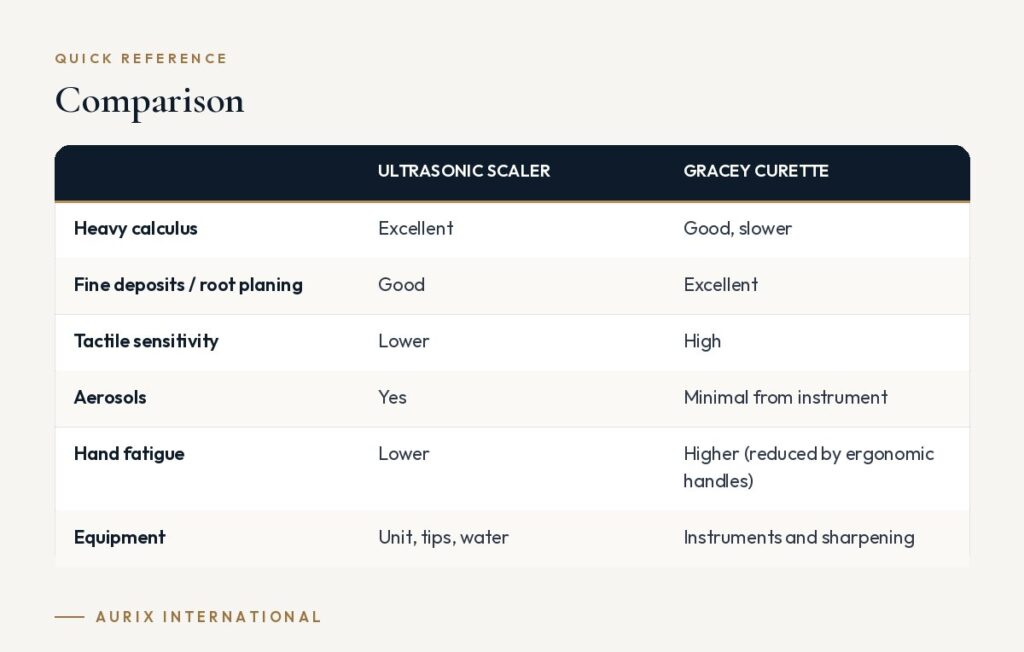
Comparison
| Ultrasonic scaler | Gracey curette | |
|---|---|---|
| Heavy calculus | Excellent | Good, slower |
| Fine deposits / root planing | Good | Excellent |
| Tactile sensitivity | Lower | High |
| Aerosols | Yes | Minimal from instrument |
| Hand fatigue | Lower | Higher (reduced by ergonomic handles) |
| Equipment | Unit, tips, water | Instruments and sharpening |
How clinicians combine them
- Assess and chart with probe and explorer.
- Use ultrasonic instrumentation to remove gross calculus and disrupt biofilm.
- Follow with Gracey curettes for detailed root debridement.
- Check with an explorer for remaining deposits.
Why the Gracey market keeps growing
Hand instruments remain part of standard periodontal care, every hygiene set still includes Graceys, and the market is projected to grow around 9.8% a year (Mordor Intelligence). Ultrasonic use may change which patterns and how many curettes are used — but not whether they are needed.
Infection control considerations
Ultrasonic instrumentation generates aerosols, which practices manage with high-volume evacuation and other controls. Hand instrumentation produces minimal aerosol from the instrument itself, which some clinicians prefer for certain patients or situations. Both ultrasonic inserts and Gracey curettes must be cleaned and sterilised between patients following manufacturer instructions.
Investing in both
For most practices the question is not which to buy but how to balance spending. Ultrasonic units are a larger one-off investment with ongoing insert replacement; Gracey curettes are lower-cost items replaced regularly. Planning both together ensures every hygiene appointment has the tools it needs. Make sure your hand instruments are up to date — see our Gracey curettes.
A typical combined workflow
- Assess pockets and calculus with a probe and explorer.
- Remove heavy deposits with an ultrasonic scaler and suitable inserts.
- Use Gracey curettes to finish root surfaces area by area: anterior, posterior facial and lingual, mesial and distal.
- Check surfaces with an explorer and re-instrument where needed.
- Irrigate and record findings for re-evaluation.
This sequence combines the speed of power instrumentation with the tactile feedback of hand instruments. It is also why demand for Gracey curettes has held up even as ultrasonic use has grown: the two are used together, not instead of each other.
Frequently asked questions
Can I use only an ultrasonic scaler?
Most clinicians find hand instruments necessary for thorough root debridement and tactile assessment.
Do I need fewer curettes if I use ultrasonics?
Possibly fewer sharpening cycles, but you still need complete sets.
Complete your instrumentation. Gracey curettes from Aurix International. Shop now →