Dental explorers are fine, flexible instruments used to feel what the eye cannot see: subgingival calculus, root irregularities, restoration margins, sealant integrity and the canal orifices in endodontics. Each design bends and angles the working end differently to reach particular surfaces. This list explains ten explorers you will find in dental catalogs and operatories, and which tasks each one handles best.
Key takeaways
- Explorers rely on tactile sensitivity: thin, flexible tips and a light grasp give the best feedback.
- Supragingival explorers (Shepherd’s hook, straight) suit margins and sealants; subgingival designs (ODU 11/12, Orban) reach pockets.
- Paired explorers such as pigtails and cowhorns work proximal surfaces from both sides.
- Endodontic explorers such as the DG16 are made to locate canal orifices.
The top 10 dental explorers
1. Shepherd’s hook (No. 23)
The most familiar explorer, with a working end bent into a hook. It is used supragingivally to examine restoration margins, sealants and pits and fissures, and to detect supragingival calculus.
Tip: the hook shape makes it less suitable for proximal and subgingival surfaces. Pair it with a subgingival explorer for complete assessment.
2. Pigtail explorer
Pigtail explorers come in paired, curved ends that wrap around proximal surfaces. They are used to examine interproximal margins and detect proximal calculus in shallow sulci.
Tip: the short curved tip can distend tissue in deeper pockets; use it mainly in healthy, shallow sites.
3. Cowhorn explorer
Similar in concept to the pigtail but with a larger, more open curve. The paired ends reach mesial and distal surfaces and are useful for checking proximal margins and contours.
4. ODU 11/12 explorer
Developed at Old Dominion University, the ODU 11/12 has a long, curved shank similar in design to a Gracey 11/12 curette. It reaches the base of posterior pockets and adapts around line angles, making it the go-to explorer for detecting subgingival calculus.
Tip: use vertical, overlapping strokes along the root surface with the side of the tip in contact. This is the explorer most hygienists use to confirm that root surfaces are smooth after debridement.
5. Orban-type explorer (No. 17 and No. 20)
Orban-type explorers have a short tip bent at a right angle to the terminal shank. The design reaches into deep pockets and furcations on anterior and posterior teeth with minimal tissue distension.
Tip: keep the back of the tip against the soft tissue and the side against the root to avoid trauma.
6. Tufts TU-17 explorer
The TU-17 has a long, bent shank with a short tip and is used for subgingival calculus detection, particularly in anterior teeth and on posterior facial and lingual surfaces.
7. Straight explorer
A straight explorer has a slender tip in line with the shank. It is used for supragingival examination of occlusal surfaces, margins and sealants and is easy to control on accessible surfaces.
8. Explorer/probe combination
Many practices use a double-ended instrument with an explorer, often a Shepherd’s hook, on one end and a periodontal probe on the other. It is efficient for routine examinations because it combines two assessment tools in one cassette slot.
Tip: make sure the probe end uses the same marking system as the rest of your probes for consistent charting. See our periodontal probe guide.
9. Right-angle explorer
Right-angle explorers have a tip bent at about 90 degrees close to the end of the shank. They help examine proximal surfaces and margins on posterior teeth where a straight or hooked tip cannot reach comfortably.
10. DG16 endodontic explorer
The DG16 is a double-ended endodontic explorer with long, stiff, sharp tips. It is used to locate canal orifices on the pulpal floor and to check access cavities, rather than for periodontal assessment.
Tip: keep the DG16 in your endodontic cassette, not the hygiene tray. Our list of endodontic hand instruments covers its companions.
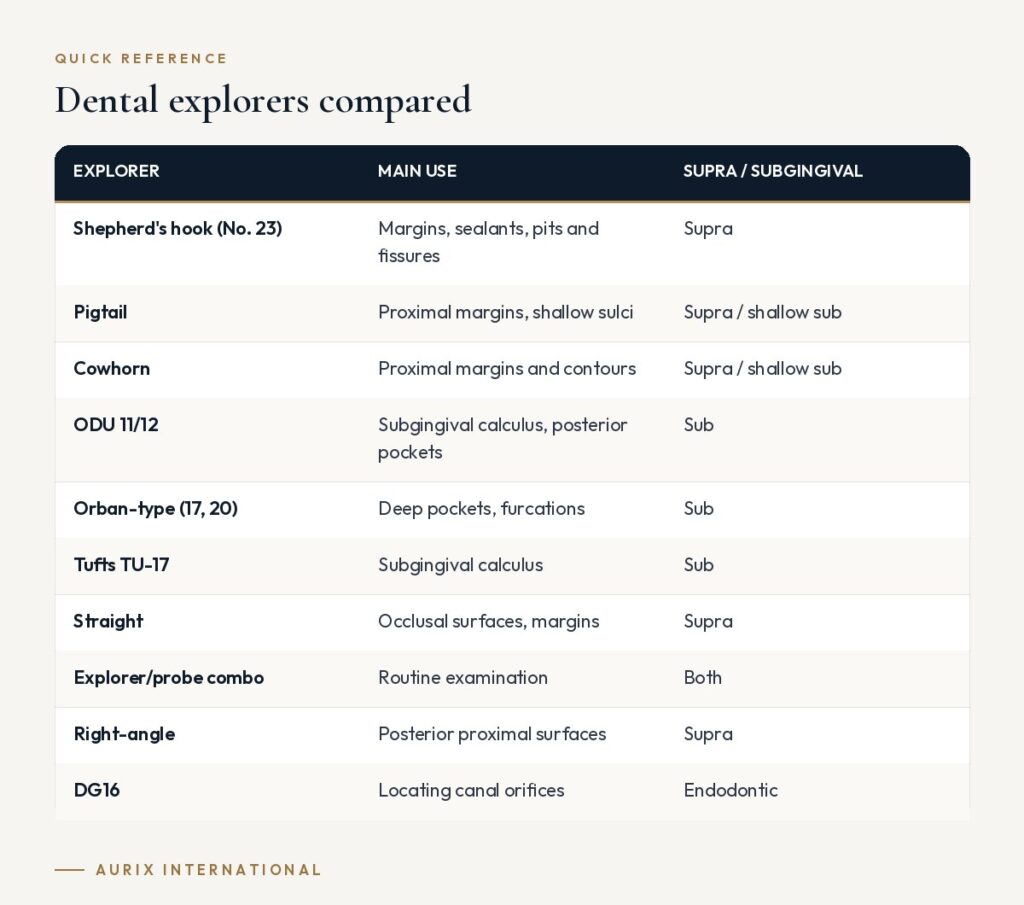
Dental explorers compared
| Explorer | Main use | Supra / subgingival |
|---|---|---|
| Shepherd’s hook (No. 23) | Margins, sealants, pits and fissures | Supra |
| Pigtail | Proximal margins, shallow sulci | Supra / shallow sub |
| Cowhorn | Proximal margins and contours | Supra / shallow sub |
| ODU 11/12 | Subgingival calculus, posterior pockets | Sub |
| Orban-type (17, 20) | Deep pockets, furcations | Sub |
| Tufts TU-17 | Subgingival calculus | Sub |
| Straight | Occlusal surfaces, margins | Supra |
| Explorer/probe combo | Routine examination | Both |
| Right-angle | Posterior proximal surfaces | Supra |
| DG16 | Locating canal orifices | Endodontic |
How to choose and use dental explorers
- Cover both zones. Most clinicians need at least one supragingival explorer (Shepherd’s hook or straight) and one subgingival explorer (ODU 11/12 or Orban-type).
- Value flexibility. A thin, flexible tip transmits vibrations better. Stiff tips are appropriate for endodontic work but reduce sensitivity for calculus detection.
- Use a light grasp. Hold the explorer loosely in a modified pen grasp and let the tip glide. Squeezing the handle dampens tactile feedback.
- Replace bent or blunt tips. Explorers are fine instruments and bend easily if dropped. A damaged tip gives misleading feedback. Check them during routine inspection, as covered in our signs instruments need replacing.
- Keep instruments organized. Explorers look similar at a glance; consistent cassette positions help assistants identify them. Our guide to Shepherd’s hook, pigtail and double-ended explorers adds more detail.
For practices that want matching diagnostic sets in every operatory, Aurix International can supply explorers as individual instruments or as part of a pre-assembled examination kit.
Frequently asked questions
Which explorer is best for detecting subgingival calculus?
The ODU 11/12 is the most widely used choice because its curved shank reaches posterior pockets and line angles. Orban-type explorers are also useful in deep pockets and furcations.
Can explorers be sharpened?
Explorers are not sharpened like scalers and curettes. Attempting to sharpen them alters the tip. Replace an explorer when the tip becomes blunt, bent or broken.
Is a Shepherd’s hook still recommended for caries detection?
Many clinicians now avoid pressing a sharp explorer forcefully into suspected carious pits, preferring visual examination, radiographs and gentle tactile assessment. Use light pressure and follow current clinical guidance.
Complete diagnostic sets for every chair. Aurix supplies explorers, probes and mouth mirrors in surgical-grade stainless steel, with oral instrument ranges for practices and distributors. Explore oral instruments →