
Needle holders grip the curved suture needle and drive it through tissue, so their jaw design, length and locking mechanism directly affect suture precision. A needle holder that suits 3-0 sutures in oral surgery may crush or bend the needle of a 6-0 suture used in periodontal microsurgery. These are the 10 needle holders most commonly used for dental suturing and how to choose between them.
Key takeaways
- The Mayo-Hegar is the most common needle holder in oral surgery and general dentistry.
- Castroviejo needle holders are preferred for fine sutures and periodontal microsurgery.
- Match jaw size and serration to the suture: fine jaws for fine needles, heavier jaws for larger needles.
- Combination instruments such as the Olsen-Hegar and Gillies hold and cut in one tool.
- Tungsten carbide jaw inserts grip needles securely and resist wear.
The top 10 needle holders
1. Mayo-Hegar
The Mayo-Hegar is a ring-handled needle holder with a ratchet lock and relatively broad jaws. It is the standard choice for suturing after extractions, implant placement and most oral surgery with medium-sized sutures such as 3-0 and 4-0.
Tip: Grasp the needle about one-third of the way from the swaged end, perpendicular to the jaws, to avoid bending it.
2. Castroviejo
The Castroviejo is a spring-handled needle holder held in a pencil grip, available with or without a lock and with straight or curved jaws. Its fine jaws are ideal for 5-0 to 7-0 sutures in periodontal plastic surgery and grafting.
Tip: Rotate the instrument between the fingers to drive the needle along its curve rather than moving the whole wrist.
3. Crile-Wood
The Crile-Wood has narrower, more delicate jaws than the Mayo-Hegar, making it a good choice for finer sutures and tighter areas while keeping the familiar ring handle and ratchet.
4. Halsey
The Halsey is a small, light needle holder with fine jaws, used with smaller needles in oral surgery and periodontics. Its compact size makes it easy to maneuver in the mouth.
5. Webster
The Webster is a fine needle holder with slender jaws, similar in size to the Halsey. It is used for delicate suturing where a lighter instrument gives better control.
6. Olsen-Hegar
The Olsen-Hegar combines a needle holder and scissors: behind the gripping jaws sits a pair of cutting blades. It lets the operator suture and cut without changing instruments, which is handy when working without an assistant.
Tip: Take care not to cut the suture accidentally while tying; keep the suture in the front of the jaws.
7. Mathieu
The Mathieu has open, curved handles with a ratchet that engages as the handles are squeezed in the palm, and releases with further pressure. Some clinicians find this palm grip quicker for repetitive suturing.
8. Derf
The Derf is a short, fine needle holder with delicate jaws. Its small size suits fine suturing in limited spaces.
9. Ryder
The Ryder has very fine, narrow jaw tips for small needles and delicate sutures, often used where a Castroviejo-level fineness is needed with a ring-handled instrument.
10. Gillies
The Gillies is a combination needle holder and scissors with offset handles and no ratchet. The operator controls the grip by hand pressure, which some surgeons prefer for speed and feel.
Needle holder comparison
| Needle holder | Handle / lock | Typical sutures |
|---|---|---|
| Mayo-Hegar | Rings, ratchet | 3-0, 4-0 |
| Castroviejo | Spring, optional lock | 5-0 to 7-0 |
| Crile-Wood | Rings, ratchet | 4-0, 5-0 |
| Halsey | Rings, ratchet | 4-0, 5-0 |
| Webster | Rings, ratchet | 4-0, 5-0 |
| Olsen-Hegar | Rings, ratchet, scissors | 3-0, 4-0 |
| Mathieu | Palm, ratchet | 3-0, 4-0 |
| Derf | Rings, ratchet | Fine sutures |
| Ryder | Rings, ratchet | Fine sutures |
| Gillies | Offset rings, no ratchet, scissors | 3-0, 4-0 |
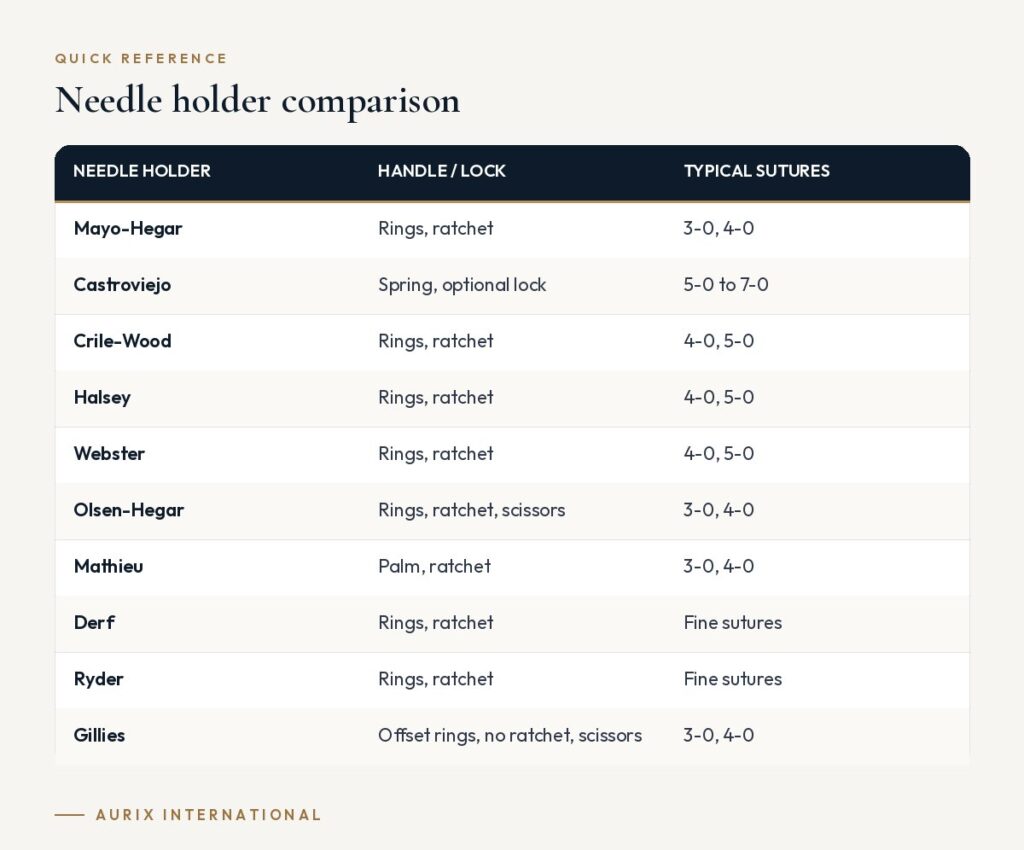
These suture sizes are typical ranges, not strict rules; always follow your clinical judgment and the suture manufacturer’s recommendations. Our article on Mayo-Hegar, Castroviejo and Crile-Wood needle holders compares the three most popular patterns.
How to choose needle holders
- Match jaws to needles. Heavy jaws flatten small needles, while fine jaws cannot hold large needles securely.
- Choose the right length. Longer instruments help in posterior areas; shorter ones give more control anteriorly.
- Consider carbide inserts. Tungsten carbide jaws, often identified by gold-colored handles, grip needles firmly and can be replaced or refurbished as they wear.
- Check the ratchet. It should engage and release smoothly and hold the needle without slipping.
- Think about your suturing set. Pair needle holders with matching tissue forceps and scissors; see our list of the top 10 tissue forceps for oral surgery.
- Clean the jaws thoroughly. Serrations trap debris; clean with the ratchet open and follow the IFU before sterilization.
Needle holder technique tips
Most needle and tissue problems come from how the needle is held. Clamp it near the tip of the jaws, about one-third of the way from the swaged end, with the needle perpendicular to the jaws. Enter the tissue at a right angle and rotate the wrist so the needle follows its own curve, rather than pushing it straight through. Close the ratchet only to the first click when using fine needles, as full closure can flatten or bend them.
With a Castroviejo, use a pencil grip and roll the instrument between thumb and fingers. When tying instrument knots, keep the suture away from any cutting blades on combination instruments. Inspect the jaws regularly: worn serrations let the needle rotate, which makes precise placement harder.
Frequently asked questions
What is the most common needle holder in dentistry?
The Mayo-Hegar is the most widely used needle holder for oral surgery and general dental suturing.
When should I use a Castroviejo needle holder?
Use a Castroviejo for fine sutures, typically 5-0 and smaller, in periodontal plastic surgery, grafting and other delicate procedures.
Is there a difference between a needle holder and a needle driver?
In practice the terms are used interchangeably for the same instrument. Read more in our article on needle drivers vs needle holders.
Why do some needle holders have gold handles?
Gold-colored handles commonly indicate tungsten carbide jaw inserts, which are harder than stainless steel and grip the needle more securely.
Build a suturing set that matches your sutures. Aurix International supplies surgical-grade stainless steel needle holders individually, in suturing kits and at wholesale volumes. Create your suturing kit →