
Bone rongeurs and bone files are the instruments used to trim, contour and smooth alveolar bone after extractions, during alveoloplasty and in implant and periodontal surgery. Rongeurs remove bone with sharp, cup-shaped jaws, while bone files refine what is left. This list covers eight rongeur patterns and two bone files that dental surgeons use most often, with notes on when to use each.
Key takeaways
- Rongeurs are classified by how they cut (end-cutting, side-cutting or both) and by beak angle and size.
- The Blumenthal and Friedman are the most common rongeurs in general oral surgery.
- Small and short-nose rongeurs suit limited access sites, such as the sinus window.
- Bone files cut on the pull stroke and help with final smoothing.
- Small, controlled bites protect the hinge and keep the cutting edges sharp.
The top 10 bone rongeurs and bone files
1. Blumenthal rongeur
The Blumenthal is a side- and end-cutting rongeur with beaks angled to the handles, commonly offered in 30-degree and 45-degree versions. It trims sharp alveolar edges after extractions and to recontour bone and gross tissue.
Tip: Its angled beaks give good access to posterior sockets, so it is often the first rongeur on a surgical tray.
2. Friedman rongeur
The Friedman is a delicate rongeur with smaller, curved beaks suited to precise trimming. It is a popular choice for alveoloplasty around individual sockets and for fine contouring.
3. Mini Friedman rongeur
The Mini Friedman has even smaller beaks for limited access areas, such as interproximal bone and narrow ridges. It is useful in periodontal and implant surgery where a full-size rongeur would be too bulky.
4. Luer rongeur
The Luer is a classic surgical rongeur pattern with cup-shaped jaws, used in dentistry and general surgery for removing and shaping bone. Dental versions are typically compact for intraoral use.
5. Mead rongeur
The Mead is a sturdy rongeur pattern used in oral surgery for trimming alveolar bone. It is often chosen when a stronger instrument is needed for larger amounts of bone.
6. Beyer rongeur
The Beyer is another established surgical rongeur pattern used for bone trimming. Surgeons often keep a Beyer alongside a Blumenthal to have a different beak size and shape available.
7. Cleveland rongeur
Cleveland rongeurs are heavier-duty patterns, some with a double-spring mechanism and curved tips, intended for bigger bone corrections in oral surgery.
Tip: Even heavy rongeurs should take multiple small bites rather than one large bite; twisting the jaws to break off bone can damage the hinge.
8. Short-nose sinus rongeur
Short-nose rongeurs with very small, end-cutting beaks (around 3 mm) carefully widen a lateral sinus window or trim bone in tight sites. Their small size gives control in delicate areas.
9. Miller bone file (straight-cut)
The Miller bone file is a double-ended file with serrated working ends of different widths. Straight-cut versions, such as the Miller 52, help with final smoothing and shaping of bone after rongeur use or extractions.
Tip: Bone files cut on the pull stroke. Draw the file in one direction and avoid pushing, which burnishes rather than cuts bone.
10. Miller-Colburn bone file (cross-cut)
The Miller-Colburn is a double-ended bone file with cross-serrated working ends. The cross-cut pattern removes bone slightly more aggressively than a straight-cut file, so it is useful for smoothing more prominent irregularities.
Rongeurs and bone files compared
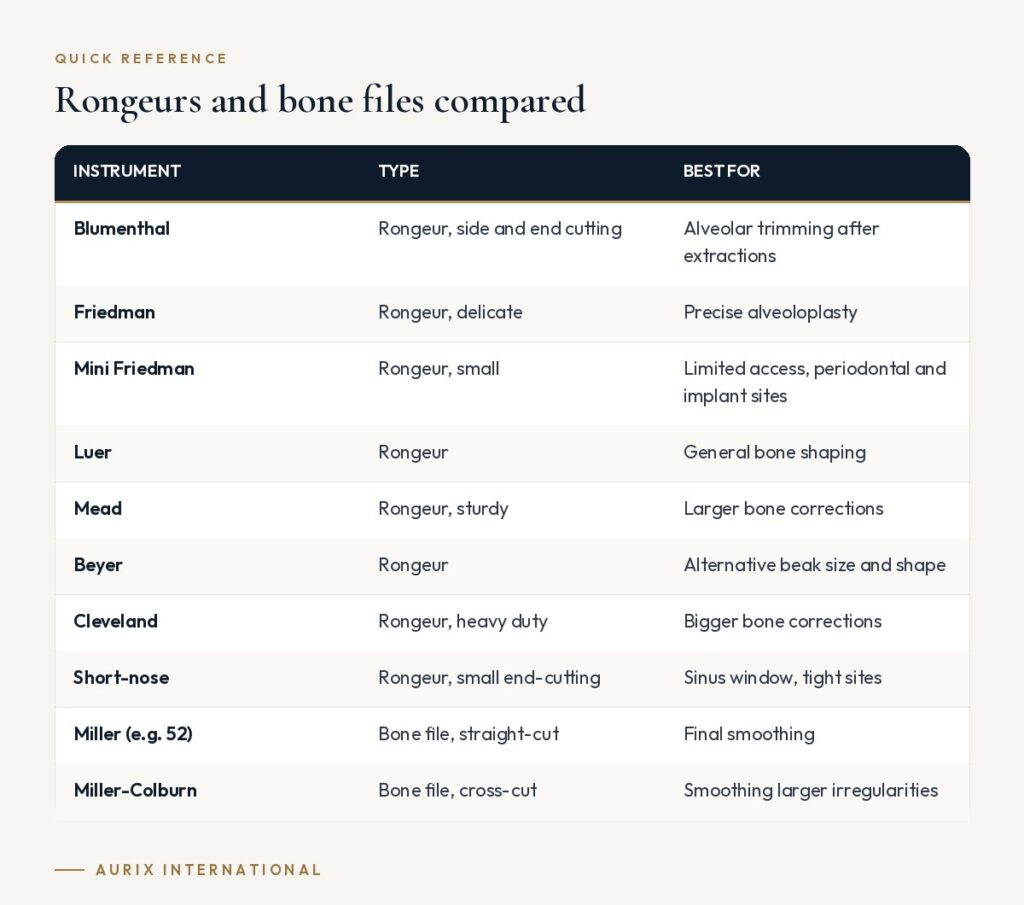
| Instrument | Type | Best for |
|---|---|---|
| Blumenthal | Rongeur, side and end cutting | Alveolar trimming after extractions |
| Friedman | Rongeur, delicate | Precise alveoloplasty |
| Mini Friedman | Rongeur, small | Limited access, periodontal and implant sites |
| Luer | Rongeur | General bone shaping |
| Mead | Rongeur, sturdy | Larger bone corrections |
| Beyer | Rongeur | Alternative beak size and shape |
| Cleveland | Rongeur, heavy duty | Bigger bone corrections |
| Short-nose | Rongeur, small end-cutting | Sinus window, tight sites |
| Miller (e.g. 52) | Bone file, straight-cut | Final smoothing |
| Miller-Colburn | Bone file, cross-cut | Used when smoothing larger irregularities |
For clinical context, read our article on rongeurs and bone files for alveoloplasty.
How to choose bone rongeurs and bone files
- Start with two rongeurs. A Blumenthal for general trimming and a Friedman or Mini Friedman for fine work cover most dental cases.
- Check the cutting edges. The jaws should meet evenly along their length. Gaps or rolled edges mean the instrument will crush rather than cut.
- Test the spring and hinge. Spring action should be smooth and the joint should have no wobble.
- Match file cut to purpose. Straight-cut files are better for finishing, cross-cut files for faster smoothing.
- Look at the steel. Cutting instruments rely on properly hardened stainless steel. Our guide to surgical-grade stainless steel grades explains the differences.
- Clean the jaws carefully. Bone chips lodge in rongeur cups and file serrations; clean with a brush and ultrasonic cleaner as directed in the IFU before sterilization.
Care and maintenance
Rongeurs and bone files are among the hardest instruments to clean because bone particles and blood pack into the cups, joints and serrations. Rinse or wipe them at chairside to stop debris drying, then clean them with the joint open using a brush and, where the IFU allows, an ultrasonic cleaner. Inspect the jaws under good light for chips, rolled edges and debris before packaging. A rongeur that needs extra force to cut is a sign that it needs resharpening, and continuing to use it can fracture the jaws. Our guide to the signs your dental instruments need replacing covers what to look for.
Frequently asked questions
What is the difference between a rongeur and a bone file?
A rongeur cuts and removes bone with its jaws and helps with larger corrections. A bone file smooths the remaining surface and removes small sharp edges.
Can rongeurs be sharpened?
Rongeurs can be professionally resharpened, but they need specialist equipment. If the jaws no longer meet evenly or cut cleanly, resharpening or replacement is needed.
Why do bone files only cut in one direction?
The serrations are angled so that they cut on the pull stroke. Pushing the file tends to burnish bone and can clog the teeth with debris.
Which rongeur is best for alveoloplasty?
Many surgeons use a Blumenthal for initial trimming and a Friedman or Mini Friedman for finer contouring, followed by a bone file for final smoothing.
Stock reliable bone management instruments. Aurix International supplies surgical-grade stainless steel rongeurs and bone files individually or as part of surgical extraction and bone management kits. Browse oral surgery instruments →