Oral surgery retractors hold the cheeks, lips, tongue and reflected flaps out of the way so the surgeon can see and work safely. Good retraction protects soft tissue from burs and blades, improves light and suction access and shortens procedures. These are the 10 retractors most commonly found in oral surgery and general dental surgical setups.
Key takeaways
- The Minnesota and Seldin are the go-to retractors for cheek and flap retraction in third molar surgery.
- The Weider protects the tongue during lingual and posterior mandibular work.
- Small right-angle retractors such as the Austin, Senn and Langenbeck suit tight areas and small flaps.
- Retraction should be firm but gentle; constant heavy pressure bruises tissue.
- Choose a matte or satin finish to reduce glare under the operating light.
The top 10 oral surgery retractors
1. Minnesota retractor
The Minnesota is an offset, curved retractor that holds back the cheek and a mucoperiosteal flap at the same time. It is perhaps the most widely used retractor in oral surgery, especially for mandibular third molars.
Tip: Rest the retractor on bone rather than on the flap edge to avoid crushing the tissue.
2. Seldin retractor
The Seldin has a smooth, broad, curved blade used mainly to retract and protect a reflected flap during bone removal. Its blade can also be used for limited flap elevation.
3. Weider tongue retractor
The Weider has a large, heart-shaped blade with a serrated surface that grips the tongue and holds it medially. It is used during lingual flap work and posterior mandibular procedures.
Tip: Watch the patient’s comfort and the gag reflex; the blade should sit on the lateral tongue, not press into the floor of the mouth.
4. Austin retractor
The Austin is a small right-angle retractor with a flat blade. It is handy for retracting the cheek, tongue or a small flap in areas where larger retractors would be bulky.
5. Obwegeser retractors
Obwegeser retractors are a family of curved retractors, including channel and ramus designs, used for access to the mandibular ramus and posterior areas. They are common in more extensive oral and maxillofacial procedures.
6. Langenbeck retractor
The Langenbeck is a single-ended retractor with a right-angled blade, borrowed from general surgery. It offers precise retraction of small flaps and lips in periodontal and minor oral surgery.
7. Senn retractor
The Senn is double-ended, with a small rake on one end and a right-angled blade on the other. It gives the surgeon two retraction options on one instrument, which is useful for small surgical sites.
Tip: Sharp-rake versions can damage thin oral mucosa; blunt rakes are generally safer intraorally.
8. Henahan retractor
The Henahan is a flat, broad retractor used for cheek and flap retraction. Some surgeons prefer it to the Minnesota when they want a wider blade for posterior access.
9. Columbia retractor
The Columbia is a cheek retractor with a curved blade, often used interchangeably with the Minnesota for posterior extractions and implant sites. Having both lets the surgeon pick the shape that fits the patient’s anatomy.
10. Lip and cheek retractors (expanders)
Lip and cheek expanders hold both lips back at once, giving wide anterior access for implant placement, photography and anterior surgery. Many are made from autoclavable plastic; check the manufacturer’s IFU for reprocessing limits.
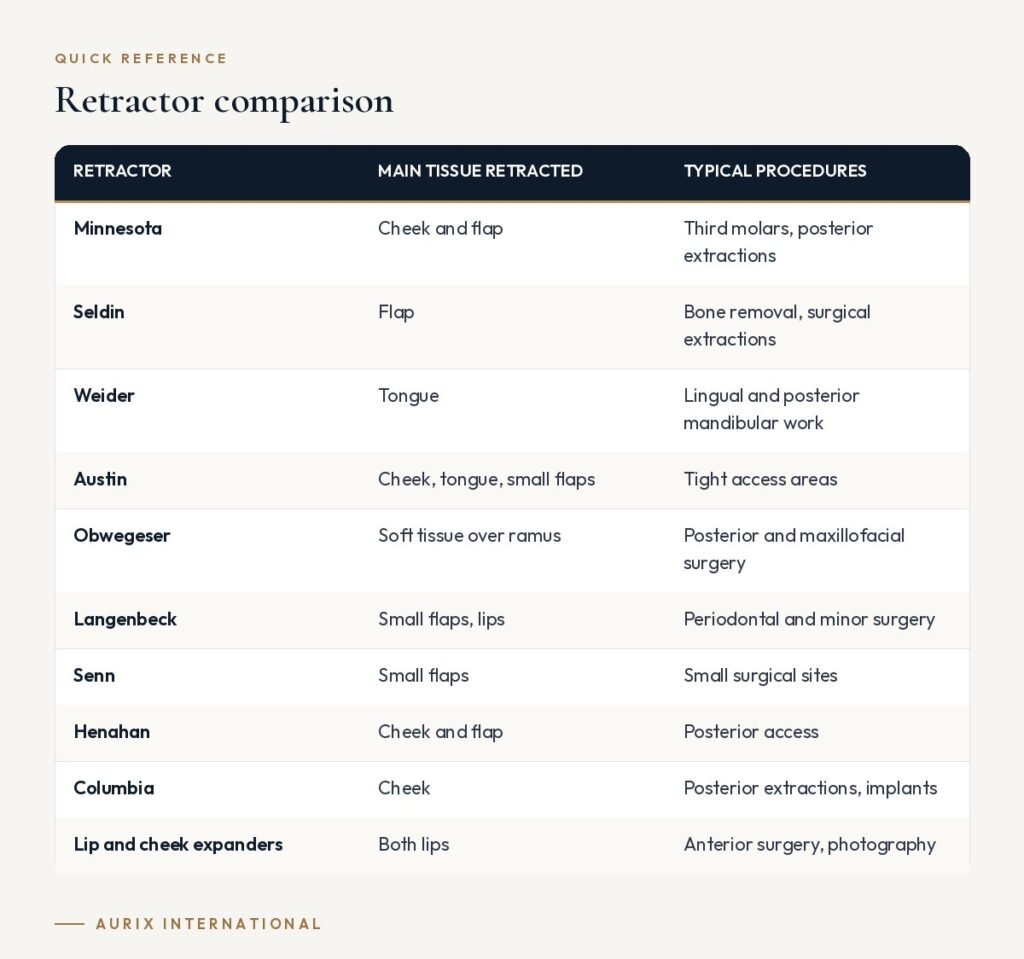
Retractor comparison
| Retractor | Main tissue retracted | Typical procedures |
|---|---|---|
| Minnesota | Cheek and flap | Third molars, posterior extractions |
| Seldin | Flap | Bone removal, surgical extractions |
| Weider | Tongue | Lingual and posterior mandibular work |
| Austin | Cheek, tongue, small flaps | Tight access areas |
| Obwegeser | Soft tissue over ramus | Posterior and maxillofacial surgery |
| Langenbeck | Small flaps, lips | Periodontal and minor surgery |
| Senn | Small flaps | Small surgical sites |
| Henahan | Cheek and flap | Posterior access |
| Columbia | Cheek | Posterior extractions, implants |
| Lip and cheek expanders | Both lips | Anterior surgery, photography |
For more detail on the most common patterns, see surgical retractors in oral surgery.
How to choose oral surgery retractors
- Start with three. A Minnesota, a Seldin and a Weider cover most extraction and implant procedures. Add smaller right-angle retractors for periodontal surgery.
- Look at the finish. Satin or matte surfaces reduce reflection under surgical lights. Our comparison of satin vs mirror finish instruments explains the trade-offs.
- Check the edges. Blade edges should be smooth and rounded so they do not cut or tear tissue.
- Consider the assistant. Retractors are often held by an assistant for long periods, so handle shape and weight matter for comfort.
- Plan reprocessing. Serrated surfaces like those on the Weider need careful cleaning; follow the IFU and inspect for retained debris before sterilization.
Using retractors safely
Retraction is a team skill. The person holding the retractor should keep it steady, stay out of the surgeon’s line of sight and keep the blade on bone or on the deep surface of the flap rather than on its thin edge. Lips and the corners of the mouth are easily stretched and cracked during long procedures, so a thin layer of lubricant on the lips and periodic short breaks from retraction help patient comfort. Watch the mental nerve region when retracting in the premolar area of the mandible, and avoid pressing a lingual retractor too hard against the floor of the mouth.
Retractors also protect soft tissue from rotating burs and saws, so they should be placed before the handpiece starts and kept in position until it stops. To see where retractors sit within a complete surgical setup, read our list of the top 15 oral surgery instruments.
Frequently asked questions
What is the difference between a Minnesota and a Seldin retractor?
The Minnesota is designed to retract both the cheek and the flap and has an offset, curved shape. The Seldin has a smoother, broader blade used mainly for flap retraction and protection during bone removal.
Which retractor is used for the tongue?
The Weider retractor is the standard tongue retractor in oral surgery. A mouth mirror can also be used for light tongue retraction in simpler procedures.
Who holds the retractor during oral surgery?
Usually the dental assistant holds the retractor so the surgeon has both hands free. Clear communication about positioning and pressure helps protect the patient’s tissues.
Can plastic retractors be sterilized?
Some plastic lip and cheek expanders are autoclavable, but heat tolerance and the number of cycles vary. Always follow the manufacturer’s IFU.
Equip your surgical trays with the right retractors. Aurix International supplies surgical-grade stainless steel retractors and can include them in pre-assembled or custom surgical kits. Talk to our team →