Mobile dental clinics and outreach programs have to deliver care with limited space, limited reprocessing capacity and often unpredictable conditions. Also, that makes instrument choice critical: every item must earn its place, survive transport and be easy to clean and sterilize. This list covers the ten instrument groups that mobile teams rely on most, with tips on packing and planning.
Key takeaways
- Choose versatile instruments that cover many procedures, such as 150/151 forceps and universal curettes.
- Organize instruments in cassettes or compact procedure kits so nothing is lost in transit.
- Plan quantities around how many patients you will see and whether instruments can be reprocessed on site.
- Infection control standards are the same as in a fixed clinic: follow CDC guidance and each instrument’s IFU.
The top 10 instruments for mobile dental clinics
1. Diagnostic setups
Mirror, explorer, periodontal probe and cotton pliers. Screening is often the main activity of outreach programs, so diagnostic sets are needed in large numbers. Bring extra mirror heads, which are easily scratched in transit.
Tip: a WHO-style ball-tipped probe is useful for community screening indices.
2. Compact cassettes and procedure kits
Cassettes keep each procedure set together through use, transport, cleaning and sterilization, and protect sharp tips from damage. In addition, smaller cassettes save space in vehicles and portable sterilizers.
Tip: label or color code cassettes by procedure so the team can pick the right set quickly in a cramped setting.
3. Hand scalers and curettes
Where power and water for ultrasonic scalers are limited, hand instruments do most of the debridement. A sickle scaler (H6/H7 or 204S), a universal curette (Columbia 13/14) and Gracey 11/12 and 13/14 cover most needs.
4. Extraction forceps
Extractions are a common need in underserved communities. A core set of 150 and 151 universals, a 23 cowhorn for lower molars and an upper molar pair such as 88R/88L covers most cases. Add pediatric 150S/151S forceps if you treat children.
5. Elevators
A straight elevator (301 and a larger pattern), a pair of Cryer elevators and possibly luxating elevators for roots. Generally, elevators reduce the force needed with forceps and help manage fractured roots. See our overview of root elevators for options.
6. Spoon excavators and hand instruments for ART
Atraumatic restorative treatment (ART) uses hand instruments to remove soft caries and place an adhesive material such as glass ionomer, without the need for electricity or a handpiece. Furthermore, spoon excavators in several sizes, an enamel hatchet and a plastic instrument are the core kit.
7. Plastic filling instrument, cement spatula and mixing pad
Needed for placing and shaping glass ionomer and other restorative materials. In practice, bring spare spatulas and plastic instruments, as they help with almost every restoration.
8. Aspirating syringes
Reusable aspirating syringes for local anesthesia, with enough units to allow for reprocessing between patients. Moreover, bring a sharps container and a recapping device or follow a one-handed scoop technique.
9. Basic surgical and suturing instruments
A periosteal elevator such as the Molt 9, a surgical curette for socket debridement, a needle holder, suture scissors, tissue forceps and a hemostat. These support more complex extractions and allow sockets to be sutured when needed.
10. Transport containers for used instruments
Used instruments must be carried safely from the treatment area to the reprocessing area. Also, use covered, puncture-resistant, leakproof containers labeled as biohazard, and keep contaminated and sterile instruments clearly separated in the vehicle.
For more on outreach procurement, see our guide to choosing a supplier for mobile and outreach clinics.
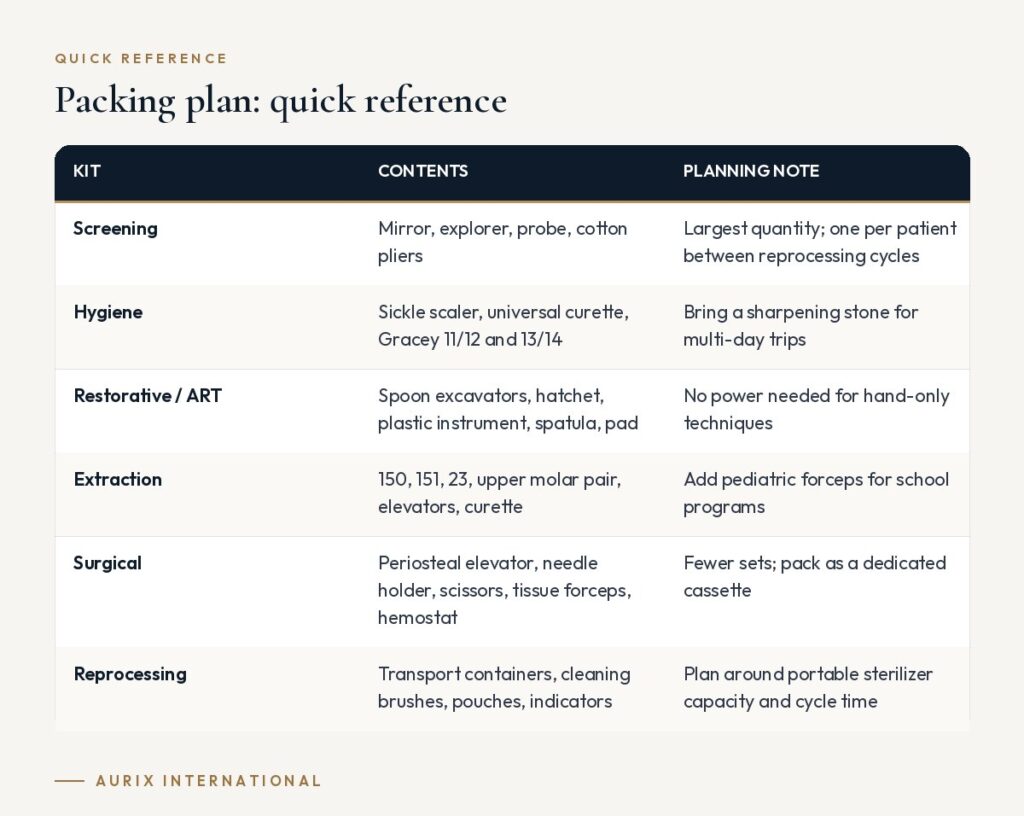
Packing plan: quick reference
| Kit | Contents | Planning note |
|---|---|---|
| Screening | Mirror, explorer, probe, cotton pliers | Largest quantity; one per patient between reprocessing cycles |
| Hygiene | Sickle scaler, universal curette, Gracey 11/12 and 13/14 | Bring a sharpening stone for multi-day trips |
| Restorative / ART | Spoon excavators, hatchet, plastic instrument, spatula, pad | No power needed for hand-only techniques |
| Extraction | 150, 151, 23, upper molar pair, elevators, curette | Add pediatric forceps for school programs |
| Surgical | Periosteal elevator, needle holder, scissors, tissue forceps, hemostat | Fewer sets; pack as a dedicated cassette |
| Reprocessing | Transport containers, cleaning brushes, pouches, indicators | Plan around portable sterilizer capacity and cycle time |
Tips for choosing instruments for a mobile clinic
- Choose versatile patterns. Universal instruments that cover many teeth reduce the number of items you need to carry.
- Prefer durable construction. Instruments are knocked about in transit; well-made stainless steel instruments with sound joints hold up better. Our guide to what surgical grade really means explains what to look for.
- Calculate quantities from reprocessing capacity. If you can reprocess on site, count how many patients you will see during one sterilization cycle. If not, bring a full set for every patient planned that day, plus spares.
- Keep a checklist for every kit. Count instruments out and back in at each site to avoid losses.
- Follow the same infection control standards. Clean, inspect, package and sterilize instruments following CDC guidance and the manufacturer’s IFU, and monitor your portable sterilizer as you would a fixed one.
Frequently asked questions
What instruments are essential for a dental outreach program?
Diagnostic setups, hand scalers and curettes, extraction forceps and elevators, ART hand instruments and anesthetic syringes cover most outreach care, along with cassettes and transport containers for safe handling.
How do mobile clinics sterilize instruments?
Many use portable or tabletop sterilizers on board or on site; others bring enough sterilized sets for the day and return used instruments to a base clinic for reprocessing. Either way, instruments must be cleaned, packaged and sterilized according to CDC guidance and the IFU.
What is atraumatic restorative treatment (ART)?
ART is an approach that uses hand instruments to remove soft carious tissue and restore the tooth with an adhesive material, usually glass ionomer. Because it needs no electricity or handpiece, it is well suited to outreach settings.
Are pre-assembled kits useful for mobile clinics?
Yes. In addition, pre-assembled or custom procedure kits keep instruments organized, make counting easier and help volunteers who may not be familiar with your setup find what they need.
Planning a mobile or outreach program? Aurix International can build compact, procedure-based instrument kits in surgical-grade stainless steel, and supports wholesale orders for larger programs. Ask about wholesale kits →