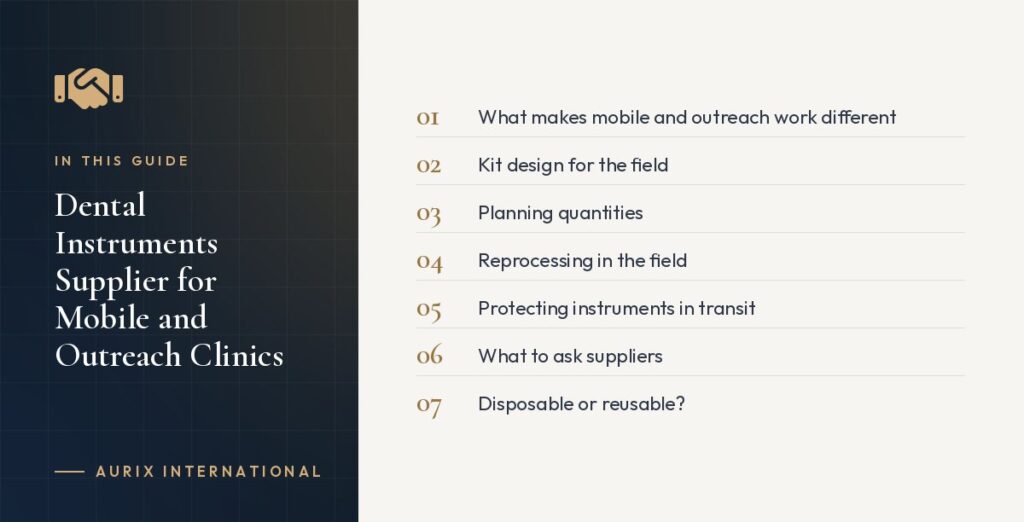
Mobile dental units, school-based programmes and humanitarian outreach clinics work in tight spaces, often with limited water, power and reprocessing capacity. Instruments travel, get knocked about and must be sterilised in portable equipment. The right dental instruments supplier helps by providing compact, durable, well-organised kits and dependable replacements between trips.
Key takeaways
- Compact combined kits in robust cassettes suit limited space.
- Plan quantities around on-site sterilisation capacity.
- Choose durable instruments and protect fine tips in transit.
- Agree fast replacement and firm delivery dates for programme starts.
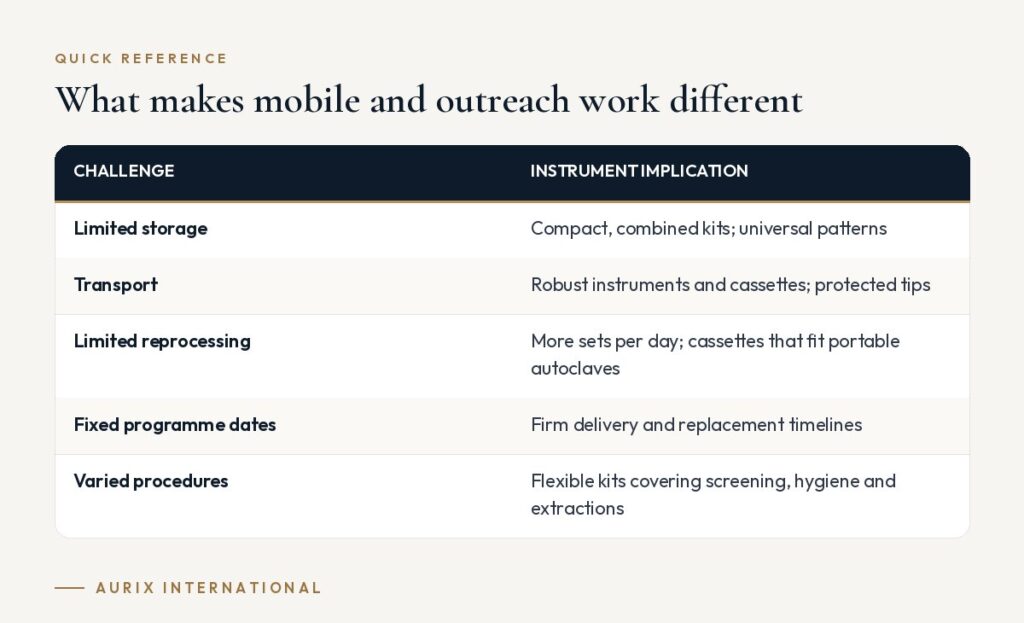
What makes mobile and outreach work different
| Challenge | Instrument implication |
|---|---|
| Limited storage | Compact, combined kits; universal patterns |
| Transport | Robust instruments and cassettes; protected tips |
| Limited reprocessing | More sets per day; cassettes that fit portable autoclaves |
| Fixed programme dates | Firm delivery and replacement timelines |
| Varied procedures | Flexible kits covering screening, hygiene and extractions |
Kit design for the field
- Combine diagnostic, hygiene and extraction instruments into fewer, clearly labelled cassettes.
- Use universal extraction forceps alongside a few tooth-specific patterns to reduce instrument count.
- Prefer robust handles that cope with transport.
- Add spares of instruments easily lost or bent — explorers, mirror heads, elevators.
- Include a photo checklist in every cassette.
Planning quantities
Sets needed = patients per day ÷ reprocessing cycles you can complete per day (rounded up, plus one spare set).
| Scenario | Planning approach |
|---|---|
| Up to ~15 patients, on-site autoclave | Enough sets for half a day plus spares |
| 15–30 patients | Enough sets for most of the day |
| 30+ patients or no on-site sterilisation | Enough sets for the full day; reprocess at base |
Reprocessing in the field
CDC guidance classes instruments that penetrate soft tissue or bone — such as forceps, scalers and elevators — as critical items to be sterilised after each use. In the field that usually means a portable steam steriliser, distilled water where required, and a workflow that separates dirty and clean areas even in a small space. Choose cassettes and pouches compatible with your equipment and follow the manufacturer’s reprocessing instructions. See autoclave cycles explained.
Protecting instruments in transit
- Use closed, latched cassettes with secure silicone rails.
- Store cassettes upright and padded in transport cases.
- Check kits after every trip for bent tips and missing instruments.
- Dry instruments completely before transport to prevent corrosion.
What to ask suppliers
- Can you design compact, combined custom kits?
- Which cassettes suit transport and portable autoclaves?
- Can you deliver by a fixed programme start date?
- How quickly can you replace lost or damaged instruments between trips?
- Can kits be marked with the programme name?
Disposable or reusable?
Single-use instruments help where reprocessing is impossible, but durable reusable instruments are usually more economical and produce less waste when sterilisation is available. Many programmes combine both. See disposable vs reusable instruments.
Example: a school screening and treatment van
A two-chair van seeing 25 children a day uses combined screening-and-hygiene cassettes and a smaller extraction cassette. With one portable autoclave completing about four cycles a day, the programme keeps eight screening-hygiene sets and three extraction sets, plus spare explorers and mirror heads.
Frequently asked questions
How do we keep kits complete in the field?
Photo checklists in each cassette and an end-of-day check before packing.
Which instruments fail most often in mobile settings?
Fine tips — explorers, luxators and root-tip elevators — and mirror heads. Carry spares.
Can a supplier pre-pack kits for each trip?
Ask; some suppliers can assemble kits to your trip schedule.
Next steps
Design a compact kit in the Aurix kit builder, contact us to plan your programme, or compare suppliers in our top 10 US guide.