Selling dental instruments online works best when your store answers the questions a clinician would ask at a trade show booth. Buyers want the exact pattern, accurate specifications, clear images and confidence that the product will perform. These ten tips cover the essentials for distributors, private label brands and suppliers building or improving an online channel.
Key takeaways
- Accurate names, pattern numbers and specifications matter more than clever marketing copy.
- Organize your catalog the way clinicians think: by procedure and instrument family.
- Keep product claims factual and consistent with your regulatory status and documentation.
- Kits, B2B accounts and easy reordering increase order value and retention.
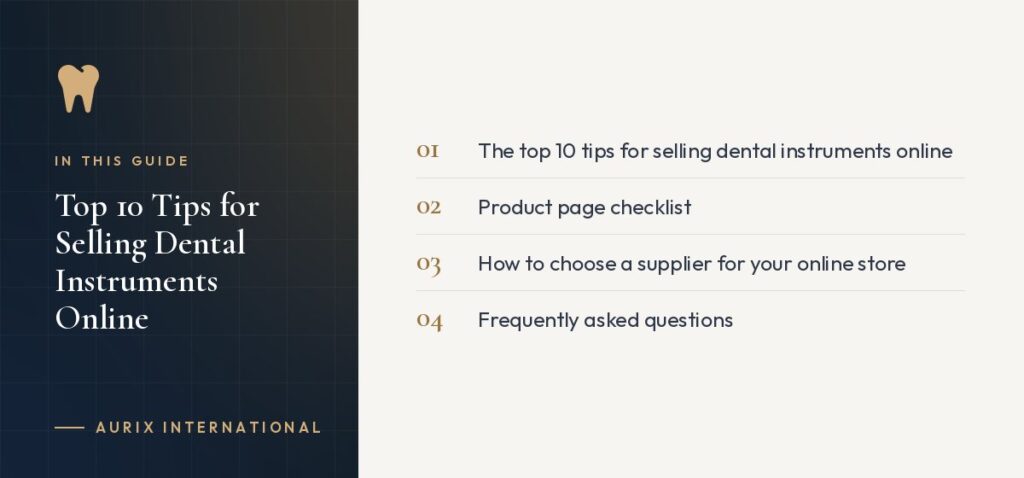
The top 10 tips for selling dental instruments online
1. Use precise instrument names and pattern numbers
Clinicians search for specific items: “Gracey 11/12,” “forceps 151,” “Cryer 30/31 elevators” or “UNC-15 probe.” Put the full name and pattern number in the product title, and include common alternative names in the description. Vague titles such as “dental scaler” make it hard for buyers to confirm they have found the right item.
2. Provide complete specifications
List the details a buyer needs to compare: instrument type, pattern, single- or double-ended, handle type and diameter if known, finish, steel type and overall length where relevant. For forceps, specify upper or lower and the intended teeth. For curettes and scalers, describe blade design and the areas the instrument is meant for. Our guide to reading an instrument catalog shows what buyers look for.
3. Invest in clear, consistent photography
Instrument working ends are small, and their shape is what buyers care about. Show the whole instrument plus close-ups of each working end, on a neutral background, at consistent angles. A scale reference helps. Make sure photos show the actual product sold, including any branding or handle color.
4. Organize the catalog by procedure and family
Many buyers shop by task: hygiene, restorative, extraction, surgery, endodontics, orthodontics. Create categories that match, with subcategories by instrument family (curettes, scalers, probes, explorers). Strong internal search that recognizes pattern numbers is essential.
5. Keep claims accurate and compliant
Dental instruments are medical devices, and what you say about them matters. Avoid unverified claims such as “never needs sharpening” or “lasts forever,” and do not imply certifications or clearances you cannot document. Describe materials and features factually, and link to reprocessing instructions for use (IFU) where available.
6. Offer kits and bundles
Kits simplify purchasing for clinics and raise average order value. Offer ready-made hygiene, restorative, extraction and suturing sets, and consider letting buyers build their own kit from a menu of instruments. Clearly list every item in each kit with its pattern number.
7. Support B2B buyers properly
Many online instrument buyers are businesses: clinics, schools, DSOs and other distributors. Provide business accounts, quote requests, volume pricing where you offer it, purchase order options, saved order lists and invoices that meet their accounting needs. Make wholesale enquiries easy to submit.
8. Publish helpful content
Guides on instrument identification, care, sharpening and choosing the right pattern attract search traffic and build trust. Link content to relevant products naturally. Educational pages also reduce support questions and wrong orders, for example a page explaining which Gracey curette suits which tooth.
9. Be clear about shipping, returns and support
State shipping options, processing times, return conditions and how defects are handled before checkout. Explain any restrictions on returning instruments that have been used or reprocessed. Provide real contact options and respond quickly, since buyers are often replacing an instrument they need for patients.
10. Encourage reviews and act on feedback
Genuine reviews from clinicians help other buyers decide. Ask satisfied customers to share feedback, never post fake reviews, and respond professionally to criticism. Use recurring comments to improve product descriptions, photography or the products themselves.
Practical tip: review search terms and returns data each month. If buyers keep searching for a pattern you do not list, or keep returning a particular item as “not as expected,” that is a clear signal to add the product, rewrite the description or improve the photos.
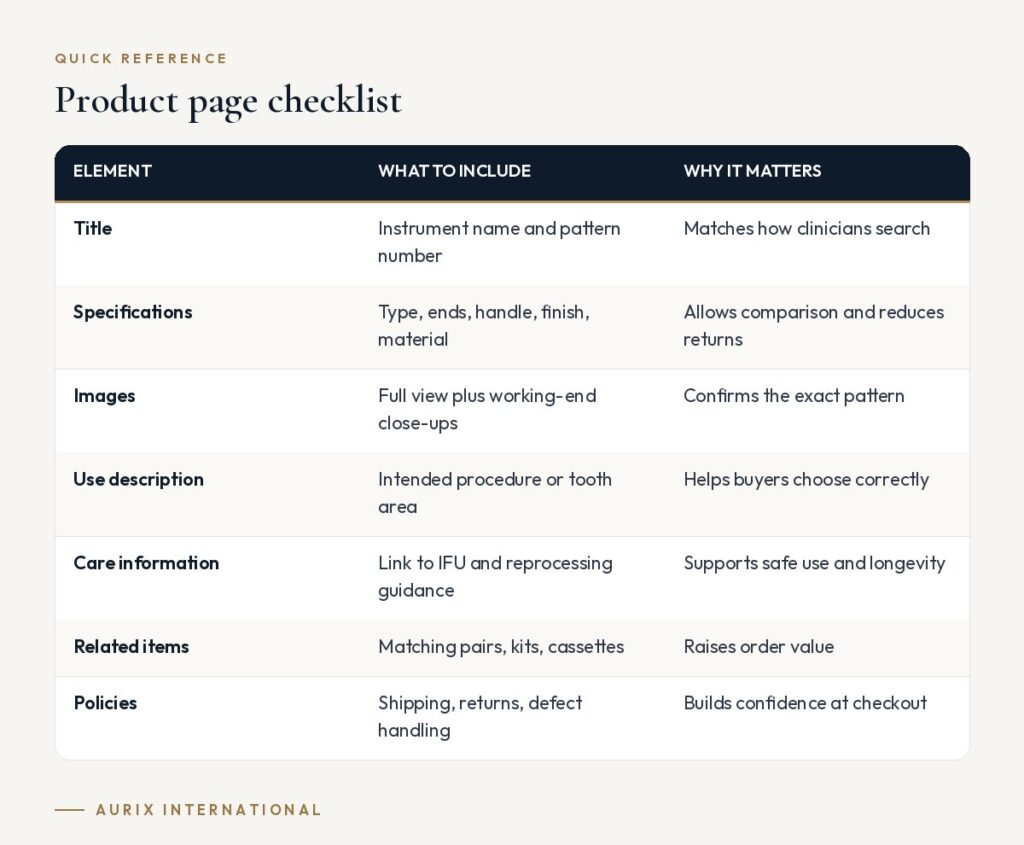
Product page checklist
| Element | What to include | Why it matters |
|---|---|---|
| Title | Instrument name and pattern number | Matches how clinicians search |
| Specifications | Type, ends, handle, finish, material | Allows comparison and reduces returns |
| Images | Full view plus working-end close-ups | Confirms the exact pattern |
| Use description | Intended procedure or tooth area | Helps buyers choose correctly |
| Care information | Link to IFU and reprocessing guidance | Supports safe use and longevity |
| Related items | Matching pairs, kits, cassettes | Raises order value |
| Policies | Shipping, returns, defect handling | Builds confidence at checkout |
How to choose a supplier for your online store
- Reliable stock and lead times. Out-of-stock pages lose sales and search ranking. Choose a supplier that can support consistent availability.
- Good product data. Ask for accurate specifications, high-resolution images and documentation you can use on product pages.
- Consistent quality. Online reviews quickly expose inconsistent batches.
- Private label options. Your own brand makes listings unique and harder to undercut.
- Kit capability. A supplier that can assemble kits saves you packing time. See our guide to choosing a dental instrument supplier.
Frequently asked questions
Do I need special permission to sell dental instruments online?
Requirements depend on your location and role. If you import, relabel or sell under your own brand, you may have regulatory obligations. Confirm requirements for each market you sell into with a qualified advisor.
Should I sell on marketplaces or my own site?
Marketplaces bring traffic but intense price competition and less control over the customer relationship. Your own site builds your brand and repeat business. Many sellers use both, with marketplaces for discovery and their own site for loyal customers.
How can I reduce returns of wrong items?
Use precise names and pattern numbers, show close-up photos of working ends, describe intended uses and offer pre-sale advice by chat or phone.
What sells best online?
Commonly reordered hand instruments such as curettes, scalers, explorers, probes and mirrors sell steadily, while kits often deliver higher order values.
Stock your online store with instruments buyers trust. Aurix International supplies surgical-grade stainless steel instruments and kits through wholesale and private label programs for online sellers and distributors. Open a wholesale conversation →