
As the Gracey curette market grows, so does the number of suppliers — and the range of quality. Independent research shows that curettes sold as equivalent can differ meaningfully in toe shape and blade finish. Here is what the evidence says and how to check instruments yourself.
Key takeaways
- An SEM study found unacceptable toe shapes from some manufacturers.
- Only a minority produced blades smooth on all surfaces.
- Toe shape and blade smoothness affect adaptation and tissue trauma.
- Inspect under magnification before standardising on a supplier.

The research
A 2022 study from Mahidol University used scanning electron microscopy (SEM) to examine the working ends of standard Gracey curettes from seven manufacturers and modified Gracey curettes from six. The researchers reported that some manufacturers produced curettes with unacceptable toes, and that only a small number produced curettes whose blades were smooth on all surfaces. The study did not name the brands.
Why toe shape matters
Gracey curettes have a rounded toe designed to adapt to root surfaces inside the pocket without lacerating soft tissue. A poorly formed toe can catch tissue, reduce adaptation in narrow sites and make instrumentation less efficient.
Why blade smoothness matters
Rough or irregular blade surfaces can affect cutting efficiency, sharpening behaviour and how cleanly deposits are removed. Smooth, uniform surfaces sharpen predictably and adapt well.
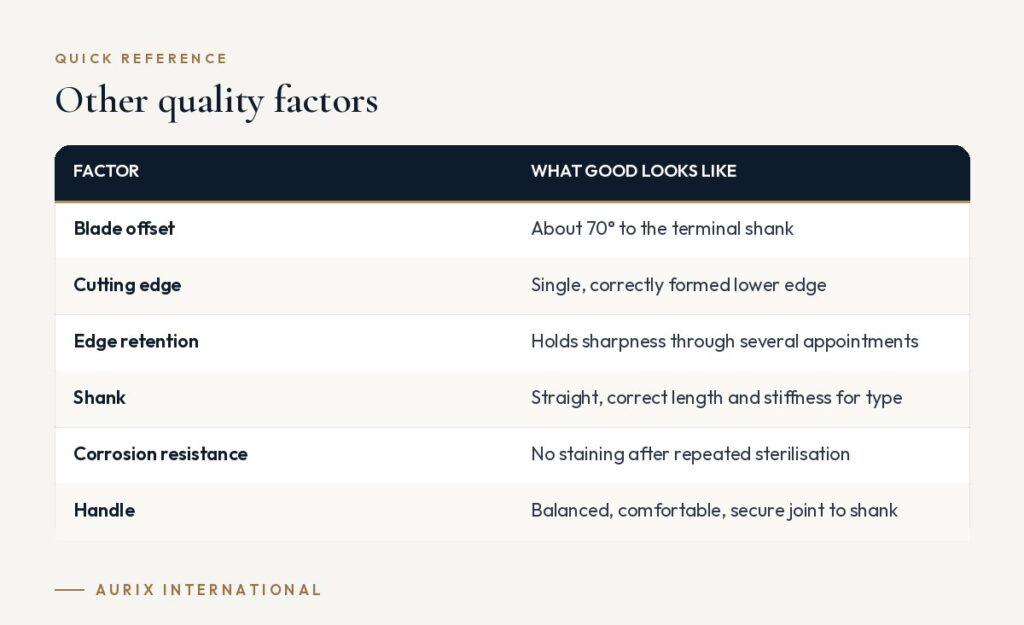
Other quality factors
| Factor | What good looks like |
|---|---|
| Blade offset | About 70° to the terminal shank |
| Cutting edge | Single, correctly formed lower edge |
| Edge retention | Holds sharpness through several appointments |
| Shank | Straight, correct length and stiffness for type |
| Corrosion resistance | No staining after repeated sterilisation |
| Handle | Balanced, comfortable, secure joint to shank |
How to check curettes yourself
- Inspect toe and blade under magnification or loupes.
- Check the blade offset with the terminal shank vertical.
- Test the edge on a plastic test stick.
- Use and sharpen samples for a week.
- Run samples through several sterilisation cycles.
See our sample testing protocol.
A five-minute quality check
- Hold the curette with the terminal shank vertical and confirm the blade tilts at the expected angle.
- Look at the toe under magnification: it should be evenly rounded, not pointed or flat.
- Run a fingertip gently along the back of the blade to feel for roughness.
- Draw the cutting edge lightly across a test stick — it should bite, not slide.
- Check the joint between handle and shank for gaps or looseness.
Quality over time
Initial quality is only half the story. Track how each curette performs after several weeks of use, sharpening and sterilisation: does the edge hold, does the blade keep its shape, does staining appear? This long-term view is the best guide to value. You can run this test on samples from our Gracey curettes range.
Frequently asked questions
Are all Gracey curettes made to the same standard?
No. Research shows meaningful variation between manufacturers.
What is the quickest quality check?
Inspect the toe and blade under magnification and test the edge on a test stick.
Inspect our quality for yourself. Request samples of Aurix Gracey curettes. View Gracey curettes →
Source: Mahidol University: SEM analysis of working ends of standard and modified Gracey curettes.