
Dental and hygiene schools are an important and often overlooked segment of the Gracey curette market. Every student needs a complete Gracey set, instruments are used intensively while skills are learned, and habits formed in school shape what clinicians buy for decades.
Key takeaways
- Identical student sets support fair teaching and assessment.
- Students need spares because blades thin quickly while learning to sharpen.
- Laser marking reduces loss in shared sterilisation units.
- Order months ahead of term.

Why schools matter to the market
- Every hygiene and dental student needs a full set.
- Learning to sharpen wears blades faster than in practice.
- Graduates often keep using the patterns and brands they trained with.
- Hygiene programme growth supports BLS projections of a 7% rise in hygienist employment from 2024 to 2034.
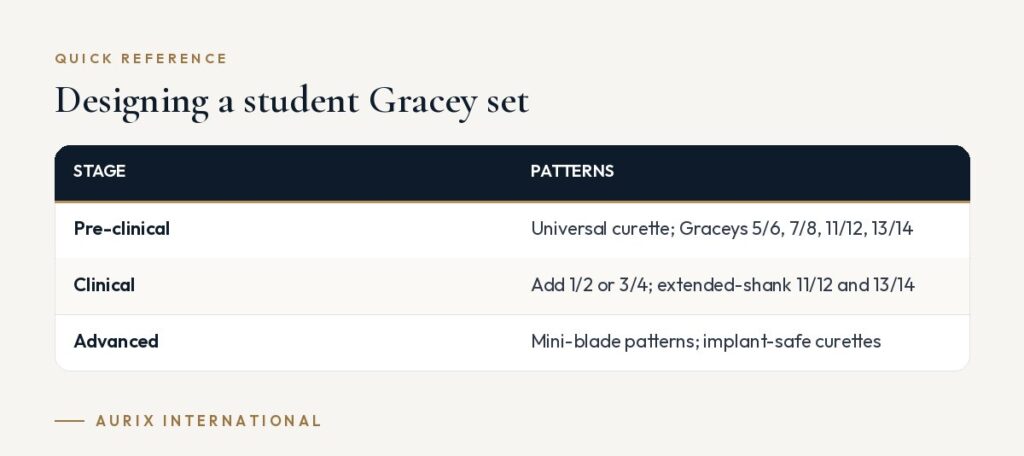
Designing a student Gracey set
| Stage | Patterns |
|---|---|
| Pre-clinical | Universal curette; Graceys 5/6, 7/8, 11/12, 13/14 |
| Clinical | Add 1/2 or 3/4; extended-shank 11/12 and 13/14 |
| Advanced | Mini-blade patterns; implant-safe curettes |
What schools should require from suppliers
- Identical patterns across the whole order and future replacements.
- Consistent blade geometry for predictable sharpening teaching.
- Laser marking with school or student identification.
- Cassettes compatible with central sterilisation.
- Firm delivery dates before term.
- A simple replacement process.
Teaching sharpening
Consistent blade shapes make sharpening easier to teach. Provide stones and test sticks with each set and teach students to recognise when a blade is too thin and must be replaced. See sharpening curettes.
Planning timeline
| When | Action |
|---|---|
| 6 months before term | Agree set contents with faculty |
| 5 months | Request samples and quotes |
| 4 months | Approve samples and marking |
| 3 months | Order |
| 4–6 weeks | Receive, reprocess, issue |
Supporting students through the programme
Students lose instruments, bend tips and over-sharpen blades while learning. A supplier who holds the school’s standard patterns in stock and processes small replacement orders quickly keeps students practising instead of waiting. Agree the replacement process — who orders, how quickly, at what price — before the first delivery.
Building good habits early
- Teach correct sharpening angles and frequent light sharpening.
- Show students how to recognise a blade that is too thin to use safely.
- Reinforce prompt cleaning and correct ultrasonic use.
- Explain why consistent patterns matter in practice.
Schools can request identical, marked student sets based on our Gracey Curettes collection.
What programmes should agree with suppliers
| Item | Why it matters |
|---|---|
| Fixed pattern list | Every student learns on the same instruments |
| Price held for the cohort | Students pay the same as classmates |
| Replacement turnaround | Lost or damaged instruments do not stop practice |
| Marking or engraving | Lost instruments are easy to return |
| Kit contents sheet | Students and faculty can check kits quickly |
Agreeing these points in writing before the academic year avoids confusion during clinic sessions and makes it easier to repeat the order for the next intake.
Frequently asked questions
How many spare curettes should students have?
At least one spare of the most-used patterns, as sharpening practice thins blades quickly.
Should schools choose premium brands?
Choose consistent, well-made instruments; cost per student matters at scale.
Student Gracey sets for schools. Identical, marked sets with wholesale pricing. Explore Gracey curettes or read our schools guide →