The Gracey curette market exists because periodontal disease is extremely common. Scaling and root planing remain foundational periodontal treatments, and Gracey curettes are the instruments designed for them. Understanding the epidemiology explains why demand is so resilient.
Key takeaways
- 42.2% of dentate US adults aged 30+ had periodontitis; 7.8% severe (NIDCR, NHANES 2009–2014).
- The WHO estimates severe gum disease affects about 1 billion people worldwide.
- Oral diseases overall affect about 3.5 billion people (WHO).
- Prevalence rises with age, and people are keeping teeth longer.
Periodontitis in the United States
Analysis of NHANES 2009–2014 data reported by NIDCR found that 42.2% of dentate adults aged 30 and older had periodontitis — 34.4% non-severe and 7.8% severe. An earlier analysis of 2009–2012 data reported 46%, representing about 64.7 million people. Either way, tens of millions of Americans need periodontal assessment and care.
Periodontal disease worldwide
The World Health Organization’s 2022 Global Oral Health Status Report estimates that severe periodontal disease affects around one billion people, and that oral diseases overall affect about 3.5 billion people — 45% of the world’s population.
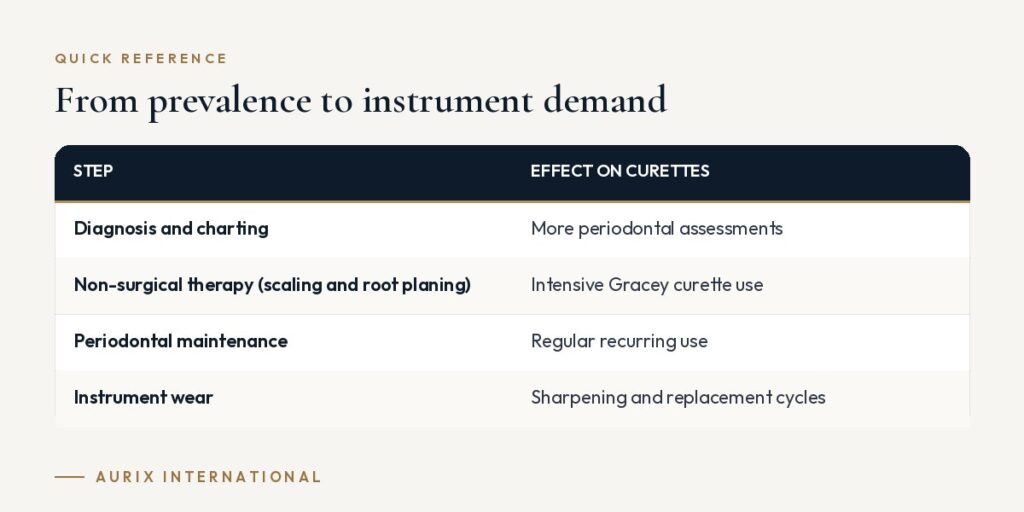
From prevalence to instrument demand
| Step | Effect on curettes |
|---|---|
| Diagnosis and charting | More periodontal assessments |
| Non-surgical therapy (scaling and root planing) | Intensive Gracey curette use |
| Periodontal maintenance | Regular recurring use |
| Instrument wear | Sharpening and replacement cycles |
Why severity matters
Severe periodontitis means deeper pockets and more furcation involvement — exactly where extended-shank and mini-blade Graceys are needed. This helps explain why specialised variants are among the fastest-growing segments. See market by product type.
Ageing and tooth retention
Periodontitis prevalence generally increases with age. As populations age and retain more natural teeth, the number of teeth at risk — and needing periodontal care — grows.
What this means for practices
- Expect steady demand for periodontal therapy and maintenance.
- Equip hygiene operatories with complete sets including deep-pocket patterns.
- Budget for regular curette replacement.
Periodontal care pathway and instrument use
| Stage | Typical instruments |
|---|---|
| Screening | Probe, explorer, mirror |
| Initial therapy | Ultrasonic scaler, Gracey curettes (full set) |
| Re-evaluation | Probe, explorer |
| Maintenance | Ultrasonic scaler, core Graceys, universal curette |
| Surgery (if needed) | Surgical instruments plus fine curettes |
Planning capacity
As periodontal caseloads grow, practices often find they need more hygiene time — and more instrument sets. Count how many periodontal therapy and maintenance appointments you deliver each week and make sure you have enough complete sets to support them without reprocessing bottlenecks. If you need to expand, our Gracey Curettes collection offers consistent patterns for adding sets.
Frequently asked questions
How common is gum disease in the US?
About 42% of dentate adults aged 30+ had periodontitis in NHANES 2009–2014.
How many people worldwide have severe gum disease?
About one billion, according to the WHO.
Equip for periodontal care. Complete Gracey curette sets from Aurix International. Shop Gracey curettes →
Sources: NIDCR; CDC NHANES 2009–2012 update; WHO report coverage.