
Generally, with dozens of brands and hundreds of listings, the Gracey curette market can be confusing for clinics. A clear purchasing strategy saves money, keeps hygienists happy and ensures every operatory has sharp, consistent instruments.
Key takeaways
- Audit current sets before buying.
- Standardise patterns across operatories.
- In general, keep spares in a sharpening rotation.
- Generally, test samples with the hygienists who use them.
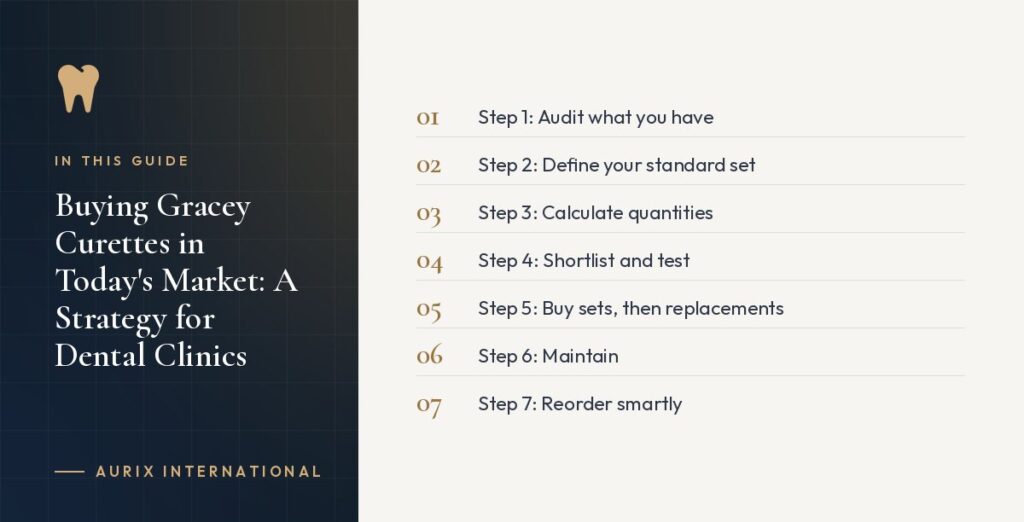
Audit what you have
- Count curettes by pattern and operatory.
- In general, check blades for thinning, bends and lost shape.
- Note which patterns are missing or duplicated.
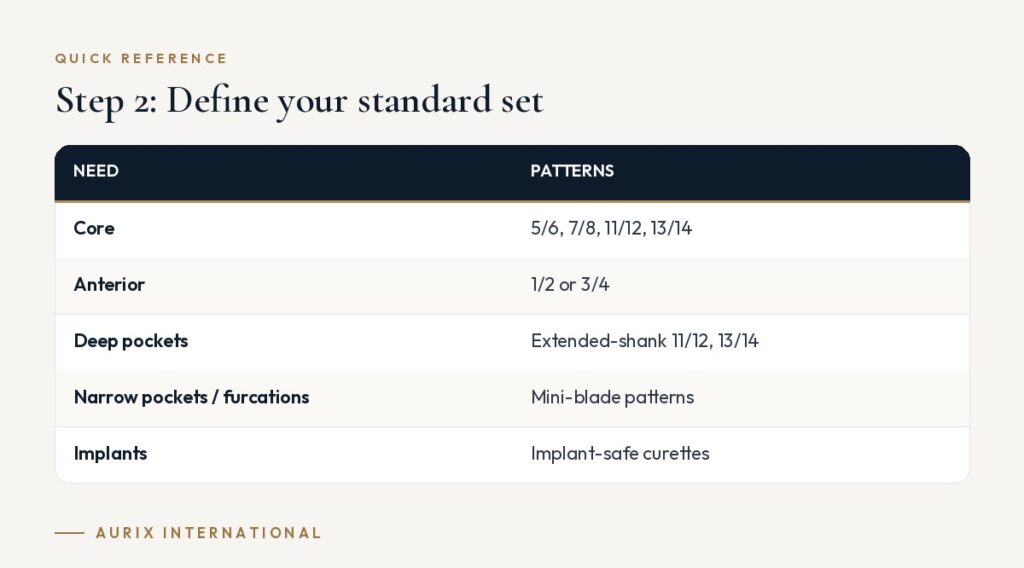
Define your standard set
| Need | Patterns |
|---|---|
| Core | 5/6, 7/8, 11/12, 13/14 |
| Anterior | 1/2 or 3/4 |
| Deep pockets | Extended-shank 11/12, 13/14 |
| Narrow pockets / furcations | Mini-blade patterns |
| Implants | Implant-safe curettes |
Calculate quantities
Plan at least three sets per hygiene operatory (in use, in reprocessing, ready) plus two to four spare curettes of the most-used patterns for sharpening rotation.
Shortlist and test
Generally, ask two or three suppliers for samples. Also, have hygienists use them for a week, sharpen them and run them through sterilisation. In addition, score finish, edge retention, balance and comfort. See sample testing protocol.
Buy sets, then replacements
Buy complete sets in cassettes for consistency, then individual patterns for replacements.
Maintain
- In general, sharpen regularly using the correct angle.
- Replace curettes when blades become thin.
- Follow reprocessing instructions to avoid corrosion.
Reorder smartly
Record SKUs and set reorder points so you never run short. See lead times and reorder points.
Common mistakes
- Mixing many brands and patterns.
- Keeping thin, worn curettes in service.
- Buying on price alone.
- Ignoring hygienists’ feedback.
Annual hygiene instrument review
| Check | Action |
|---|---|
| Blade condition | Replace thin or misshapen curettes |
| Pattern coverage | Add missing anterior or deep-pocket patterns |
| Set consistency | Align operatories to the standard set |
| Hygienist feedback | Note comfort and performance issues |
| Supplier performance | Review delivery, quality and pricing |
Involving hygienists in decisions
Generally, hygienists know which curettes hold an edge, which handles cause fatigue and which patterns they reach for most. Involve them in sample testing and set design, and you will get better clinical results and fewer worn favourites hidden in drawers. Share shortlisted options — including our Gracey Curettes collection — and let the team score them.
A sample annual budget
Take a practice with two hygiene operatories, three sets per operatory and four core patterns per set. Additionally, that is 24 curettes in rotation. If about half need replacing each year because sharpening has thinned the blades, the practice buys around 12 replacements, plus a few anterior or extended-shank patterns as needs change. Adding sharpening stones, a test stick and one cassette replacement gives a predictable yearly figure. Also, use your own appointment numbers to adjust it. Once you know the figure, you can compare suppliers on total annual cost rather than unit price, and ask for wholesale terms on the full list.
In general, keep a simple log of each order: date, patterns, quantity and supplier. After a year you will know exactly which patterns wear fastest and can order them in advance.
Frequently asked questions
How many Gracey curettes does one hygienist need?
Enough for several full sets plus spares — typically more than most clinics expect.
Should every hygienist choose their own?
Agree a standard set with a short list of approved alternatives.
Standardise your hygiene sets. Browse Aurix Gracey curettes or build a custom kit. View the collection →