
Browse the Gracey curette market and you will see prices that differ several-fold for what looks like the same instrument. Some of that difference reflects genuine quality; some reflects brand and distribution costs. This guide explains what drives Gracey curette pricing and how to judge value.
Key takeaways
- Steel, heat treatment and hand finishing drive both quality and cost.
- Handles, shank types and coatings add cost.
- Brand and distribution layers explain much of the price gap.
- Cost per use is the fairest comparison.
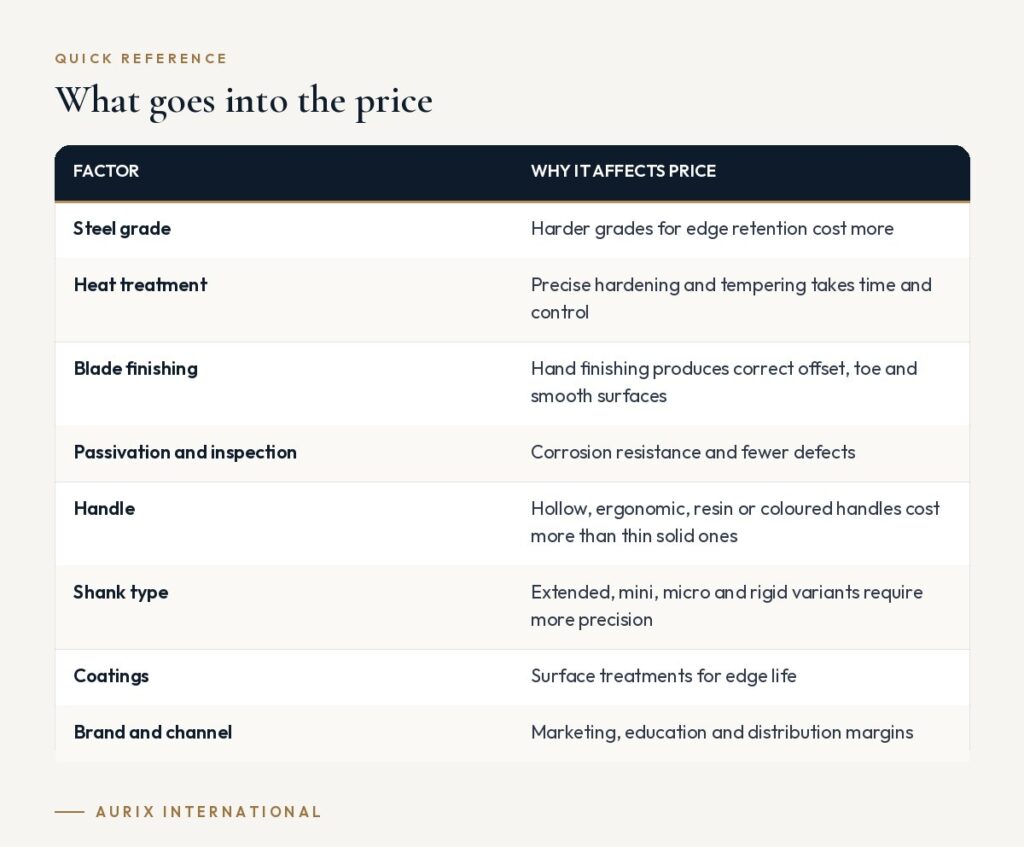
What goes into the price
| Factor | Why it affects price |
|---|---|
| Steel grade | Harder grades for edge retention cost more |
| Heat treatment | Precise hardening and tempering takes time and control |
| Blade finishing | Hand finishing produces correct offset, toe and smooth surfaces |
| Passivation and inspection | Corrosion resistance and fewer defects |
| Handle | Hollow, ergonomic, resin or coloured handles cost more than thin solid ones |
| Shank type | Extended, mini, micro and rigid variants require more precision |
| Coatings | Surface treatments for edge life |
| Brand and channel | Marketing, education and distribution margins |
Price tiers in the market
- Premium brands: proprietary designs, coatings and education programmes.
- Specialist value suppliers: quality instruments with fewer distribution layers.
- Low-cost imports: attractive prices, highly variable quality.
Cost per use
Cost per use = (price + sharpening cost) ÷ number of uses
| Curette A | Curette B | |
|---|---|---|
| Price | $16 | $28 |
| Uses before replacement | 250 | 600 |
| Cost per use | 6.4¢ | 4.7¢ |
These figures are illustrative. A better curette also needs fewer strokes per appointment and less frequent sharpening — savings in clinician time and fatigue.
Sets vs individual curettes
Complete Gracey sets in cassettes often cost less per instrument than buying individually and include organisation benefits. See Gracey curette sets.
How to get better value
- Standardise patterns across operatories.
- Buy sets and wholesale quantities.
- Test samples to estimate lifespan.
- Look after instruments: correct sharpening and reprocessing.
- Compare total landed cost including shipping.
Hidden costs of the wrong curette
- More strokes per appointment and longer procedures.
- More frequent sharpening, reducing clinician time.
- Faster blade thinning and earlier replacement.
- Hand fatigue from poor balance or thin handles.
- Corrosion requiring early disposal.
Budgeting for a hygiene operatory
Instead of budgeting per curette, budget per operatory per year: the number of sets in rotation, expected replacements, sharpening supplies and implant instruments. This makes costs predictable and helps you compare suppliers on total annual spend rather than unit price. When you are ready to compare, see our Gracey curettes and ask about wholesale tiers.
Frequently asked questions
Why are some Gracey curettes so cheap?
Often softer steel, minimal finishing or no passivation. Test before committing.
Are premium brands worth the price?
Sometimes. Compare evidence and cost per use; well-made value instruments can match them.
Quality Gracey curettes at fair prices. Wholesale pricing available for clinics, schools and distributors. Shop Gracey curettes →