
Running out of a key instrument disrupts clinics; ordering too early ties up cash and shelf space. Understanding dental instruments supplier lead times — how long it takes from order to delivery — lets you order at the right moment and keep every room fully equipped.
Key takeaways
- Generally, lead times differ for in-stock items, kits, custom kits and branded products.
- In general, use a reorder point formula with safety stock for high-turnover items.
- Generally, schools and new practices should order months ahead.
- In general, get dates in writing for anything time-critical.
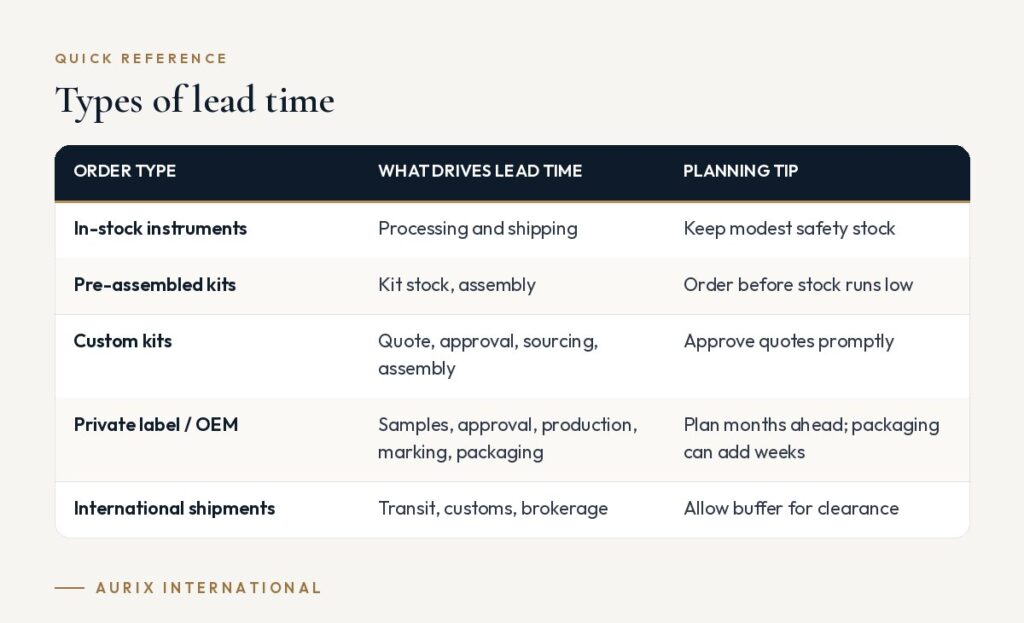
Types of lead time
| Order type | What drives lead time | Planning tip |
|---|---|---|
| In-stock instruments | Processing and shipping | Keep modest safety stock |
| Pre-assembled kits | Kit stock, assembly | Order before stock runs low |
| Custom kits | Quote, approval, sourcing, assembly | Approve quotes promptly |
| Private label / OEM | Samples, approval, production, marking, packaging | Plan months ahead; packaging can add weeks |
| International shipments | Transit, customs, brokerage | Allow buffer for clearance |
The reorder point formula
Reorder point = (average weekly use × lead time in weeks) + safety stock.
| Item | Weekly use | Lead time | Safety stock | Reorder at |
|---|---|---|---|---|
| Explorers | 4 | 2 weeks | 4 | 12 |
| Mirror heads | 10 | 1 week | 10 | 20 |
| Gracey 11/12 | 1 | 2 weeks | 2 | 4 |
“Weekly use” here means instruments retired or lost per week, not uses per week. Review the numbers every few months.
Planning for clinics
- Set reorder points for high-turnover items.
- Replace instruments before they are fully worn.
- Generally, keep sterile back-up pouches of critical surgical instruments.
Schools and new practices
- Order student kits three months or more before term.
- Order new-practice instruments six to eight weeks before opening.
- Agree firm delivery dates in writing.
Groups and distributors
- Stagger deliveries for multi-site roll-outs.
- Forecast demand for best sellers and share forecasts with your supplier.
- Order ahead of seasonal peaks such as the academic year.
- Allow extra time for branded packaging.
How to shorten lead times
- Standardise patterns so suppliers can keep them in stock.
- Share forecasts.
- Approve samples and quotes quickly.
- In general, choose a supplier with domestic stock where possible.
- Generally, use saved kit configurations for reorders.
When an order is late
- In general, ask for a realistic revised date and the reason.
- Generally, ask whether part of the order can ship now.
- Consider an equivalent in-stock pattern temporarily — without mixing patterns within kits.
- Increase safety stock for that item in future.
Building resilience
In general, supply chains can be disrupted unexpectedly. Also, modest safety stock, standardised patterns and suppliers who communicate openly make your practice resilient. See global dental supply chains in 2026.
Communicating with your supplier about timing
Tell your dental instruments supplier when you need instruments, not just what you need. A firm date allows the supplier to confirm whether stock is available, suggest alternatives or prioritise production. In addition, for schools and new practices with fixed opening dates, this conversation should happen months in advance.
Frequently asked questions
What is a realistic lead time for custom kits?
Generally, it depends on contents and quantity. Aurix aims to return custom kit quotes within about 48 hours; production time is confirmed with the quote.
Can I get rush delivery?
Often for in-stock items, at extra shipping cost. Additionally, custom and branded items are harder to rush.
How much safety stock should I hold?
Enough to cover at least one lead time’s worth of unexpected losses for critical items.
Next steps
See MOQs, lead times and payment terms, ask Aurix about current lead times, or compare suppliers in our top 10 guide.