These sustainability tips for dental instruments focus on changes a clinic can actually make without compromising infection control or patient care. Instruments are a smaller part of a practice’s environmental footprint than energy or single-use plastics, but choices about what you buy, how you care for it and how you reprocess it still add up. Every tip below works within CDC guidance and the manufacturer’s instructions for use (IFU).
Key takeaways
- Durable, well-made reusable instruments that last for years are usually the most sustainable choice.
- Good care, sharpening and timely repair extend instrument life and reduce replacement.
- Efficient reprocessing (full loads, right-sized packaging, cassettes) cuts energy, water and waste.
- Patient safety always comes first: never shortcut cleaning or sterilization to save resources.
The top 10 sustainability tips for dental instruments
1. Choose durable reusable instruments where appropriate
Reusable stainless steel instruments can be reprocessed many times when they are well made and correctly cared for. For many hand instruments, a quality reusable option replaces a large number of disposable equivalents over its working life. Single-use items still have their place, for example where the manufacturer labels a device single-use or where reprocessing is impractical, but review whether disposables are being used out of habit. Our comparison of disposable vs reusable instruments covers the trade-offs.
2. Buy quality to avoid early replacement
Poorly heat-treated or badly finished instruments dull quickly, bend, stain or corrode, and end up replaced sooner. Well-made instruments in appropriate stainless steel grades last longer, which reduces both cost and material use. Looking at total cost of ownership rather than unit price usually favors durable instruments.
3. Clean promptly to prevent damage
Blood and debris left to dry on instruments are harder to remove and can contribute to corrosion and pitting. Keeping instruments moist after use and cleaning them promptly, as recommended in CDC guidance, protects both infection control and instrument life. Avoid harsh chemicals not recommended in the IFU.
4. Sharpen correctly and regularly
Correct, regular sharpening keeps scalers and curettes effective while removing as little metal as possible. Poor technique or infrequent sharpening of very dull blades removes more steel and shortens instrument life. Training staff in proper sharpening is one of the simplest ways to get more years from each instrument.
5. Repair or re-tip before replacing
Some instruments can be repaired, realigned, re-tipped or refurbished instead of discarded, depending on the instrument and the provider. Ask your supplier or a reputable repair service what is possible. Our guide on when to repair, re-tip or replace explains how to decide.
6. Run full, properly loaded sterilizer cycles
Running cycles with partial loads uses energy and water for fewer instruments. Where workflow allows, plan reprocessing to run full loads, but never overload: overloading can prevent sterilant contact and drying. Follow the sterilizer manufacturer’s loading instructions and keep monitoring records as required.
7. Use cassettes and right-sized packaging
Instrument cassettes keep sets together through cleaning, sterilization and storage, and can reduce the number of individual pouches used. Where pouches are needed, choose sizes that fit the instruments rather than oversized ones. Always use packaging cleared for your sterilization method and process according to IFU.
8. Right-size your procedure trays
Trays packed with instruments that are rarely used still have to be cleaned, packaged and sterilized after every opening. Review each tray with your clinicians and remove instruments that are almost never used, keeping them in separate pouches for when they are needed. Custom kits designed around your real workflow help avoid this waste.
9. Track inventory to avoid overbuying
Instruments bought “just in case” may sit in drawers for years, while lost instruments get replaced unnecessarily. A simple inventory system, with counts per tray and per room, reduces overbuying and loss. Planned reordering also allows consolidated shipments rather than many small deliveries.
10. Recycle retired stainless steel instruments
Stainless steel is recyclable. When instruments reach the end of their life, ask whether a local metal recycler or your supplier can accept them. Instruments must be cleaned and decontaminated first, and sharp items handled according to your local regulations and waste policies. Never place contaminated sharps in general recycling.
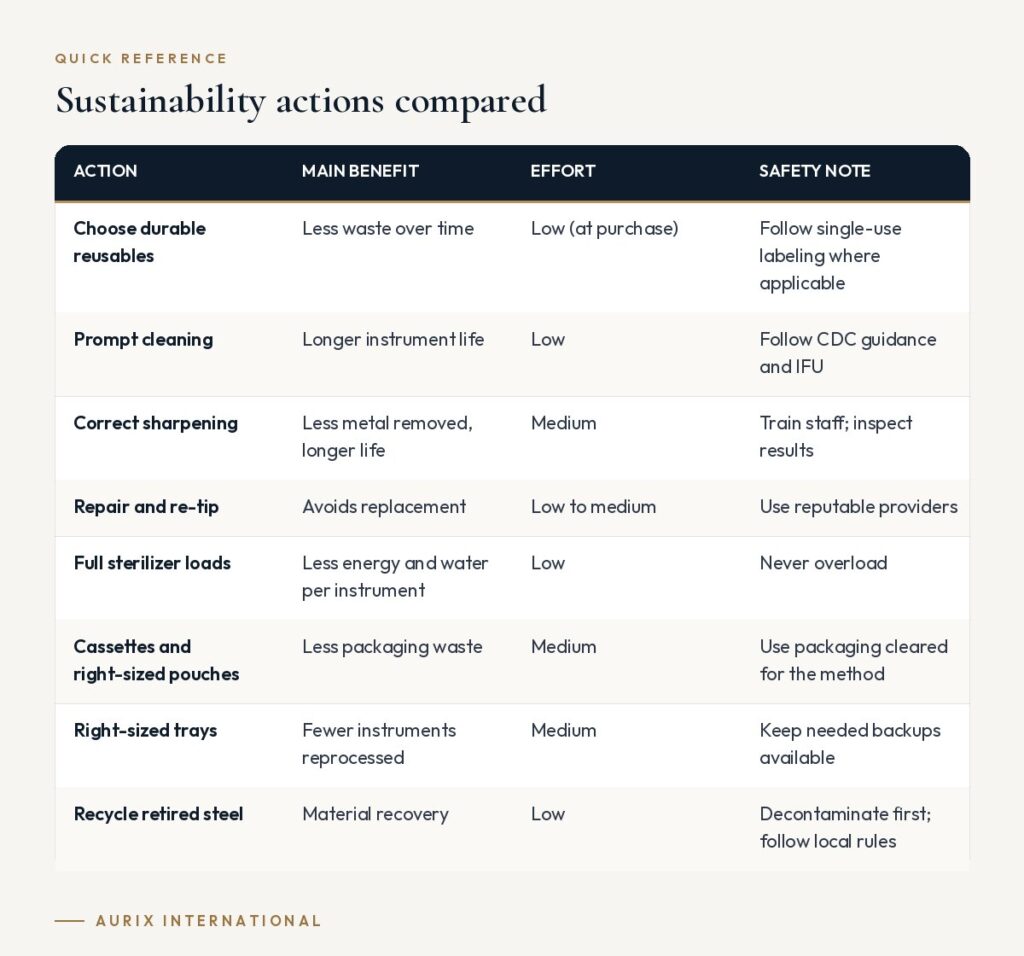
Sustainability actions compared
| Action | Main benefit | Effort | Safety note |
|---|---|---|---|
| Choose durable reusables | Less waste over time | Low (at purchase) | Follow single-use labeling where applicable |
| Prompt cleaning | Longer instrument life | Low | Follow CDC guidance and IFU |
| Correct sharpening | Less metal removed, longer life | Medium | Train staff; inspect results |
| Repair and re-tip | Avoids replacement | Low to medium | Use reputable providers |
| Full sterilizer loads | Less energy and water per instrument | Low | Never overload |
| Cassettes and right-sized pouches | Less packaging waste | Medium | Use packaging cleared for the method |
| Right-sized trays | Fewer instruments reprocessed | Medium | Keep needed backups available |
| Recycle retired steel | Material recovery | Low | Decontaminate first; follow local rules |
How to choose sustainable instruments and suppliers
- Ask about materials and durability. Request steel grade information and care instructions, and look for instruments designed for repeated reprocessing.
- Ask about packaging. Some suppliers can reduce or consolidate packaging on bulk or wholesale orders.
- Prefer complete, well-planned kits. Kits matched to your procedures avoid duplicate purchases and unnecessary instruments.
- Check repair and sharpening support. A supplier that can advise on repair or refurbishment helps extend instrument life.
- Avoid unverified green claims. Ask for specifics behind any environmental claim rather than relying on vague labels.
Frequently asked questions
Are reusable dental instruments more sustainable than disposables?
Often, yes, for durable hand instruments used many times, although reprocessing uses energy, water and packaging. The balance depends on the instrument, how long it lasts and how efficiently you reprocess. Single-use devices should never be reprocessed against their labeling.
Can I reduce sterilization to save energy?
No. Sterilization of reusable critical and semicritical instruments must follow CDC guidance and IFU. Savings should come from efficient loading, scheduling and tray design, not from skipping steps.
Can old dental instruments be recycled?
Stainless steel is recyclable, but instruments must be cleaned and decontaminated first and handled according to local sharps and waste regulations. Check with local recyclers about what they accept.
What is the single biggest instrument-related change a clinic can make?
For many clinics, buying durable instruments and caring for them well, through prompt cleaning, correct sharpening and timely repair, has the largest effect because it reduces how often instruments need replacing.
Build trays that last and waste less. Aurix International offers surgical-grade stainless steel instruments and custom kits designed around the procedures you actually perform. Design a custom kit →