Dental instrument terms can be confusing for new assistants, students and buyers, especially when catalogs assume you already know them. Understanding a handful of core words makes it much easier to identify instruments, follow technique instructions and order the right pattern. Here are the ten terms that come up most often, explained in plain language.
Key takeaways
- Most hand instruments have three parts: handle, shank and working end.
- Shank design determines access; working-end design determines function.
- Pattern numbers identify a specific design, such as Gracey 11/12 or forceps 151.
- Hinged instruments have their own vocabulary: joints, ratchets, beaks and serrations.
The top 10 dental instrument terms
1. Handle
The handle is the part you hold. Handles vary in diameter, weight, texture and material: hollow or solid stainless steel, or resin. Larger diameters and textured surfaces can reduce pinch force and hand fatigue during long procedures. Many hand instruments carry the pattern number and manufacturer marking on the handle. Our article on hollow, solid and resin handles compares the options.
2. Shank
The shank connects the handle to the working end. A straight shank suits anterior teeth and easy-access surfaces, while an angled or contra-angled shank bends to reach posterior teeth. The terminal shank is the section closest to the working end; on area-specific curettes, positioning it parallel to the tooth surface being instrumented is part of correct technique. Extended-shank variants have a longer terminal shank for deeper pockets.
3. Working end
The working end is the part that contacts the tooth or tissue: a blade, point, nib, beak or tip. A single-ended instrument has one working end; a double-ended instrument has two, usually mirror images (for example, a Gracey 13/14) or two complementary designs.
4. Blade, face and cutting edge
On scalers and curettes, the blade is the working end. The face is its inner surface, and the cutting edge is formed where the face meets the lateral surfaces. A sickle scaler has a pointed tip and a triangular cross-section, while a curette has a rounded toe and a semicircular cross-section, which makes it better suited to subgingival work. Keeping cutting edges sharp is essential; see our guide to sharpening curettes and scalers.
5. Offset blade
Gracey curettes have an offset blade: the face is angled at about 70 degrees to the terminal shank, so only one cutting edge (the lower one) is used. Universal curettes have a face at 90 degrees to the terminal shank and two usable cutting edges. This single difference explains why Graceys are area-specific and universals can be used throughout the mouth.
6. Pattern number
A pattern number identifies a specific design. Examples include Gracey 1/2 through 17/18, extraction forceps 150 and 151, the 23 “cowhorn” forceps, or the 88R and 88L upper molar forceps. Pattern numbers are not always standardized between manufacturers, so check images and descriptions when buying. Our guide to reading an instrument catalog explains more.
7. Beaks
On extraction forceps, the beaks are the working ends that grip the tooth. Beak shape is matched to tooth anatomy: pointed beaks to engage the furcation of molars, rounded beaks for single-rooted teeth, narrow beaks for roots. Upper forceps beaks tend to be in line with the handles, while lower forceps beaks are angled for access to mandibular teeth.
8. Joint (box joint and screw joint)
Hinged instruments such as forceps, scissors, needle holders and hemostats pivot at a joint. A box joint passes one half through a slot in the other, giving stability, while a screw joint is held by a screw or rivet. Joints need thorough cleaning, inspection and, where the manufacturer’s IFU recommends it, lubrication with a sterilization-compatible product.
9. Ratchet and serrations
A ratchet is the locking mechanism on the handles of needle holders and hemostats, letting the instrument hold its grip without hand pressure. Serrations are the grooves on jaws or beaks that improve grip. Fine serrations suit delicate tissue and fine sutures; coarser patterns suit firm tissue or larger needles. Some needle holders use tungsten carbide inserts with a crosshatch pattern.
10. Finish
The surface finish affects appearance and glare. A satin (matte) finish reduces light reflection under the operating light, while a mirror (polished) finish has a bright, smooth surface. Both depend on proper finishing and passivation to resist corrosion. Choose based on the team’s preference for glare control and appearance.
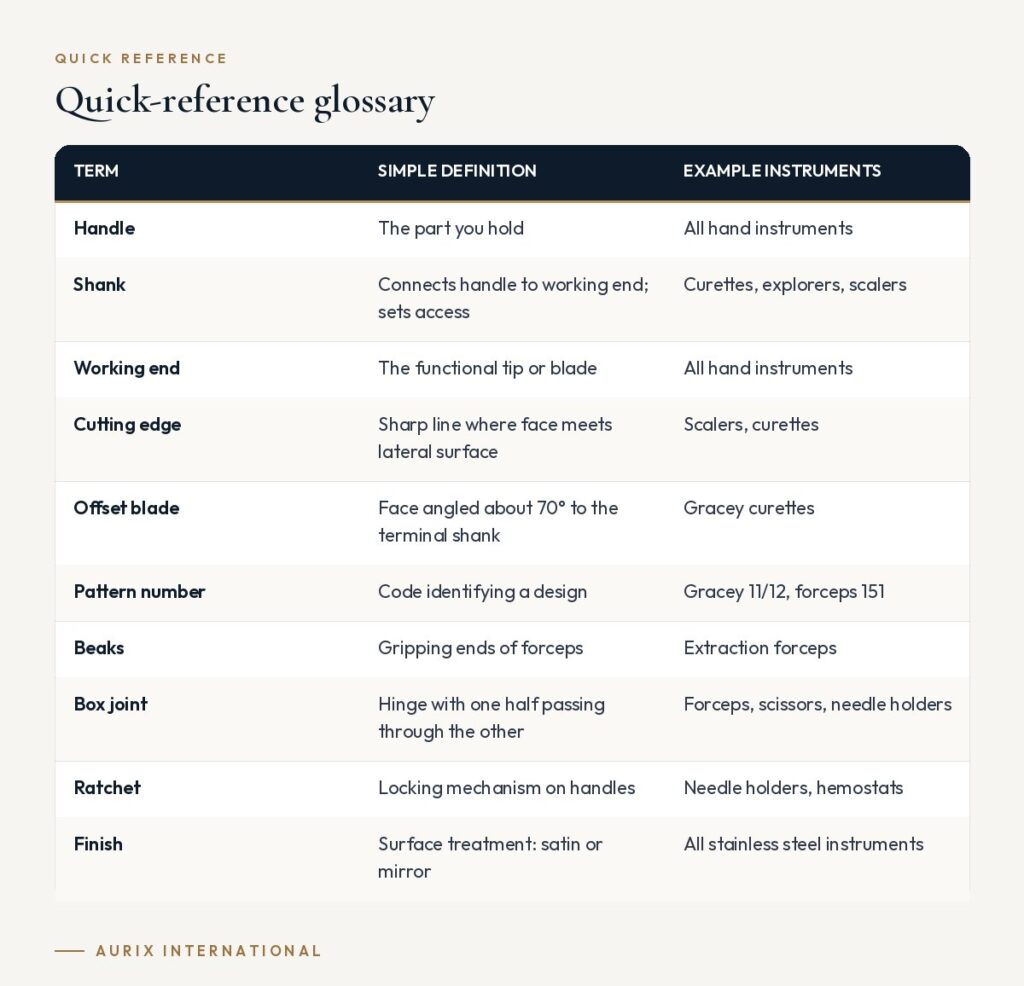
Quick-reference glossary
| Term | Simple definition | Example instruments |
|---|---|---|
| Handle | The part you hold | All hand instruments |
| Shank | Connects handle to working end; sets access | Curettes, explorers, scalers |
| Working end | The functional tip or blade | All hand instruments |
| Cutting edge | Sharp line where face meets lateral surface | Scalers, curettes |
| Offset blade | Face angled about 70° to the terminal shank | Gracey curettes |
| Pattern number | Code identifying a design | Gracey 11/12, forceps 151 |
| Beaks | Gripping ends of forceps | Extraction forceps |
| Box joint | Hinge with one half passing through the other | Forceps, scissors, needle holders |
| Ratchet | Locking mechanism on handles | Needle holders, hemostats |
| Finish | Surface treatment: satin or mirror | All stainless steel instruments |
How to choose instruments using these terms
- Match shank to access. Choose straight shanks for anterior work and angled or extended shanks for posterior teeth and deeper pockets.
- Match working end to task. Curettes for subgingival root surfaces, sickles for supragingival deposits, pointed explorers for tactile detection.
- Consider the handle. If team members report hand fatigue, try wider, lighter, textured handles.
- Check joints and ratchets. On hinged instruments, look for smooth action, aligned tips and secure ratchet engagement.
- Confirm the pattern. Compare images and descriptions as well as numbers, since numbering conventions can differ.
Frequently asked questions
What are the three main parts of a dental hand instrument?
The handle, the shank and the working end. Knowing these three parts makes most other terms easier to understand.
What does the slash in a number like 11/12 mean?
It indicates a double-ended instrument with two working ends, here a mirror-image pair designed for different surfaces of the same teeth.
Is a sickle scaler the same as a curette?
No. A sickle has a pointed tip and triangular cross-section and is mainly used supragingivally. A curette has a rounded toe and back, which makes it better suited to subgingival work.
Where can I learn more terms?
Our full glossary of dental instrument terms covers many more words used in catalogs and textbooks.
Know the terms, then find the right pattern. Aurix International supplies a wide range of surgical-grade stainless steel hand instruments, from Gracey curettes to extraction forceps, with clear pattern information. Browse Gracey curettes →