
Dental distributors grow sales most reliably by becoming more useful to the clinics they serve, not just by cutting prices. The market is competitive, and many buyers can compare list prices in seconds. These ten strategies focus on building value, raising order size and keeping customers coming back.
Key takeaways
- Specialist knowledge and service differentiate a distributor more than price alone.
- Procedure kits and private label lines raise average order value and protect margin.
- Institutional buyers such as schools and DSOs reward consistency and standardization.
- Easy reordering and proactive account management turn one-off buyers into long-term customers.
The top 10 ways dental distributors can grow sales
1. Specialize where you can be the expert
Generalist distributors compete mainly on price. Those who specialize, in periodontics, oral surgery, orthodontics or hygiene education for example, can offer advice that clinicians value. A specialist who can explain why a periodontist might prefer extended-shank Gracey curettes for deep pockets earns trust that converts into orders.
2. Sell procedure kits, not just single items
Clinics often buy instruments piecemeal, which leads to small orders and gaps on trays. Offering complete kits for hygiene, restorative, extraction or suturing procedures increases average order value and solves a real workflow problem. Custom kits built to a practice’s preferences are even stickier. Explain the benefits with resources like pre-assembled kits vs individual instruments.
3. Add a private label line
A private label range gives you products competitors cannot match line for line, plus more control over pricing. Start with fast-moving patterns such as mirrors, explorers, probes and curettes, and expand as demand grows. Your brand on the handle also encourages repeat orders.
4. Train clinic teams on instruments
Short lunch-and-learn sessions on instrument identification, care, sharpening or tray setup help assistants and hygienists, and position you as a partner rather than a vendor. Training also reduces wrong orders and returns. Keep sessions practical and brief, and leave behind a simple reference sheet.
5. Target dental schools and hygiene programs
Students need complete instrument kits, and the brands they learn on often follow them into practice. Building relationships with program directors and offering standardized student kits can bring steady annual volume. Expect formal purchasing processes and plan supply well before each academic year starts.
6. Win DSOs and multi-location groups
DSOs want standardized instruments across locations, predictable pricing and simple ordering. Offering consistent specifications, location-level kitting and consolidated invoicing can win sizeable contracts. Our guide to supplying DSOs and multi-location groups covers what these buyers look for.
7. Make reordering effortless
Many lost sales are simply reorders that went elsewhere because it was easier. Offer saved order lists, reorder reminders, clear SKU references and fast quoting. A well-organized B2B website with searchable pattern numbers helps clinics order from you without a phone call.
8. Promote replacement cycles responsibly
Worn instruments affect clinical results and ergonomics. Help clinics recognize when items need replacement, such as curettes sharpened down to thin blades, misaligned forceps tips or corroded joints, and offer convenient replacement packages. Honest guidance builds credibility; pushing unnecessary purchases erodes it. You can share resources like signs instruments need replacing.
9. Use content and digital marketing
Clinicians search online for instrument names, comparisons and care advice. Useful guides, comparison tables and short videos attract qualified buyers and support your sales team. Email newsletters featuring new kits, care tips and seasonal offers keep you in front of existing customers.
10. Measure accounts and act on the data
Track order frequency, average order value and product mix for each account. A clinic that used to order monthly and has gone quiet is worth a call. Identify which customers buy only one category and introduce related products. Simple account reviews often uncover more growth than chasing new leads.
Practical tip: schedule a short quarterly review with your largest accounts. Ask what is working, what is missing from their trays and which procedures they plan to add. Those conversations often surface needs, such as a new implant maintenance set or extra hygiene cassettes for a new operatory, before the clinic starts shopping elsewhere.
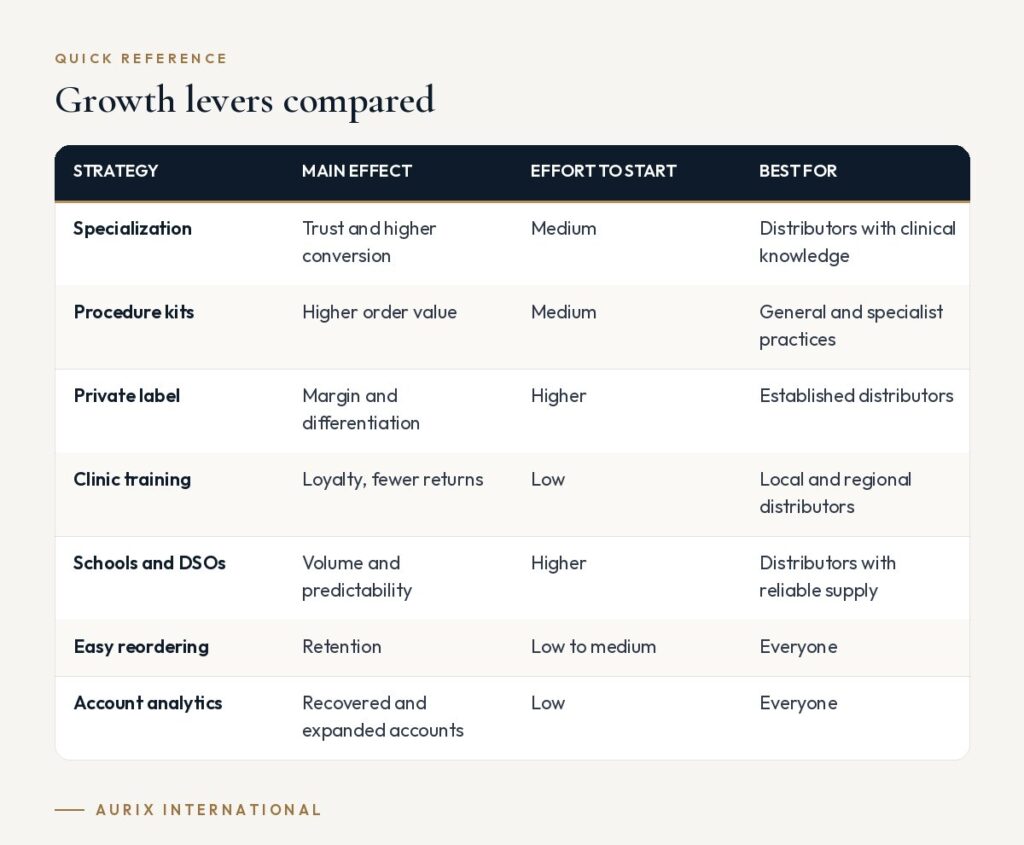
Growth levers compared
| Strategy | Main effect | Effort to start | Best for |
|---|---|---|---|
| Specialization | Trust and higher conversion | Medium | Distributors with clinical knowledge |
| Procedure kits | Higher order value | Medium | General and specialist practices |
| Private label | Margin and differentiation | Higher | Established distributors |
| Clinic training | Loyalty, fewer returns | Low | Local and regional distributors |
| Schools and DSOs | Volume and predictability | Higher | Distributors with reliable supply |
| Easy reordering | Retention | Low to medium | Everyone |
| Account analytics | Recovered and expanded accounts | Low | Everyone |
How to choose which growth strategy to start with
- Start with your existing customers. Retention and account expansion usually cost less than winning new clinics.
- Play to your strengths. If your team has clinical backgrounds, specialization and training are natural fits.
- Check your supply base. Kits, private label and institutional contracts all depend on a supplier that can deliver consistent quality and quantities.
- Pilot before scaling. Test a new kit or private label line with a handful of trusted accounts and refine it before a wider launch.
- Review quarterly. Track the impact of each initiative and drop what does not work.
Frequently asked questions
What is the quickest way for a dental distributor to increase sales?
Reviewing existing accounts is often fastest. Contacting lapsed customers, introducing related categories and offering kits to clinics that buy single items can lift sales without new marketing spend.
Are private label instruments worth it for small distributors?
They can be, if you start with a limited range of fast-moving patterns and a manufacturer with reasonable minimum orders. Weigh the margin gain against the inventory commitment.
How do distributors compete with large online retailers?
By offering what large retailers struggle to provide: specialist advice, custom kits, training, personal account management and fast resolution of problems.
Should distributors sell online?
Most benefit from at least a B2B ordering site. Even clinics that value personal service appreciate being able to reorder quickly online.
Give your customers more reasons to reorder. Aurix International partners with distributors to supply surgical-grade stainless steel instruments, pre-assembled and custom kits, and private label lines. Become an Aurix distributor →