Becoming a dental distributor can be a rewarding business, but it is more demanding than simply buying instruments and reselling them. Successful distributors understand their customers, choose reliable suppliers, manage inventory carefully and provide service that clinics value. Here are the ten things worth knowing before you take the step.
Key takeaways
- Pick a clear niche, such as hand instruments, a specialty or a region, rather than trying to sell everything at once.
- Your supplier relationships and product quality become your reputation.
- Regulatory, tax and import obligations vary by country and must be confirmed before you sell.
- Cash flow, inventory and after-sales service decide long-term success more than launch pricing.
The top 10 things to know before becoming a dental distributor
1. Define your niche and customer
The dental market includes general practices, specialists, hygiene teams, dental schools, DSOs, laboratories and veterinary clinics. Each buys differently. A distributor focused on periodontal and hygiene instruments needs different product knowledge than one supplying oral surgeons. Decide early who you serve and what problems you solve for them.
Practical tip: interview a handful of clinics in your target segment about how they buy instruments today and what frustrates them. Their answers are a better guide than any market report.
2. Know the products in depth
Clinicians expect distributors to understand what they sell. You should be able to explain the difference between a Gracey 11/12 and 13/14, why an oral surgeon might choose a 23 cowhorn over a 150 forceps, and how a Williams probe differs from a UNC-15. Product knowledge builds trust and reduces returns caused by wrong orders. Resources such as our guide to 50 common dental instruments are a good starting point for new sales staff.
3. Choose suppliers carefully
Your supplier’s quality becomes your quality in the customer’s eyes. Evaluate manufacturers on steel grades, heat treatment, finishing, consistency between batches, documentation and responsiveness. Request samples, test them, and ask how complaints and defects are handled. Our article on how to vet a dental instruments supplier lists useful questions.
4. Understand regulatory obligations
Dental instruments are regulated medical devices in most markets. Depending on where you operate and whether you import, relabel or simply resell, you may have registration, labeling, record-keeping or complaint-handling duties. In the United States, for instance, importers and companies that label devices under their own name can have FDA registration obligations. Get qualified advice for each market before your first sale.
5. Plan for import, tax and logistics
If you source internationally, factor in freight, customs duties, brokerage fees, insurance and local sales taxes. Delays at customs or missing paperwork can tie up stock for weeks. Build relationships with a reliable freight forwarder and customs broker, and keep documentation organized from the start.
6. Manage cash flow and inventory
Distribution ties up cash in stock long before customers pay. Wholesale suppliers often have minimum order quantities, and institutional buyers may expect payment terms. Track which patterns sell steadily and which sit on the shelf, and reorder based on real sales data. A focused core range turns over faster than a sprawling catalog.
7. Decide on branded, private label or both
Reselling established brands gives instant recognition but limited margin and differentiation. A private label line builds your own brand and gives you more pricing control, at the cost of minimum orders and greater responsibility for product claims and labeling. Many distributors start with one approach and add the other as they grow.
8. Build service into your offer
Clinics stay with distributors who make life easier. Consider value-added services such as custom procedure kits, instrument identification training, sharpening referrals, reorder reminders and clear guidance on care and sterilization. Service is harder for competitors to copy than price.
9. Invest in sales channels
Most distributors combine several channels: direct sales visits, trade shows, a business-to-business website, email marketing and relationships with dental schools or study clubs. Each channel needs time and budget. Work out which ones reach your niche most efficiently before spreading resources thin.
10. Expect to build trust over time
Clinics rarely switch their entire instrument supply at once. They test a few items, watch how orders and issues are handled, and gradually move more business to a distributor who proves reliable. Plan for a ramp-up period, keep promises on delivery and quality, and treat every early customer as a long-term relationship.
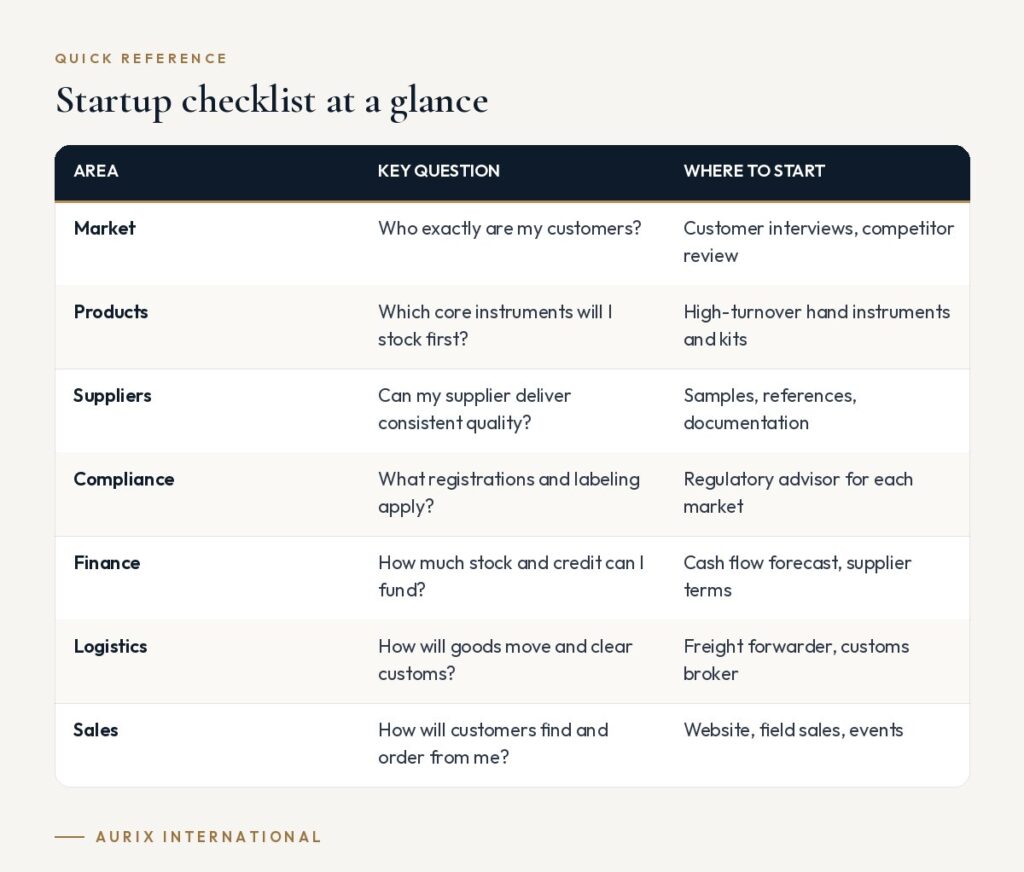
Startup checklist at a glance
| Area | Key question | Where to start |
|---|---|---|
| Market | Who exactly are my customers? | Customer interviews, competitor review |
| Products | Which core instruments will I stock first? | High-turnover hand instruments and kits |
| Suppliers | Can my supplier deliver consistent quality? | Samples, references, documentation |
| Compliance | What registrations and labeling apply? | Regulatory advisor for each market |
| Finance | How much stock and credit can I fund? | Cash flow forecast, supplier terms |
| Logistics | How will goods move and clear customs? | Freight forwarder, customs broker |
| Sales | How will customers find and order from me? | Website, field sales, events |
How to choose a supplier partner as a new distributor
- Look for distributor programs. Some manufacturers run formal distributor networks with product training, marketing materials and territory support.
- Check range breadth. A supplier that covers diagnostic, periodontal, restorative and surgical instruments lets you consolidate purchasing.
- Ask about kits. Pre-assembled and custom kits are attractive to clinics and can raise your average order value.
- Clarify terms in writing. Minimum orders, lead times, payment terms, returns for defects and exclusivity (if any) should be documented.
- Start small. Place a trial order, inspect it thoroughly and gather customer feedback before committing to large volumes.
Frequently asked questions
Do I need a license to become a dental distributor?
Requirements depend on your country and state. Dental instruments are medical devices, so you may need business registrations, tax registrations and, in some cases, regulatory registrations if you import or relabel products. Confirm local requirements with an advisor.
Should a new distributor carry consumables as well as instruments?
Consumables bring frequent reorders but often have thin margins and heavy competition. Many specialist distributors start with durable instruments and kits, where product knowledge adds more value, then add selected consumables later.
How much inventory do I need to start?
There is no single figure. Start with a focused set of fast-moving patterns, understand your supplier’s minimum order quantities and lead times, and size stock to cover realistic demand during the reorder period.
Can I sell to dental schools and DSOs from the start?
You can, but these buyers usually expect consistent supply, standardized specifications and sometimes formal tenders. Building a track record with individual clinics first often makes institutional sales easier.
Building a dental distribution business? Aurix International works with distributors worldwide, supplying surgical-grade stainless steel instruments, kits and private label options. Join the distributor network →