
Autoclave mistakes are a common cause of failed sterilization, wet packs, stained instruments and costly repairs in dental clinics. Steam sterilization is highly reliable when it is done right, but it depends on clean instruments, correct packaging, good loading and consistent monitoring. Here are the ten errors we see most often and how to correct them. Also, your sterilizer’s and instruments’ instructions for use (IFU) always take priority.
Key takeaways
- An autoclave cannot sterilize instruments that are still dirty, overcrowded or packaged incorrectly.
- Every load needs mechanical and chemical monitoring, with biological spore testing at least weekly.
- Wet packs and early door opening compromise sterility.
- Routine maintenance and good record keeping prevent many hidden failures.
The top 10 autoclave mistakes
1. Sterilizing instruments that are not fully clean
Steam must contact every surface to sterilize it. In addition, blood, tissue and cement can shield microorganisms and bake onto instruments, causing stains. CDC guidance requires cleaning before sterilization.
Fix: clean instruments with an ultrasonic cleaner or instrument washer, rinse, dry and inspect them under good light before packaging.
2. Overloading the chamber
Packed chambers prevent steam from circulating and condensate from draining, which leads to failed cycles and wet packs. It is tempting during a busy day, but it usually costs more time when loads have to be repeated.
Fix: follow the manufacturer’s maximum load and spacing guidance, and keep enough duplicate instruments that no one feels pressured to cram the chamber.
3. Packaging and orienting pouches incorrectly
Pouches that are overfilled, poorly sealed or laid flat on top of each other can block steam and trap moisture. Generally, many sterilizer manufacturers recommend placing pouches on edge in a rack, with paper sides facing in the same direction. Wraps and pouches must be FDA-cleared for steam sterilization and compatible with your unit.
Our article on sterilization pouches and cassette wraps covers best practice.
4. Choosing the wrong cycle
Wrapped, unwrapped, cassette and hollow loads may each require different cycles. Furthermore, using an unwrapped cycle for wrapped instruments, or a short cycle for a dense cassette load, can leave instruments unsterile.
Fix: check both the instrument IFU and the sterilizer IFU, and post a cycle chart by the unit. Our guide to autoclave cycles explains the common options.
5. Processing hinged instruments closed
Forceps, needle holders, scissors and hemostats with closed joints or locked ratchets prevent steam from reaching the box joint and put stress on the instrument during heating and cooling, which can contribute to cracks.
Fix: sterilize hinged instruments open or on the first ratchet only if the IFU allows it, and lubricate joints with a water-soluble instrument lubricant as directed.
6. Ignoring indicators or skipping spore tests
A display showing the right temperature does not prove that every pack was sterilized. In practice, mechanical readings, chemical indicators and biological indicators all need to be checked.
- Review time, temperature and pressure for every load.
- Check external and internal chemical indicators for every package.
- Run a biological spore test at least weekly, and with every load containing an implantable device.
7. Opening the door early and removing wet packs
Packs that leave the chamber wet can draw microorganisms through the packaging. Moreover, cutting the drying phase short to save time is a common cause.
Fix: allow the full drying cycle and let packs cool before handling. If packs are often wet, check loading, pouch orientation and maintenance.
8. Using the wrong water
Many sterilizer manufacturers specify distilled or demineralized water. Also, tap water can leave mineral deposits on instruments and inside the chamber, leading to spotting and equipment problems. Read more about water quality and autoclave spotting.
9. Neglecting autoclave maintenance
Door gaskets, chamber surfaces, filters and reservoirs need regular attention. A worn gasket or blocked filter can cause failed cycles that are hard to diagnose.
Fix: follow the manufacturer’s daily, weekly and periodic maintenance schedule, and keep a log of cleaning, servicing and repairs.
10. Poor record keeping and no plan for failures
Without records, you cannot show that loads were monitored or trace packs if a spore test fails. Without a written plan, staff may not know what to do when a test fails.
Fix: label packs with the date, sterilizer and load number, keep sterilization logs, and write down your response to a failed biological indicator, including removing the sterilizer from service, retesting and recalling items when indicated.
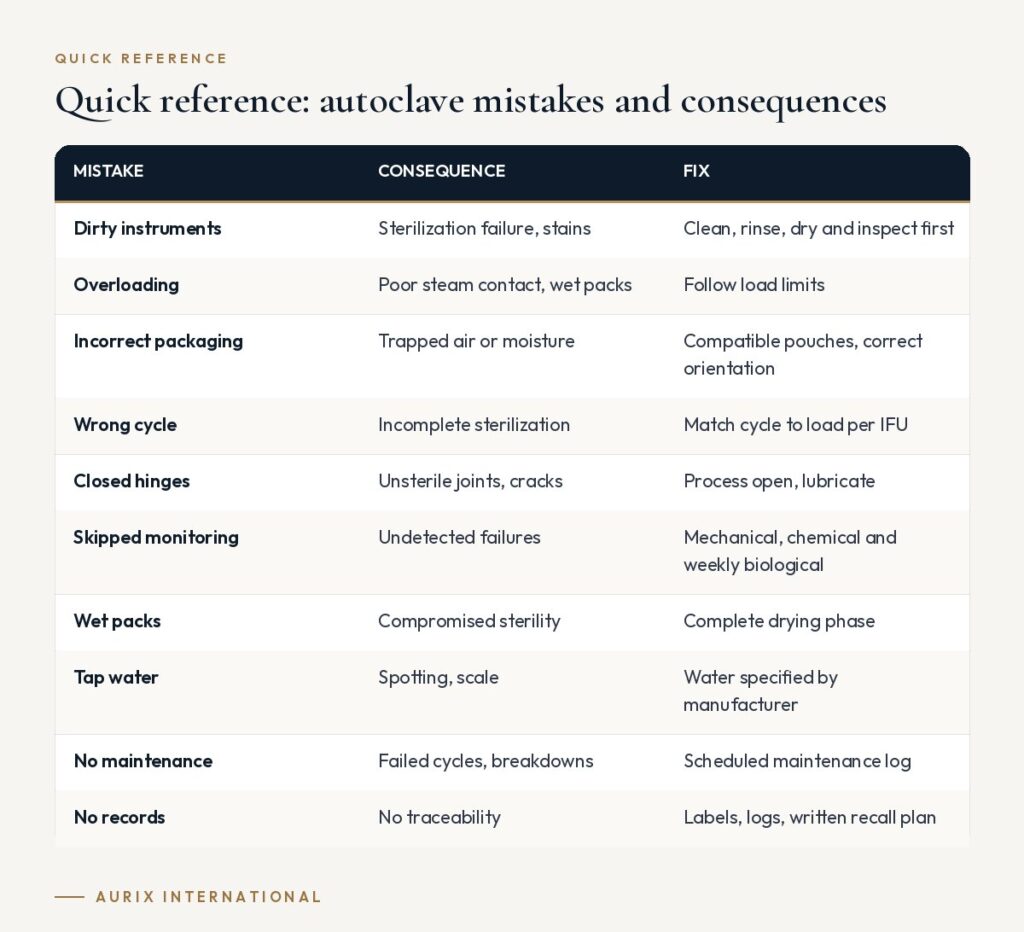
Quick reference: autoclave mistakes and consequences
| Mistake | Consequence | Fix |
|---|---|---|
| Dirty instruments | Sterilization failure, stains | Clean, rinse, dry and inspect first |
| Overloading | Poor steam contact, wet packs | Follow load limits |
| Incorrect packaging | Trapped air or moisture | Compatible pouches, correct orientation |
| Wrong cycle | Incomplete sterilization | Match cycle to load per IFU |
| Closed hinges | Unsterile joints, cracks | Process open, lubricate |
| Skipped monitoring | Undetected failures | Mechanical, chemical and weekly biological |
| Wet packs | Compromised sterility | Complete drying phase |
| Tap water | Spotting, scale | Water specified by manufacturer |
| No maintenance | Failed cycles, breakdowns | Scheduled maintenance log |
| No records | No traceability | Labels, logs, written recall plan |
How to choose instruments and supplies that perform well in the autoclave
- Ask for validated reprocessing instructions: the IFU should state compatible sterilization methods and parameters.
- Choose quality stainless steel: well-hardened, passivated instruments withstand repeated steam cycles with less staining.
- Use cassettes sized for your chamber: measure your chamber before ordering cassettes and racks.
- Keep spare sets: enough duplicates reduce pressure to overload or cut cycles short.
- Standardize pouches: a few correct sizes on hand make proper packaging easier.
For an official overview, see the CDC’s best practices for sterilization in dental settings.
Frequently asked questions
Why do my autoclave packs come out wet?
Common causes include overloading, laying pouches flat or stacked, opening the door before the drying phase ends, incorrect packaging and maintenance problems. In addition, review the sterilizer IFU and contact the manufacturer if the issue persists.
Can I use tap water in my autoclave?
Check your sterilizer’s IFU. Many manufacturers specify distilled or demineralized water because minerals in tap water cause deposits and spotting.
What should I do if a spore test fails?
Follow your written protocol and the manufacturer’s guidance. Generally, typically the sterilizer is taken out of service, loading and operation are reviewed, the test is repeated, and items from suspect loads may need to be recalled and reprocessed.
Instruments that stand up to repeated cycles. Aurix International supplies surgical-grade stainless steel dental instruments, individually or in pre-assembled and custom kits. Contact Aurix →