The right dental suturing instruments make the difference between a quick, tension-free closure and a frustrating few minutes chasing a slipping needle. Whether you are closing an extraction socket, a periodontal flap or an implant incision, the same small group of instruments does most of the work. This guide walks through the ten suturing instruments clinicians reach for most often, what each one does and how to pick the right pattern for your procedures.
Key takeaways
- A basic suturing setup is a needle holder, tissue forceps, suture scissors and a retractor; everything else refines that core.
- Match the needle holder jaw to the suture size: standard jaws for 3-0 and 4-0, fine or Castroviejo jaws for 5-0 and smaller.
- Keep suture-cutting scissors separate from tissue scissors so the tissue blades stay sharp.
- Toothed tissue forceps hold flaps securely with less crushing than smooth forceps.
- Clean, inspect and lubricate hinged instruments according to the manufacturer’s instructions for use (IFU).
The top 10 dental suturing instruments
1. Mayo-Hegar needle holder
The Mayo-Hegar is the workhorse needle holder in most dental and oral surgery trays. It has a ratchet lock, ring handles and short, strong jaws with a crosshatched (often tungsten carbide) insert that grips curved needles without twisting.
It suits most intraoral closures with 3-0 and 4-0 sutures. Lengths around 5 to 6 inches are common for dental work; a longer pattern helps when reaching posterior sites.
Tip: grasp the needle about one-third to one-half of the way back from the swaged end. Gripping right at the swage can bend or break the needle.
2. Castroviejo needle holder
The Castroviejo is a spring-handled, pencil-grip needle holder with a lock and fine, narrow jaws. It gives excellent fingertip control and rotation, which is why periodontists and implant surgeons use it for microsurgical and papilla closures.
It is designed for fine sutures, typically 5-0 to 7-0. Using it with heavy sutures and large needles will damage the delicate jaws.
3. Olsen-Hegar needle holder
The Olsen-Hegar combines a needle holder and suture scissors in one instrument: the jaws hold the needle, and a cutting edge just behind them trims the suture. It reduces instrument changes when you are working without an assistant.
The trade-off is that you can accidentally cut the suture while tying if you hold the instrument carelessly, so it takes a little practice.
4. Adson tissue forceps
Adson forceps are short tissue forceps with a broad, flat thumb area and narrow tips. The 1×2 toothed version (one tooth on one side, two on the other) holds gingival and mucosal flaps securely while you pass the needle.
Serrated (non-toothed) Adson forceps are useful for handling sutures and membranes, but toothed tips are usually kinder to soft tissue because they hold with less squeezing pressure.
5. Fine tissue pliers (Gerald, Semken or micro forceps)
For delicate tissue and fine sutures, slimmer forceps such as Gerald or micro tissue pliers give better visibility and precision than Adson forceps. Semken forceps are a slightly heavier option with serrated tips, good for general tissue and suture handling.
Many periodontal and implant trays carry one standard and one fine tissue forceps so the operator can switch to suit the site.
6. Goldman-Fox scissors
Goldman-Fox scissors have a short, curved, often serrated blade and are used for trimming tissue tags and flap margins. They are a staple of periodontal and oral surgery trays.
Because they are tissue scissors, avoid using them routinely to cut sutures; doing so dulls the edge faster.
7. Dean or general suture scissors
Dean scissors have angled handles and serrated, curved blades that reach the mouth comfortably and cut suture material cleanly. Straight or curved operating scissors in a short length serve the same purpose.
Tip: when cutting, leave tails long enough to keep the knot secure and to make suture removal easy, typically a few millimeters.
8. Suture removal scissors (Spencer or Littauer)
Stitch scissors such as Spencer or Littauer patterns have a small hooked or notched tip on one blade. The hook slides under the suture loop so it can be cut without lifting or tearing healing tissue.
They are worth keeping in the hygiene or post-op tray where suture removal visits are handled.
9. Minnesota retractor
A Minnesota retractor holds the cheek and tongue away and protects the flap while you suture. Clear access is half the battle in posterior closures, and an assistant with a good retractor speeds the whole process.
Seldin or Weider retractors can be used instead depending on the site and the operator’s preference.
10. Mosquito hemostat
A small curved or straight mosquito hemostat is handy for holding suture ends, retrieving a dropped needle, grasping small tissue tags or securing a suture while a second throw is placed.
It should not be used as a substitute for a needle holder: hemostat jaws are not designed to hold curved needles and can crush or flatten them.
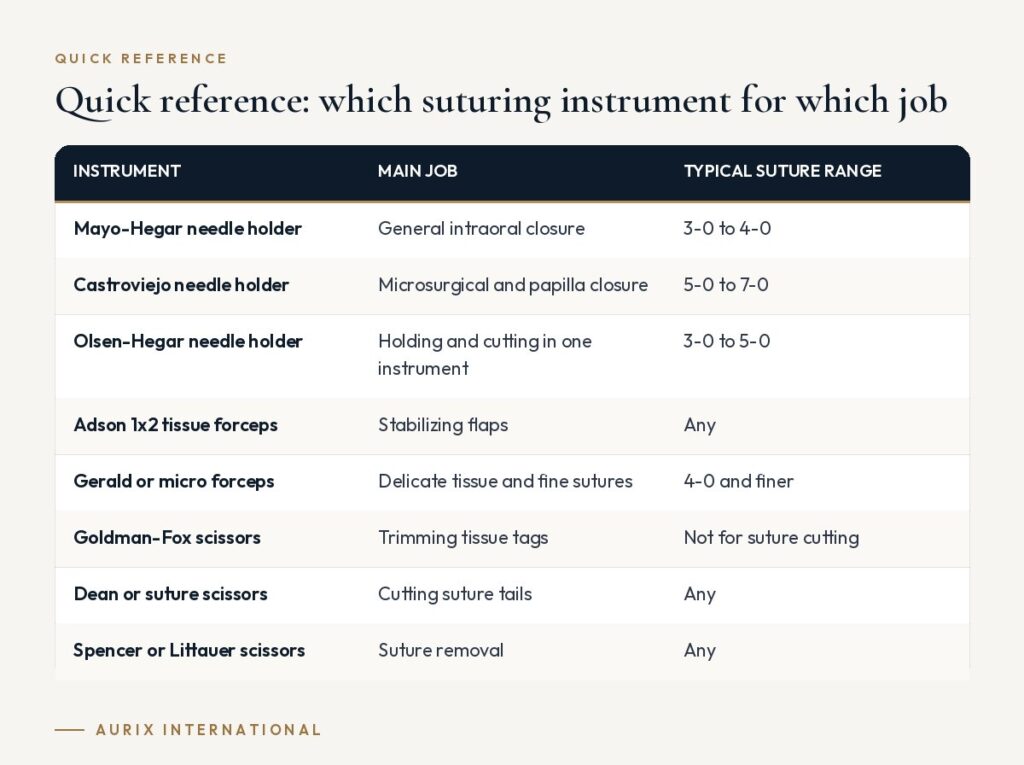
Quick reference: which suturing instrument for which job
| Instrument | Main job | Typical suture range |
|---|---|---|
| Mayo-Hegar needle holder | General intraoral closure | 3-0 to 4-0 |
| Castroviejo needle holder | Microsurgical and papilla closure | 5-0 to 7-0 |
| Olsen-Hegar needle holder | Used when holding and cutting in one instrument | 3-0 to 5-0 |
| Adson 1×2 tissue forceps | Stabilizing flaps | Any |
| Gerald or micro forceps | Delicate tissue and fine sutures | 4-0 and finer |
| Goldman-Fox scissors | Trimming tissue tags | Not for suture cutting |
| Dean or suture scissors | Cutting suture tails | Any |
| Spencer or Littauer scissors | Suture removal | Any |
How to choose dental suturing instruments
- Start with your procedures. A general practice doing routine extractions needs a reliable Mayo-Hegar, Adson forceps and suture scissors. Periodontal and implant work adds a Castroviejo and fine tissue forceps.
- Check the jaws. Tungsten carbide inserts grip better and can often be replaced when worn, extending the instrument’s life. Jaws should close evenly with no light showing between them.
- Test the ratchet. The lock should engage and release smoothly in each position without springing open under light pressure.
- Consider length and grip. Ring-handled holders suit most users; pencil-grip Castroviejo patterns suit fine work. Try both if you can.
- Keep a dedicated set. Grouping suturing instruments in one cassette or pouch saves time. Our guide to building a dental suturing kit covers a full setup, and you can compare holder patterns in Mayo-Hegar, Castroviejo and Crile-Wood needle holders.
Care matters as much as choice. Clean hinged instruments promptly, process them open or unlocked, and lubricate box joints with an instrument lubricant compatible with your sterilizer, as directed in the IFU. For more detail on scissor patterns, see surgical scissors for dentistry.
Frequently asked questions
What is the most important dental suturing instrument?
The needle holder. A well-made Mayo-Hegar handles most routine intraoral closures, and a Castroviejo adds precision for fine sutures. Pair either with toothed tissue forceps and suture scissors.
Can I use a hemostat instead of a needle holder?
It is not recommended. Hemostat jaws have different serrations and are designed to clamp tissue, not hold curved needles. They can bend or flatten the needle and give poor control.
Why do needle holders have tungsten carbide inserts?
Tungsten carbide is harder than stainless steel, so the crosshatched jaw pattern grips the needle firmly and wears more slowly. Many holders with carbide inserts are identified by gold-colored handles.
How often should suturing instruments be replaced?
There is no fixed interval. Replace or repair them when jaws no longer hold a needle firmly, the ratchet slips, scissors fold or chew suture material, or there is corrosion or cracking at the box joint.
Put your suturing instruments in one ready-to-go tray. Aurix International supplies surgical-grade stainless steel needle holders, tissue forceps and scissors, and lets you combine them into a custom kit for your procedures. Build a custom suturing kit →