
Strong growth does not mean the Gracey curette market is free of problems. Buyers face a crowded field of products with uneven quality, aggressive pricing and confusing claims. Manufacturers face competition from ultrasonic technology and pressure on margins. Understanding these challenges helps you buy smarter.
Key takeaways
- Quality varies significantly between manufacturers.
- Low prices can hide soft steel, poor finishing and short lifespan.
- Sharpening skill and time remain a hidden cost.
- Ultrasonic scalers complement rather than replace Graceys.

1. Uneven quality
A 2022 scanning electron microscope study from Mahidol University compared standard and modified Gracey curettes from several manufacturers and reported unacceptable toe shapes from some and smooth blades on all surfaces from only a few. Poor toes and rough blades affect adaptation, tissue trauma and calculus removal. See quality evidence.
2. Price pressure
Low-cost imports and online marketplaces have pushed prices down. Some savings are genuine; others come from softer steel, skipped passivation or minimal inspection. The result can be curettes that blunt quickly and need replacing far sooner.
3. Counterfeits and misleading claims
Instruments marketed with copied images, vague “German steel” claims or imitation branding make comparison difficult. See supplier red flags.
4. The sharpening burden
Curettes must be sharpened regularly. Sharpening takes time and skill, and incorrect technique changes blade shape and shortens life. Instruments with better edge retention reduce this burden. See sharpening guide.
5. Competition from ultrasonic scaling
Ultrasonic and piezoelectric scalers remove heavy calculus efficiently, and some practices use them for most debridement. However, hand instruments remain important for tactile root planing, fine deposits and sites where ultrasonic tips are less effective. See ultrasonic vs Gracey.
6. Ergonomic and workforce concerns
Hand fatigue and musculoskeletal problems among hygienists push demand toward lighter, wider handles — and away from poorly designed instruments.
7. Reprocessing damage
Poor water quality, chlorides and harsh detergents can stain and pit curettes, shortening their life regardless of initial quality.
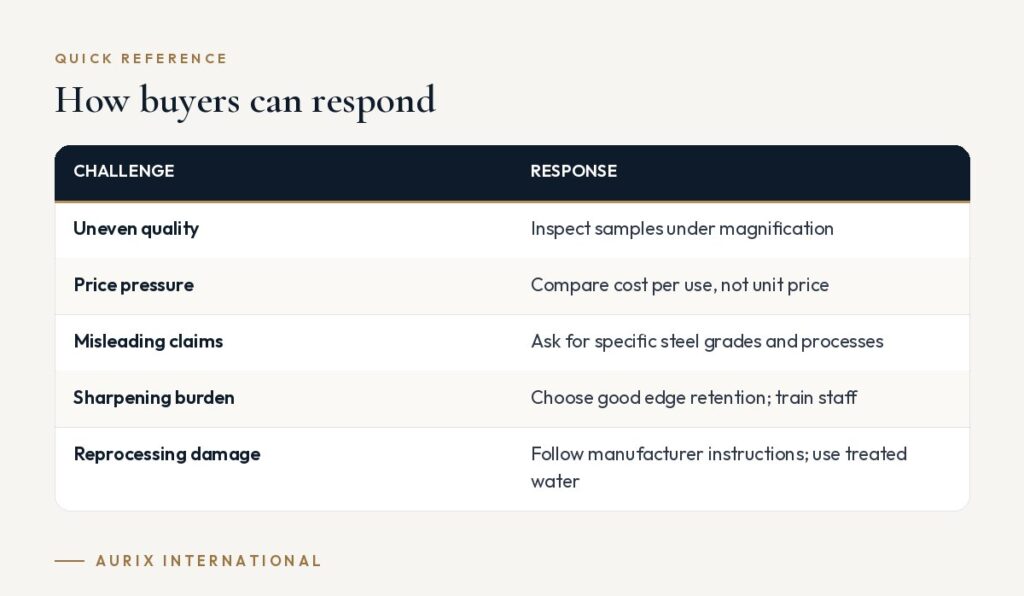
How buyers can respond
| Challenge | Response |
|---|---|
| Uneven quality | Inspect samples under magnification |
| Price pressure | Compare cost per use, not unit price |
| Misleading claims | Ask for specific steel grades and processes |
| Sharpening burden | Choose good edge retention; train staff |
| Reprocessing damage | Follow manufacturer instructions; use treated water |
A simple quality-control routine for clinics
- Inspect new curettes on arrival under magnification.
- Test edges on a test stick before first use.
- Track which patterns need sharpening most often.
- Remove thin, bent or stained curettes from service.
- Review supplier performance once a year.
How suppliers can help
Good suppliers reduce these challenges by publishing clear specifications, offering samples, keeping patterns consistent and providing reprocessing guidance. When evaluating suppliers, ask how they address each challenge above. You can request samples from our Gracey Curettes collection to see how they perform in your own reprocessing.
Frequently asked questions
Why do cheap curettes go dull so fast?
Often because of softer steel or inadequate heat treatment.
Is it worth buying premium curettes?
Judge by evidence: edge retention, finish and lifespan. Mid-priced instruments from careful manufacturers can perform very well.
Quality you can inspect. Request samples of Aurix Gracey curettes and test them yourself. View Gracey curettes →
Source: Mahidol University SEM study.