
The Gracey curette has kept its basic design for eight decades, yet the Gracey curette market is changing quickly. New blade and shank variants, ergonomic handles, implant-safe materials and new ways of buying are reshaping what clinics purchase and how. Here are eight trends to watch.
Key takeaways
- Mini/micro blades and titanium are the fastest-growing segments.
- Ergonomics is now a purchasing priority, not an extra.
- Kits, cassettes and online customisation are changing how sets are bought.
- Private label is expanding, especially in growth regions.
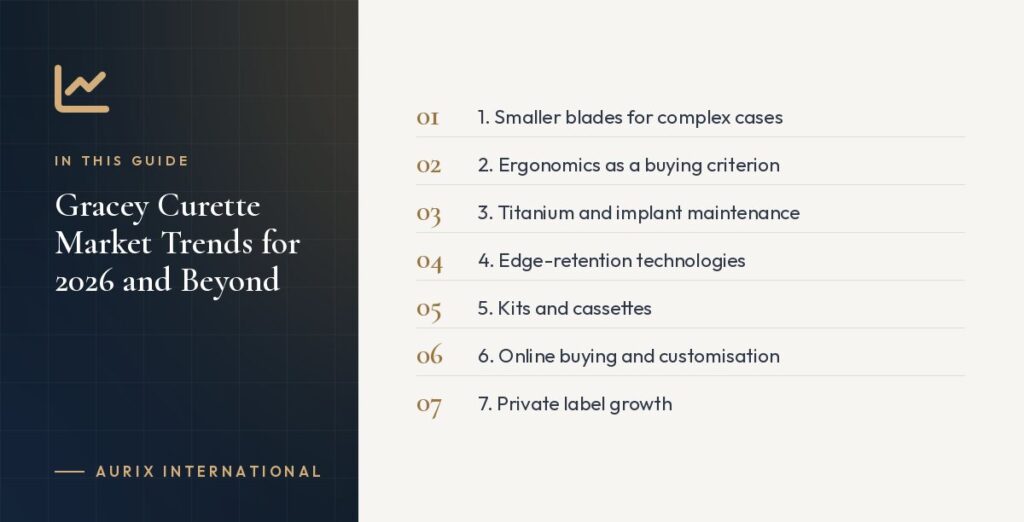
1. Smaller blades for complex cases
Mordor Intelligence projects micro/mini Gracey variants to grow around 10.95% a year through 2031. Clinicians increasingly treat deep, narrow pockets and furcations, where shorter blades on extended shanks adapt better.
2. Ergonomics as a buying criterion
Hygienists use curettes for hours a day. Wider, lighter, textured handles that reduce pinch force are becoming standard expectations. See ergonomics and hand fatigue.
3. Titanium and implant maintenance
With more implants placed every year, implant-safe curettes are growing. Titanium is projected to grow around 10.7% a year (Mordor Intelligence). See Gracey curettes and implant maintenance.
4. Edge-retention technologies
Manufacturers are investing in steel selection, heat treatment and surface treatments that keep blades sharp longer, reducing sharpening time.
5. Kits and cassettes
Clinics increasingly buy complete hygiene sets in cassettes rather than single instruments, improving consistency and infection control. See Gracey curette sets.
6. Online buying and customisation
Online suppliers and kit builders let clinics assemble custom sets and compare specifications easily — increasing price transparency and competition.
7. Private label growth
Distributors are launching branded Gracey ranges, especially in Asia-Pacific and other growth regions. See private label Gracey curettes.
8. Sustainability and longevity
Durable, resharpenable stainless instruments and efficient reprocessing appeal to clinics looking to reduce waste. See sustainability in the Gracey curette market.
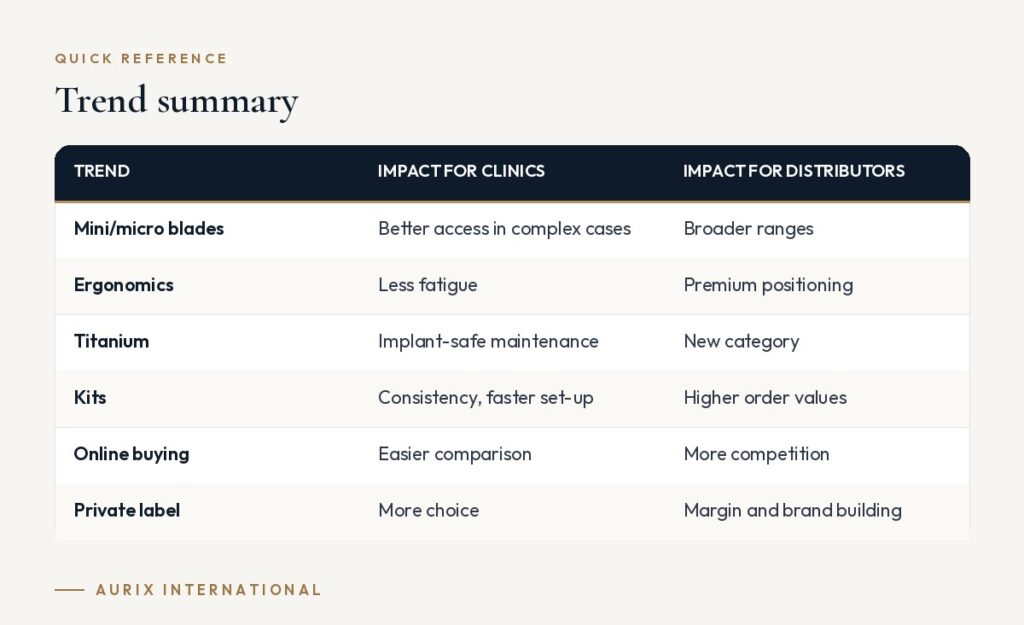
Trend summary
| Trend | Impact for clinics | Impact for distributors |
|---|---|---|
| Mini/micro blades | Better access in complex cases | Broader ranges |
| Ergonomics | Less fatigue | Premium positioning |
| Titanium | Implant-safe maintenance | New category |
| Kits | Consistency, faster set-up | Higher order values |
| Online buying | Easier comparison | More competition |
| Private label | More choice | Margin and brand building |
What the trends mean for your next order
- Review whether your sets include mini or extended patterns for complex cases.
- Ask hygienists about handle comfort and consider ergonomic upgrades.
- Add implant-safe curettes if you maintain implants.
- Consider moving from loose curettes to sets in cassettes.
- Use online tools to compare specifications and build custom sets.
Trends to treat with caution
Not every new feature is worth paying for. Coatings, novel handle materials and colour systems can add value, but they should be judged on evidence: does the edge last longer, does the handle survive sterilisation, does the colour stay legible? Test samples before switching a whole practice. A good starting point is to compare current designs in our Gracey curettes range with what you already use.
Frequently asked questions
What is the biggest trend in Gracey curettes?
Growth in specialised mini/micro blades and ergonomic designs.
Are coated curettes better?
Coatings can help, but steel quality and heat treatment matter most. Test before switching.
Stay ahead of the trends. Explore Gracey curettes and custom hygiene kits from Aurix. Shop now →
Source: Mordor Intelligence.