Buying instruments one by one and assembling trays in-house takes time and creates inconsistency between rooms and clinicians. A modern dental instruments supplier should be able to build kits to your specification — and the best make it easy with an online kit builder. This guide explains why custom kits matter, how kit builders work and how to design a kit that genuinely speeds up your day.
Key takeaways
- Custom kits combine your preferred patterns with kit organisation.
- Arrange instruments in order of use in a cassette.
- Look for a large searchable catalogue, visual layout and fast quotes.
- Save configurations so every reorder is identical.
What a custom kit is
A custom kit is a set of instruments you choose, arranged in a cassette in the order you use them, supplied ready for reprocessing and use. It sits between a supplier’s standard kits and buying instruments individually.
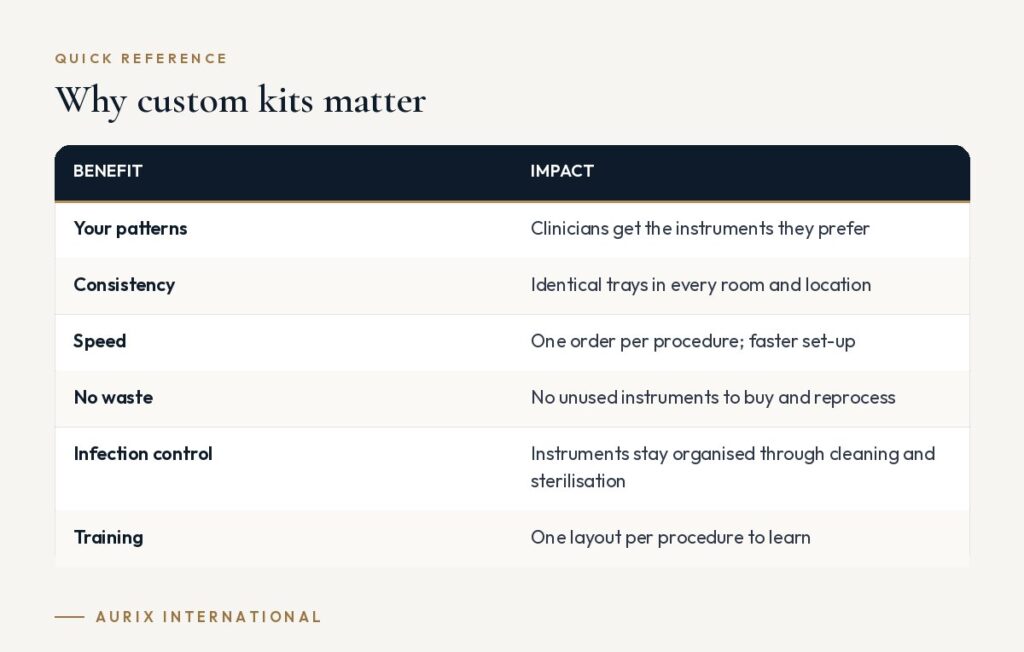
Why custom kits matter
| Benefit | Impact |
|---|---|
| Your patterns | Clinicians get the instruments they prefer |
| Consistency | Identical trays in every room and location |
| Speed | One order per procedure; faster set-up |
| No waste | No unused instruments to buy and reprocess |
| Infection control | Instruments stay organised through cleaning and sterilisation |
| Training | One layout per procedure to learn |
How online kit builders work
- Search the supplier’s catalogue by instrument name, pattern or category.
- Add instruments to a virtual tray.
- Arrange the layout by drag and drop.
- Submit for a quote and confirm quantities.
- Reorder the same configuration whenever you need more kits.
The Aurix kit builder lets you search over 500 instruments, drag and drop your layout and receive a quote, typically within 48 hours. See how to use the kit builder.
Designing a kit that works
- Map each step of the procedure and the instruments used at each step.
- Remove instruments that are never used.
- Choose specific patterns (for example Molt No. 9, Minnesota, Crile-Wood).
- Arrange in order of use, with fine instruments protected and hinged instruments able to stay open.
- Choose a cassette that fits your autoclave and ultrasonic basket.
- Pilot the kit for a few weeks, then standardise.
More detail in designing a custom tray.
Custom kits by setting
- General practice: extraction, restorative and hygiene kits with preferred patterns.
- Specialists: deeper surgical, periodontal or orthodontic kits.
- Schools: identical student kits by year group.
- Outreach: compact combined kits.
- Distributors: branded kit ranges for resale.
What to look for in a kit-building supplier
| Feature | Why it helps |
|---|---|
| Large searchable catalogue | Find exact patterns |
| Visual layout | See the tray before ordering |
| Fast quotes | Plan budgets quickly |
| Saved configurations | Identical reorders |
| Branding options | Groups, schools and distributors |
| Cassette choice | Fit your equipment |
Example
A four-chair practice used to assemble extraction trays from drawers, with each assistant laying them out differently. After designing one custom extraction kit online — luxators, Bein and Cryer elevators, six forceps patterns, Molt periosteal, Minnesota retractor, curette and haemostat in a single cassette — set-up time fell and missing-instrument interruptions stopped.
Frequently asked questions
Are custom kits more expensive than standard kits?
Not necessarily. You pay for what you choose, without unused instruments.
Can I change a kit later?
Yes. Update the configuration and future orders follow the new layout.
What is the minimum order for a custom kit?
It varies by supplier; ask when requesting a quote.
Next steps
Start building in the kit builder, browse standard kits in the Oral collection, or compare suppliers in our top 10 US guide.