Professional buyers increasingly need documentation as well as instruments. Distributors, hospitals, groups and schools may be asked by auditors, procurement teams or regulators to show where instruments come from and how they should be reprocessed. A reliable dental instruments supplier should be able to explain which documents apply and provide them promptly. This guide summarises the essentials for 2026, with a US focus. It is general information, not legal or regulatory advice.
Key takeaways
- Dental hand instruments are FDA Class I devices under 21 CFR 872.4565; many are 510(k) exempt with limitations.
- Establishments generally register and list devices with the FDA; foreign manufacturers need a US agent.
- The FDA’s QMSR, effective February 2, 2026, incorporates ISO 13485:2016.
- Reprocessing instructions are the documents your team uses every day.
US regulatory basics for dental hand instruments
Classification
Under 21 CFR 872.4565, dental hand instruments are Class I devices. The FDA classification database lists many product codes under this regulation — for example periodontic probes and operative explorers — as 510(k) exempt, subject to the limitations in 21 CFR 872.9. Always confirm the status of a specific product code.
Registration and listing
Establishments involved in producing and distributing devices for the US generally must register annually with the FDA and list their devices. Foreign establishments must register before exporting to the US for the first time and designate a US agent. Initial importers must also register. Registration is renewed annually and carries a user fee.
Quality systems: QMSR and ISO 13485
The FDA’s Quality Management System Regulation took effect on February 2, 2026. It amends 21 CFR Part 820 by incorporating ISO 13485:2016 by reference. ISO 13485 certification is not required by the QMSR, and FDA-specific obligations such as labelling, UDI and registration still apply — but alignment with ISO 13485 is now the baseline expectation for device manufacturers.
Material and manufacturing standards
- ISO 7153-1:2016 specifies metals commonly used for surgical instruments, including those used in dentistry.
- ASTM A967 describes chemical passivation treatments (nitric acid, citric acid, electrochemical) for stainless steel parts.
Suppliers do not have to cite these standards by name, but being able to discuss them is a sign of genuine expertise.
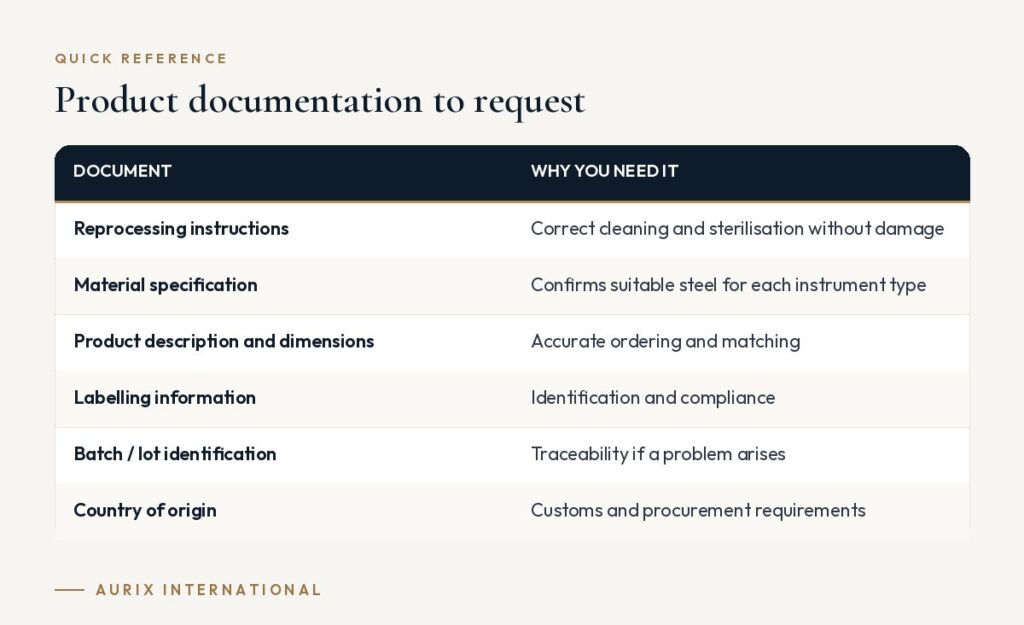
Product documentation to request
| Document | Why you need it |
|---|---|
| Reprocessing instructions | Correct cleaning and sterilisation without damage |
| Material specification | Confirms suitable steel for each instrument type |
| Product description and dimensions | Accurate ordering and matching |
| Labelling information | Identification and compliance |
| Batch / lot identification | Traceability if a problem arises |
| Country of origin | Customs and procurement requirements |
Infection-control context
CDC guidance for dental settings classifies instruments that penetrate soft tissue or bone (for example forceps, scalpels, scalers and surgical burs) as critical items to be sterilised after each use, and items that contact oral tissues without penetrating (for example mirrors and amalgam condensers) as semicritical, normally heat-sterilised. Reprocessing instructions from the supplier support compliance with these practices.
Documentation needs by buyer type
| Buyer | Typical needs |
|---|---|
| Clinic | Reprocessing instructions, invoices, warranty |
| Group / DSO / hospital | Plus procurement forms, supplier details, traceability |
| School | Plus teaching materials and central sterilisation protocols |
| Distributor / importer | Plus registration and listing details, labelling data, country of origin, quality system evidence |
How to verify what you are told
- Ask for the manufacturer’s name and the registration details that apply.
- Check them in the FDA’s public establishment registration and device listing database.
- Confirm the product code and exemption status in the FDA classification database.
- For ISO 13485 claims, ask for the certificate and check the issuing body and scope.
Keeping records
Keep quotes, invoices, warranties, reprocessing instructions and any certificates organised by supplier. Good records simplify audits, warranty claims and reordering.
Reprocessing instructions in practice
Of all the documents a dental instruments supplier can provide, reprocessing instructions are the most used day to day. They tell your team how to clean, dry, lubricate, package and sterilise each instrument without damaging it. Keep them accessible in the sterilisation area and include them in staff training. Our guides on autoclave cycles and ultrasonic cleaning complement manufacturers’ instructions.
Documentation for distributors
Distributors usually need more: product data for catalogues, labelling information, country-of-origin details and support with regulatory obligations in their markets. Establish early which documents your supplier can provide, and allow time for preparing anything additional before launch.
Frequently asked questions
Do clinics need certificates for every instrument?
Usually not, but reprocessing instructions and clear labelling are important. Larger organisations may have specific procurement requirements.
Does a supplier need ISO 13485 certification?
Not by law under the QMSR, but certification at the manufacturing level is a strong signal of a mature quality system.
Are dental hand instruments 510(k) exempt?
Many are, under 21 CFR 872.4565 subject to limitations in 872.9. Confirm per product code.
Next steps
Ask Aurix for documentation on any product: contact our team. See also importing dental instruments into the USA and our top 10 US supplier guide.