
Few clinicians are as particular about instruments as periodontists and hygienists — and with good reason. They use curettes and scalers for hours every day, and small differences in balance, handle diameter, blade geometry and edge retention affect clinical results and their own long-term musculoskeletal health. Choosing a dental instruments supplier for periodontics and hygiene means looking closely at details most buyers never consider.
Key takeaways
- Check the full Gracey range, including extended-shank and mini patterns.
- Edge retention and consistent blade geometry reduce sharpening time.
- Wider, lighter, textured handles reduce pinch force.
- Let hygienists test samples before switching suppliers.
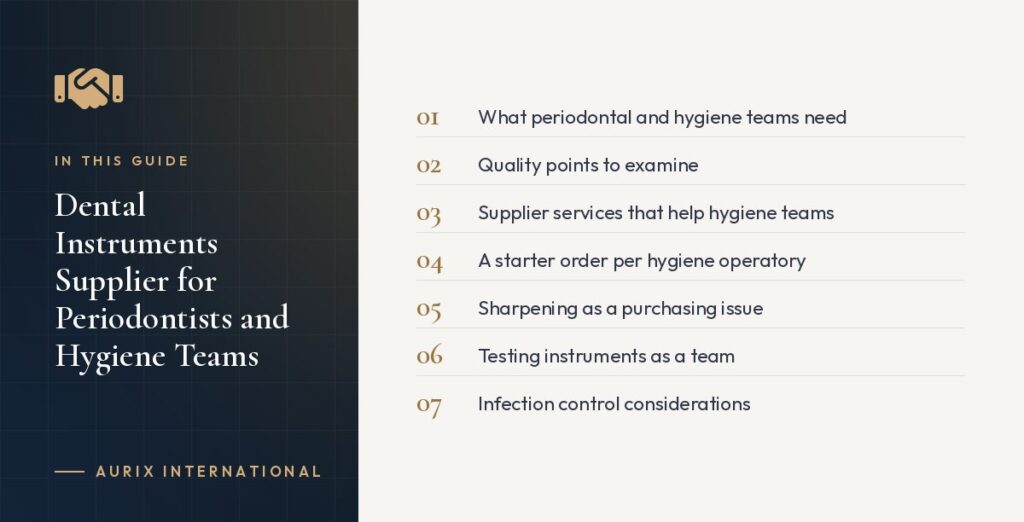
What periodontal and hygiene teams need
| Category | Instruments |
|---|---|
| Assessment | Williams, UNC-15, WHO and Nabers probes; 11/12 explorers; front-surface mirrors |
| Scaling | Anterior and posterior sickle scalers, Jacquettes |
| Root planing | Universal curettes; Graceys 1/2 to 17/18, including extended-shank and mini blades |
| Surgery | Fine periosteal elevators, Goldman-Fox and La Grange scissors, Castroviejo needle holders, fine tissue forceps |
| Maintenance | Sharpening stones, test sticks, guides |
Quality points to examine
Edge retention
Harder stainless grades hold an edge longer, reducing sharpening frequency and the strokes needed per appointment. Ask what grade is used for curettes and scalers and how instruments are heat-treated.
Blade geometry
Gracey blades should have the correct offset (around 70° to the terminal shank) and a consistent shape across the range, so sharpening is predictable and adaptation reliable.
Handle ergonomics
Thin handles require a tighter pinch grip. Many ergonomic recommendations favour handles of roughly 9–10 mm or wider, lighter weight and textured grips for periodontal instruments. See ergonomics and hand fatigue.
Probe accuracy and durability
Markings must be accurate and remain legible through repeated sterilisation; tips must stay straight and the correct diameter.
Tactile sensitivity
Hollow handles and well-balanced explorers transmit vibrations better, helping detect subgingival calculus.
Supplier services that help hygiene teams
- Pre-assembled hygiene and periodontal kits in cassettes.
- Custom kits for each hygienist’s preferences.
- Samples to test feel and balance.
- Sharpening guidance for their blade designs.
- Consistent patterns for replacements.
A starter order per hygiene operatory
| Instrument | Quantity |
|---|---|
| Mirror, probe, explorer sets | 4–6 |
| Sickle scalers (anterior and posterior) | 3 each |
| Universal curette | 3 |
| Graceys 5/6, 7/8, 11/12, 13/14 | 3 each |
| Spare curettes for sharpening rotation | 2–4 |
| Sharpening stone and test sticks | 1 set |
For a complete blueprint, see building a 17-piece periodontal kit.
Sharpening as a purchasing issue
Sharpening removes instruments from circulation and gradually thins blades. Teams that keep spare curettes never run short, and a supplier that explains the correct sharpening angles for its blades helps instruments last longer. Replace instruments when blades become thin or lose shape — a thin blade can fracture in a pocket. See sharpening curettes and scalers.
Testing instruments as a team
Give each hygienist sample curettes and scalers for a week of normal use, then compare notes on balance, comfort, edge retention and adaptation. Choosing instruments the team likes improves adoption and prevents worn favourites lingering in drawers.
Infection control considerations
Scalers and curettes are classed by CDC guidance as critical items because they can penetrate soft tissue, so they must be sterilised after each use. Choose instruments and cassettes that tolerate repeated steam sterilisation and follow the manufacturer’s reprocessing instructions.
Supporting periodontal surgery
Periodontists also need fine surgical instruments: delicate periosteal elevators, Goldman-Fox and La Grange scissors, Castroviejo needle holders and fine tissue forceps. Choosing a supplier who covers both hygiene and surgical instruments keeps patterns consistent across the practice. Compare options in our top 10 US supplier guide.
Frequently asked questions
How often should curettes be replaced?
When the blade becomes thin or loses its shape after sharpening — the frequency depends on use and sharpening technique.
Can I mix curettes from different suppliers?
You can, but consistent patterns make sharpening, adaptation and replacement easier.
Are coloured resin handles a good idea?
They are light and easy to identify, but check durability through repeated sterilisation.
Next steps
Aurix supplies Gracey curettes, scalers and periodontal kits. Request samples, build a hygiene kit in the kit builder, or compare suppliers in our top US suppliers guide.