Every website says “premium quality” and every catalogue looks professional. The way to find out whether a dental instruments supplier is right for you is to ask precise questions and listen carefully to the answers. Below are fifteen questions grouped into five areas, each with what a good answer and a warning-sign answer sound like, followed by a ten-minute due-diligence checklist and a scoring sheet.
Key takeaways
- Specific answers signal a capable supplier; vague answers signal risk.
- Ask about materials, inspection, compliance, terms and after-sales.
- Do basic due diligence on the business, not just the product.
- Score answers, then test samples from your top two.
Area 1: Materials and manufacturing
1. Which stainless steel grades do you use for which instruments?
Good answer: specific grades by instrument type — tougher grades for forceps and retractors, harder grades for curettes and scalers — with reference to recognised standards such as ISO 7153-1. Warning sign: “All our instruments are surgical grade” and nothing more.
2. How are instruments hardened, tempered and passivated?
Good answer: a clear description of heat treatment and passivation after finishing (for example to methods described in ASTM A967). Warning sign: the supplier does not know or will not say.
3. How is each instrument inspected before shipping?
Good answer: function checks on joints, tips and edges, plus visual inspection under magnification — ideally of every instrument. Warning sign: no defined process.
Area 2: Compliance and documentation
4. Who manufactures these instruments, and how are they registered with the FDA?
In the US, dental hand instruments are Class I devices under 21 CFR 872.4565, and establishments generally must register and list devices. Good answer: the manufacturer’s identity and how registration and listing apply, so you can verify them in FDA databases. Warning sign: evasion.
5. Do you provide reprocessing instructions for every product?
Your team needs manufacturer instructions to clean and sterilise instruments correctly. Good answer: yes, available on request or with every shipment.
6. How do you identify batches for traceability?
Good answer: batch or lot identification on packaging or records, so issues can be traced.
Area 3: Range and customisation
7. Which instrument categories do you cover?
Check extraction, surgical, periodontal, restorative, endodontic and orthodontic coverage against your procedures.
8. Do you offer pre-assembled and custom kits?
Good answer: yes, with a defined process — ideally an online kit builder and a quick quote.
9. Can you add our branding or laser marking?
Essential for distributors; useful for schools and groups.
Area 4: Commercial terms
10. What are your pricing tiers for volume or wholesale?
11. What payment terms apply to standard and bulk orders?
12. What are typical lead times for in-stock, custom and branded items?
Good answer: separate, realistic estimates for each order type, confirmed in writing for time-critical orders.
Area 5: After-sales
13. What does your warranty cover, and how are claims handled?
Good answer: clear coverage of manufacturing defects and a simple claims process.
14. Can you match the same patterns when we reorder in a year or two?
15. Who will be our point of contact?
A named person or responsive team makes problems far easier to solve.
Reading between the lines
- Speed: a supplier slow to answer pre-sales questions will not be faster after the sale.
- Specificity: details are a sign of knowledge; superlatives are not.
- Honesty about limits: good suppliers tell you when an instrument is wrong for your use or a lead time is long.
- Willingness to write it down: quotes, terms and warranties should be documented.
Ten-minute due diligence on the business
- Is there a physical business address and phone number?
- Are shipping, returns, warranty and privacy policies published?
- How long has the business operated?
- Are there independent mentions of the company?
- For US suppliers of imported instruments, can registrations be verified in FDA public databases?
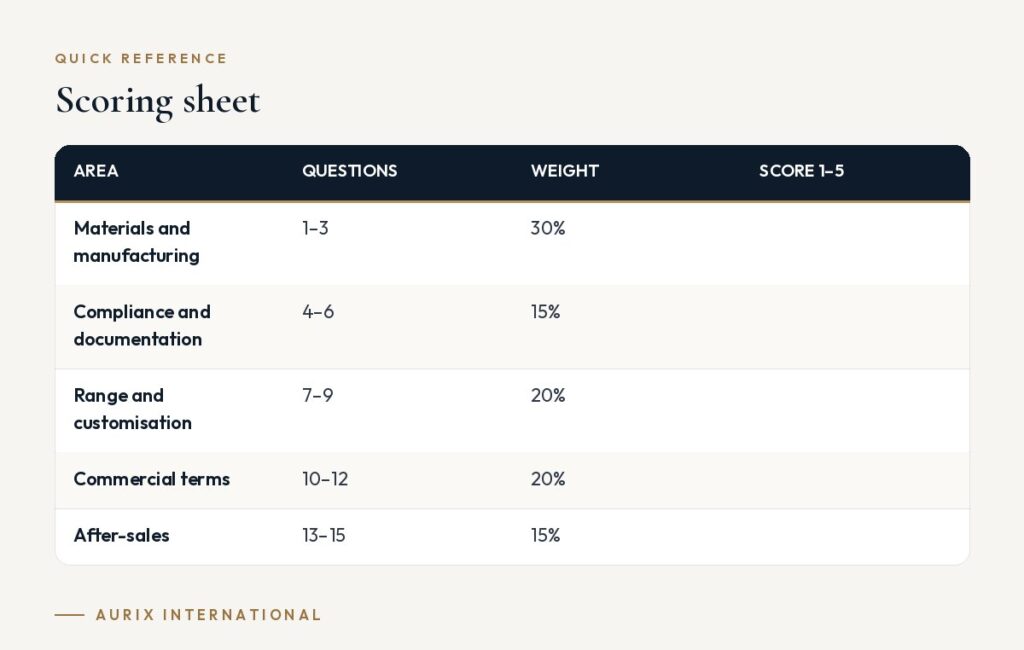
Scoring sheet
| Area | Questions | Weight | Score 1–5 |
|---|---|---|---|
| Materials and manufacturing | 1–3 | 30% | |
| Compliance and documentation | 4–6 | 15% | |
| Range and customisation | 7–9 | 20% | |
| Commercial terms | 10–12 | 20% | |
| After-sales | 13–15 | 15% |
Then order samples from your top two and run them through your normal reprocessing for two to four weeks. See our sample testing protocol.
Using the questions as a team
Split the questions: clinicians take materials and range; the practice manager takes terms, compliance and after-sales. Bring scores together in one meeting so the decision reflects both clinical and business priorities.
Frequently asked questions
How many suppliers should I vet?
Three is usually enough to compare meaningfully without excessive work.
What if a supplier refuses to answer?
Treat silence as an answer. Vagueness before the sale rarely improves afterwards.
Should I ask for references?
Yes, especially for large or branded orders. Ask references about consistency and how problems were handled.
Next steps
Aurix welcomes these questions — ask our team. Compare established names in our top 10 US supplier guide, and read the complete buyer’s guide.