When comparing instruments, attention usually goes to the working end. But the handle determines how the instrument feels over a long day, how much fatigue it causes and how much tactile information reaches the fingers.
Solid stainless steel handles
- Pros: extremely durable, fully autoclavable, usually the least expensive.
- Cons: heavier, and thin solid handles require a tighter grip.
Hollow stainless steel handles
- Pros: lighter, and they transmit vibrations well, improving tactile sensitivity for explorers and curettes.
- Cons: slightly more expensive; can dent if dropped.
Resin and silicone handles
- Pros: light, wide and soft to grip, reducing pinch force; often colour-coded.
- Cons: may degrade over many sterilisation cycles; less tactile feedback.
Handle diameter
Research on hand-instrument ergonomics generally supports wider handles (around 9–10 mm or more) for reducing muscle load compared with thin ones. Wider handles let the hand relax instead of pinching.
Texture
Knurled or textured handles improve grip with wet gloves and reduce the force needed to control the instrument.
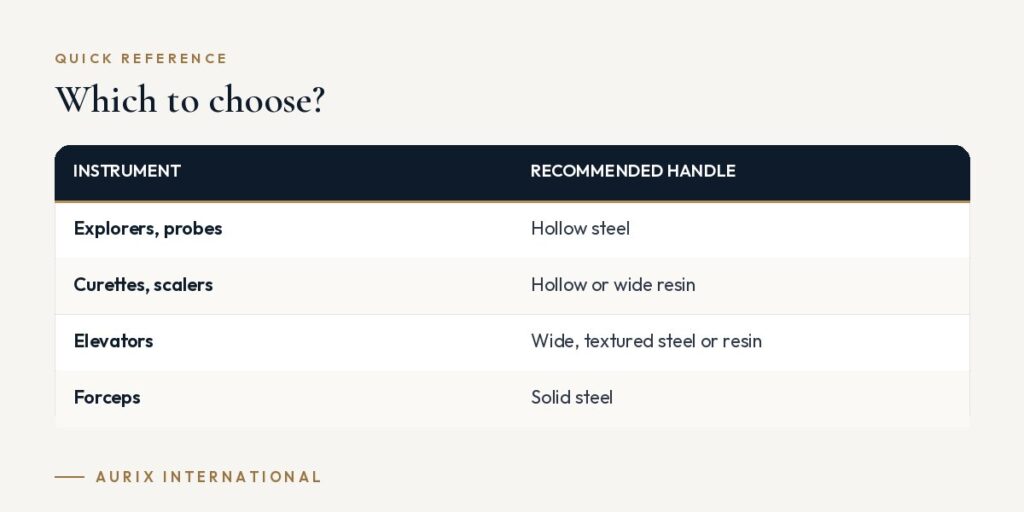
Which to choose?
| Instrument | Recommended handle |
|---|---|
| Explorers, probes | Hollow steel |
| Curettes, scalers | Hollow or wide resin |
| Elevators | Wide, textured steel or resin |
| Forceps | Solid steel |
Balance
A well-balanced instrument feels lighter than it is. Hold an instrument at the point you grip it; it should not feel heavy at either end.
Ask Aurix about handle options when ordering instruments or building a custom kit.