Every extraction is also the start of what happens next: a bridge, a denture or, increasingly, an implant. Preserving the socket walls during extraction keeps those options open. Atraumatic extraction is less about one special instrument and more about choosing tools that remove a tooth with minimal force.
The principles
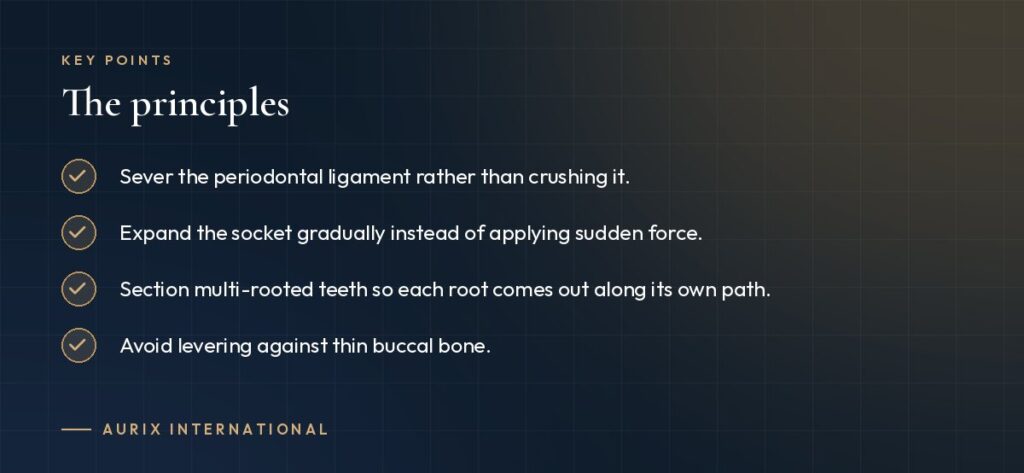
- Sever the periodontal ligament rather than crushing it.
- Expand the socket gradually instead of applying sudden force.
- Section multi-rooted teeth so each root comes out along its own path.
- Avoid levering against thin buccal bone.
Key instruments
Periotomes
Periotomes have extremely thin blades that are pushed into the PDL space to cut the fibres. They are especially useful for anterior teeth with thin buccal plates.
Luxating elevators
Luxators combine a thin cutting blade with enough strength to wedge the PDL space open. They are the core of most atraumatic kits.
Fine root elevators
Patterns such as the Heidbrink allow small root fragments to be teased out without removing extra bone.
Narrow-beak forceps
Once the tooth is mobile, narrow forceps grip far down the root and deliver it with a gentle rotation rather than a buccal rock.
Surgical burs and handpiece
For multi-rooted teeth, sectioning with a surgical bur allows each root to be removed separately.
A typical sequence
- Cut circumferential fibres with a periotome or sharp luxator.
- Luxate around the root with progressively wider blades.
- Section multi-rooted teeth if needed.
- Deliver with narrow forceps using rotation.
- Debride the socket gently with a surgical curette.
Instrument condition matters
Atraumatic technique relies on sharp blades. A blunt luxator crushes the ligament and forces you back to heavier leverage. Inspect fine blades monthly and replace them when they no longer hold an edge.
Explore the Aurix Atraumatic Luxation System or build your own tray in our custom kits service.