Generally, elevators do much of the real work in an extraction. Used well, they loosen a tooth before forceps are applied, reduce the force needed and lower the risk of root fracture. Also, used badly, they damage bone and neighbouring teeth. Choosing the right types is the first step to using them well.
What an elevator does
In general, an elevator is a lever. In addition, its blade is placed between the tooth and the bone or between roots, and rotation or gentle leverage expands the socket and tears the periodontal ligament fibres. The tooth gradually loosens until it can be lifted out or removed easily with forceps.
Main types of elevator
Straight elevators
Generally, straight elevators have a concave blade in line with the handle. Additionally, they are the most versatile type, used to begin luxation on almost any tooth. Common examples include the Coupland and the Bein patterns.
Angled (Cryer-type) elevators
Cryer elevators have a triangular, angled blade and come in left and right pairs. They are designed to engage an empty socket or the furcation and lift out a remaining root, especially on lower molars.
Pick and root-tip elevators
Fine, pointed elevators such as the Heidbrink pattern retrieve small root tips that remain at the bottom of a socket.
Luxating elevators
Luxators have thin, sharp blades that are pushed down the periodontal ligament space with a gentle rocking motion. Also, they are not designed for heavy leverage. See our separate guide to luxators vs elevators.
How to choose
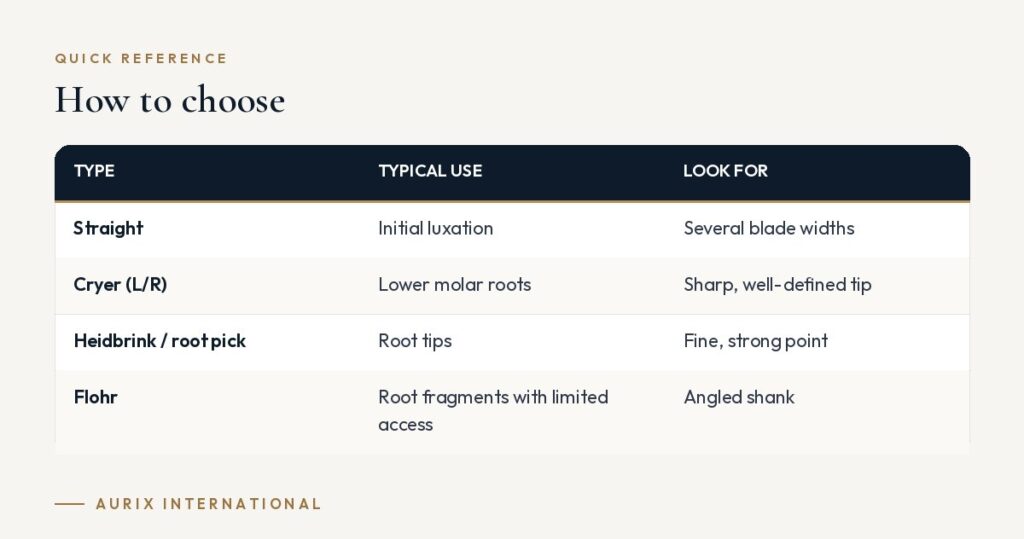
| Type | Typical use | Look for |
|---|---|---|
| Straight | Initial luxation | Several blade widths |
| Cryer (L/R) | Lower molar roots | Sharp, well-defined tip |
| Heidbrink / root pick | Root tips | Fine, strong point |
| Flohr | Root fragments with limited access | Angled shank |
Handle design
Elevators are held with the handle in the palm and the index finger along the shank as a guide. Pear-shaped or fluted handles give better rotational control than thin, straight ones. Resin handles are lighter; steel handles are more durable and fully autoclavable at high temperature.
Safety and care
- Always support the instrument with the other hand to prevent slipping.
- Never use a neighbouring tooth as a fulcrum unless it is also being extracted.
- Check blade edges regularly; a rounded tip slips more easily.
The Aurix Root Elevation Instrument Kit brings together Heidbrink, Bein, Flohr and Cryer elevators with periosteal elevators in one cassette.