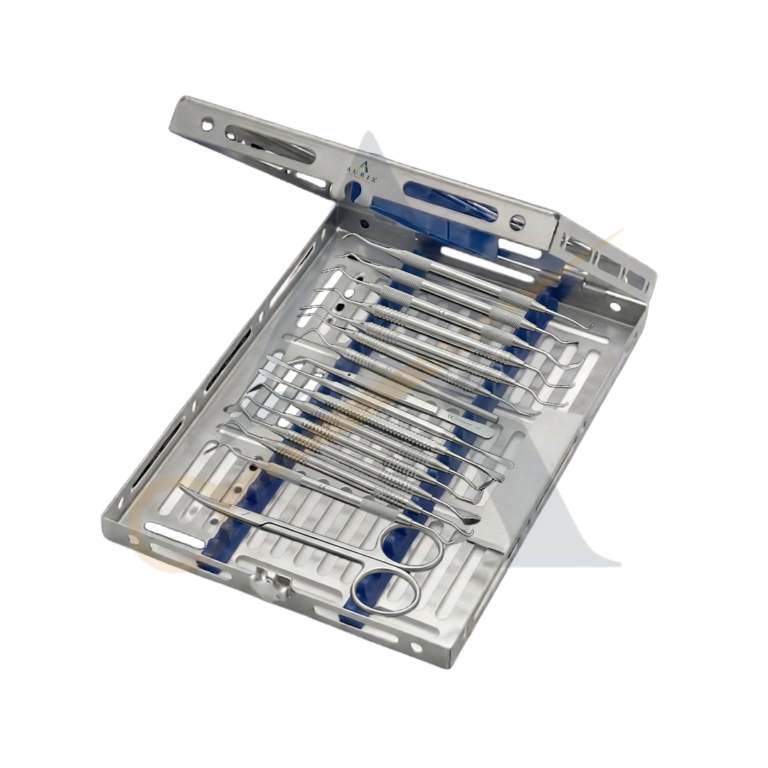
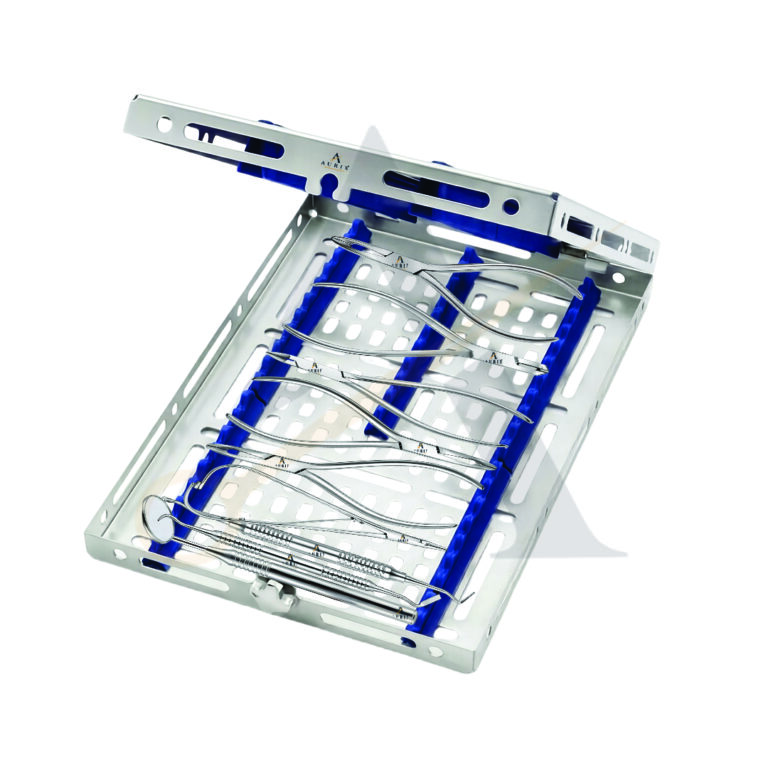
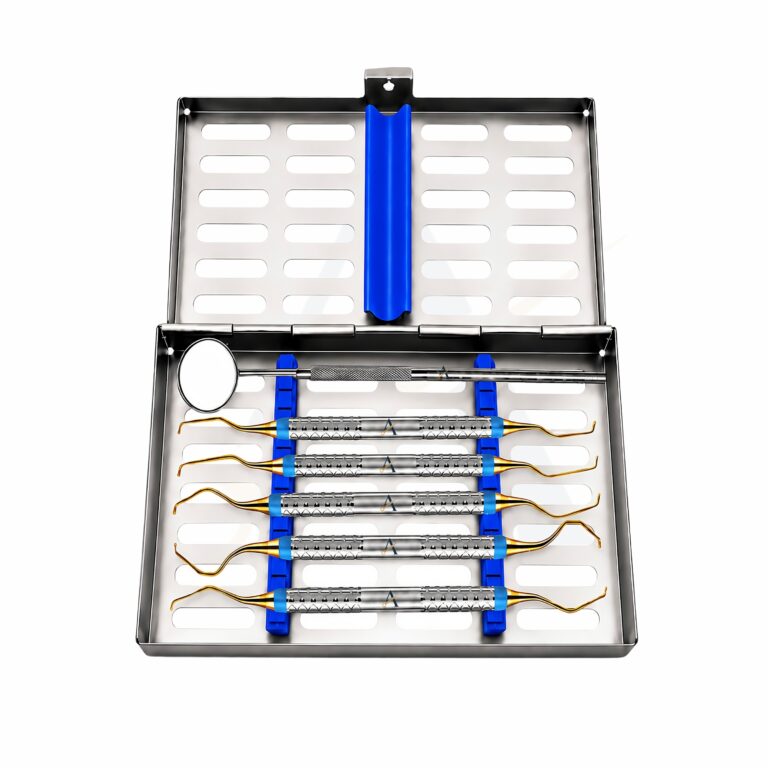
Every dental treatment starts with an examination, and every examination starts with the right diagnostic instruments. A mouth mirror, an explorer, a periodontal probe and a pair of tweezers may look basic. Yet these four tools decide how much a clinician can see, feel and measure. If any of them is worn or poorly made, small problems can go unnoticed. In this guide, we explain the essential dental diagnostic instruments, what each one does, and what to look for when you buy them.

The Basic Kit of Dental Diagnostic Instruments
Most dental schools teach the same core setup, often called the “basic set” or “exam kit”. It usually includes:
- A mouth mirror
- A dental explorer
- A periodontal probe
- College (cotton) tweezers
Many clinics prepare one of these kits for every patient. Therefore, buying in sets is often more cost-effective than buying single items.
1. Mouth Mirror
The mouth mirror has three jobs. First, it gives indirect vision of surfaces you cannot see directly, such as the lingual side of the upper teeth. Second, it reflects light into dark areas. Third, it retracts the cheek or tongue.
Mirrors come as plane (flat) surface or front-surface types. Front-surface mirrors give a sharper image with no “ghost” reflection, so many clinicians prefer them. Common head sizes are #4 and #5. Also, check that the mirror head screws firmly into the handle and that the handle has a good grip.
2. Dental Explorer
An explorer has a thin, sharp tip that sends tactile feedback to your fingers. In addition, clinicians use it to feel for calculus, rough restoration margins and irregular surfaces. Popular patterns include the shepherd’s hook (#23) and the pigtail or cowhorn explorer. Also, you can learn more in our dental explorer collection.
A good explorer tip should be fine and slightly flexible. If the tip is thick or blunt, it will not pick up small details.
3. Periodontal Probe
A periodontal probe measures the depth of the gum pocket around each tooth. Moreover, these readings are essential for gum health charting and treatment planning. Common designs include:
- Williams probe: Markings at 1, 2, 3, 5, 7, 8, 9 and 10 mm.
- UNC-15 probe: Markings at every millimetre up to 15 mm, often with colour bands.
- WHO/CPI probe: A ball tip and colour band, used for community screening.
Clear, permanent markings are critical. Faded or worn markings can lead to wrong readings, so replace probes when you can no longer read them easily.
4. College Tweezers
College tweezers carry cotton rolls, pellets and small items in and out of the mouth. Serrated tips give a secure grip, and locking versions stop items from dropping. Angled tips make access to posterior teeth easier.
Why Quality Dental Diagnostic Instruments Matter
Dental diagnostic instruments are used on almost every patient, every day. As a result, they go through more sterilization cycles than most other instruments. Here is what separates a quality set from a cheap one:
- Corrosion-resistant steel that does not rust or pit after hundreds of autoclave cycles.
- Precise tips that stay sharp and aligned.
- Laser-etched or deeply engraved markings on probes that do not wear off.
- Comfortable handles that reduce hand strain during long clinic days.
Moreover, consistent quality across a whole set builds patient trust. Patients notice clean, bright and well-kept instruments.
How to Care for Dental Diagnostic Instruments
- Rinse or place instruments in a holding solution right after use.
- Next, clean them in an ultrasonic cleaner or washer-disinfector.
- Then, inspect mirror surfaces for scratches and probes for faded markings.
- After that, dry fully and pack in pouches or cassettes.
- Finally, autoclave according to your clinic protocol.
Mirror heads are wear items, so keep spares in stock. In addition, rotate your kits so all sets get similar use.
Dental Diagnostic Instruments for Hygiene and Perio Care
After the exam, the next step is often cleaning. Therefore, many clinics pair their diagnostic kits with dental scalers and Gracey curettes. In fact, having both on the same tray makes hygiene appointments quicker.
Want to learn more about the background? Read this overview of dental instruments on Wikipedia. When you are ready to buy, our team will help you choose the right dental diagnostic instruments for your clinic.
Dental Diagnostic Instruments FAQs
How many exam kits does a clinic need?
A good rule is one kit per patient slot in a session, plus extras to cover sterilization time. For a busy clinic, that often means 15–30 kits.
Which periodontal probe is best?
It depends on your charting style. UNC-15 probes give the most detail, while Williams probes are quick and widely used.
Can Aurix supply complete exam kits?
Yes. We supply single instruments and complete sets, and we can add private labelling for distributors.
Furthermore, explore our full range of dental diagnostic instruments in our catalogue to equip your examination rooms.
Order Dental Diagnostic Instruments from Aurix International
Aurix International manufactures dental and surgical instruments in Sialkot, Pakistan, and supplies clinics, hospitals and distributors worldwide. We offer wholesale pricing, private labelling, custom kits and flexible order quantities. Need a mixed tray? Try our Medical Kit Builder, or contact us today for a fast quote.