Implant systems supply their own drills, drivers and torque wrenches. But a successful implant procedure also needs a set of surgical hand instruments for flap management, site preparation, grafting and closure. These are often overlooked when setting up an implant practice.
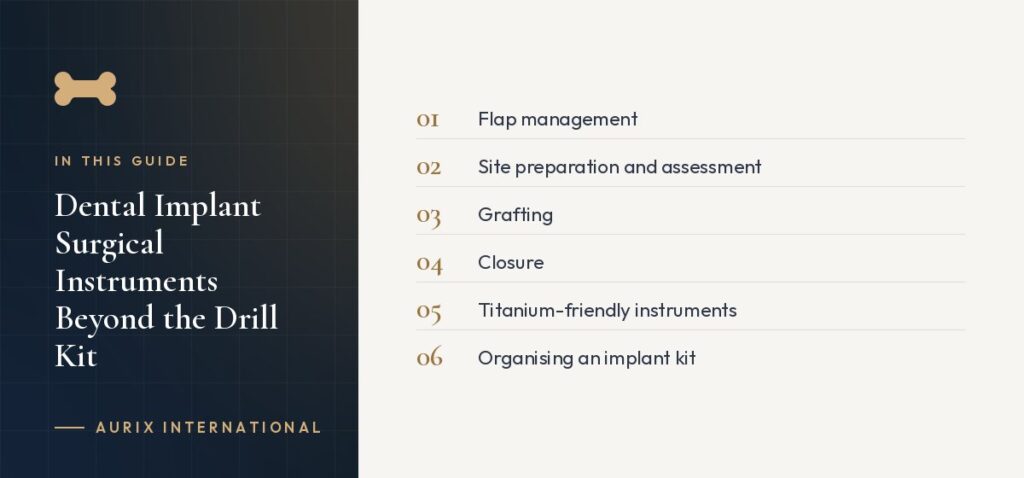
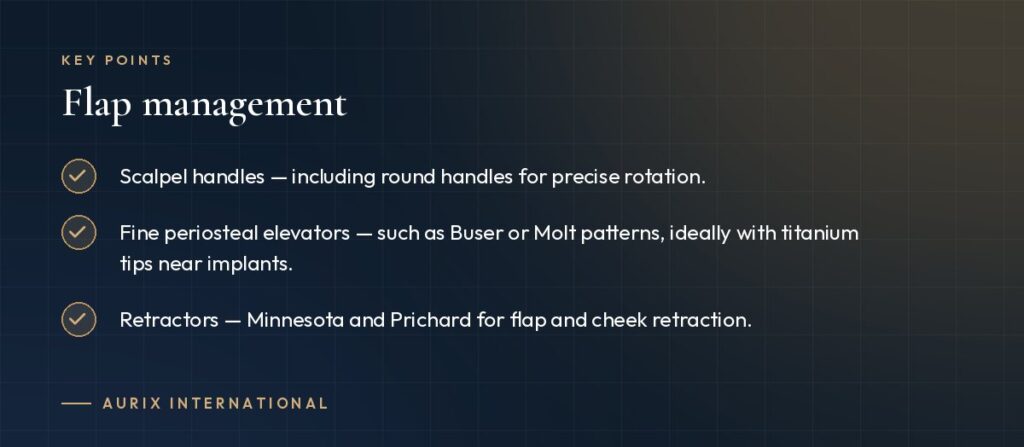
Flap management
- Scalpel handles — including round handles for precise rotation.
- Fine periosteal elevators — such as Buser or Molt patterns, ideally with titanium tips near implants.
- Retractors — Minnesota and Prichard for flap and cheek retraction.
Site preparation and assessment
- Surgical curettes — to debride extraction sockets before immediate placement.
- Bone calipers and probes — to measure ridge width and depth.
- Rongeurs — to remove sharp bone edges.
Grafting
- Bone graft carriers and condensers — to place and pack graft material.
- Mixing wells — to hydrate and mix graft materials.
- Membrane forceps and placement instruments — to handle barrier membranes.
Closure
- Castroviejo needle holder — for fine sutures.
- Fine tissue forceps — such as Gerald or micro Adson patterns.
- Fine scissors — for suture and tissue trimming.
Titanium-friendly instruments
Steel instruments can scratch implant surfaces and abutments. Titanium or plastic-tipped instruments are recommended where contact with the implant is likely, for example when cleaning around healing abutments.
Organising an implant kit
Keep surgical hand instruments in a separate cassette from the implant system’s drill kit so they can be reprocessed and replaced independently.
Aurix International can assemble implant surgical hand instruments into a dedicated cassette. Build your implant kit.