Periodontal instrument manufacturers make the curettes, scalers, probes and powered scaling systems that hygienists and periodontists rely on every day. Because these instruments are used for long, detailed procedures, small differences in tip design, handle diameter and edge retention matter. This list covers eight notable manufacturers, from US and European hand-instrument specialists to makers of ultrasonic and air-polishing systems.
Key takeaways
- Six of the eight companies focus on hand instruments; EMS and Acteon focus on ultrasonic and related equipment.
- The companies are listed in no particular order; this is not a ranking.
- Handle ergonomics, tip design and edge retention are the main differences between hand-instrument brands.
- Most hygiene teams combine powered scaling with hand instruments such as Gracey curettes.
Selection criteria: these are notable manufacturers whose main focus includes periodontal instruments, chosen for breadth of range, specialization and market presence. They are listed in no particular order and the list is not a ranking by revenue or quality. The full, searchable list of instrument companies is in our dental instruments supplier directory.
The top 8 periodontal instrument manufacturers
1. Hu-Friedy (HuFriedyGroup)
Chicago-based Hu-Friedy has manufactured dental hand instruments since 1908 and also makes instrument management systems. Its focus covers hand instruments, periodontal instruments and infection control, so it is a common reference brand for curettes, scalers and probes.
2. American Eagle Instruments
Based in Missoula, Montana, American Eagle is a US manufacturer of scalers, curettes and other periodontal hand instruments. It is a specialist brand that hygienists often compare when choosing scalers and curettes.
3. Paradise Dental Technologies (PDT)
Also in Missoula, PDT is a US manufacturer of periodontal and hygiene hand instruments. Its focus on the hygiene operatory makes it relevant to teams reviewing their scaling and root planing sets.
4. Aurix International (our company)
Aurix International is a USA-based supplier of surgical-grade stainless steel dental and surgical instruments, with periodontal hand instruments, kits, wholesale and private-label options. It is an option for practices, schools and distributors that want periodontal instruments individually or as complete kits.
5. Deppeler
Deppeler, in Rolle, Switzerland, manufactures periodontal and hygiene hand instruments. It is a European specialist to compare for scalers and curettes.
6. LM-Instruments
Finland’s LM-Instruments, based in Parainen, makes ergonomic dental hand instruments with a periodontal focus. Clinicians who prioritize handle comfort for long scaling sessions often look at ergonomic designs like these.
7. EMS Dental
EMS, in Nyon, Switzerland, makes ultrasonic scalers and air-polishing systems. It represents the powered side of periodontal instrumentation, which complements hand instruments.
8. Acteon
Acteon, based in Mérignac, France, makes ultrasonic, imaging and dental equipment, with periodontal care among its focus areas. It is another option for practices choosing ultrasonic scaling units and tips.
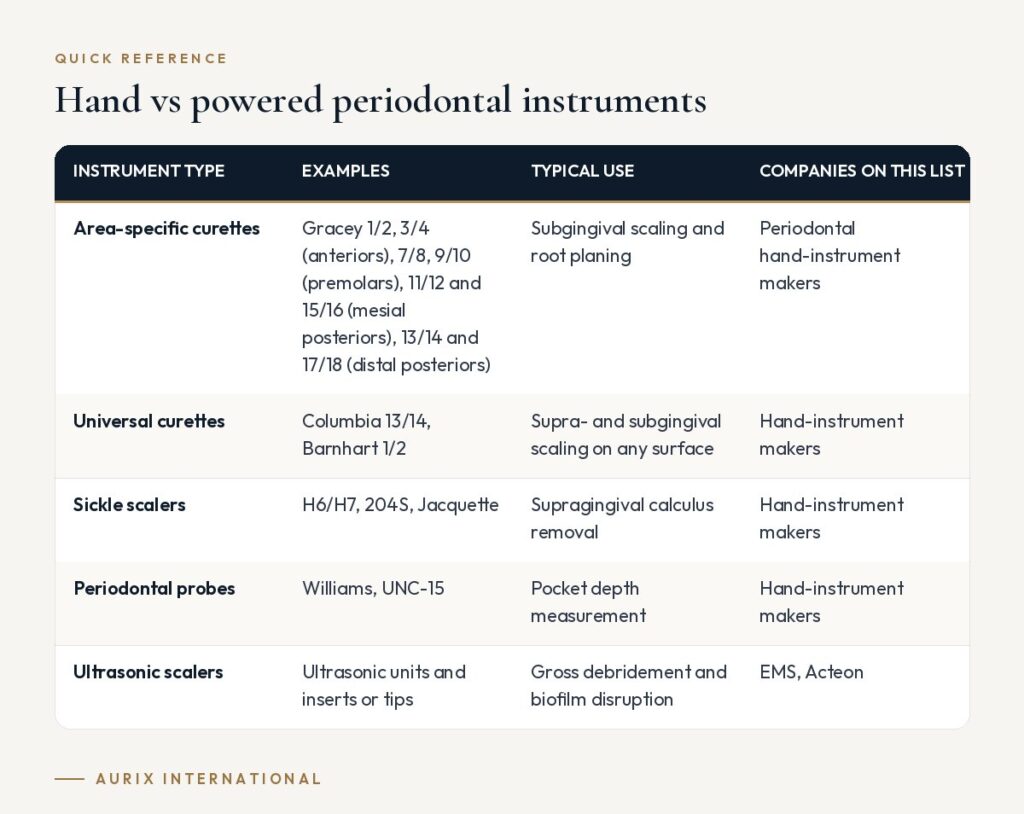
Hand vs powered periodontal instruments
| Instrument type | Examples | Typical use | Companies on this list |
|---|---|---|---|
| Area-specific curettes | Gracey 1/2, 3/4 (anteriors), 7/8, 9/10 (premolars), 11/12 and 15/16 (mesial posteriors), 13/14 and 17/18 (distal posteriors) | Subgingival scaling and root planing | Periodontal hand-instrument makers |
| Universal curettes | Columbia 13/14, Barnhart 1/2 | Supra- and subgingival scaling on any surface | Hand-instrument makers |
| Sickle scalers | H6/H7, 204S, Jacquette | Supragingival calculus removal | Hand-instrument makers |
| Periodontal probes | Williams, UNC-15 | Pocket depth measurement | Hand-instrument makers |
| Ultrasonic scalers | Ultrasonic units and inserts or tips | Gross debridement and biofilm disruption | EMS, Acteon |
For tooth-by-tooth guidance on curette selection, see our Gracey curettes numbers guide.
Building a periodontal instrument set
Whichever manufacturers you choose, most hygiene and periodontal setups include a similar core. A typical tray might contain:
- Examination: mouth mirror, explorer (such as an 11/12 or a shepherd’s hook) and a periodontal probe such as a Williams or UNC-15.
- Supragingival scaling: one or two sickle scalers, for example an H6/H7 or 204S.
- Subgingival scaling and root planing: a Gracey set covering anteriors (1/2 or 5/6), premolars (7/8), mesial posteriors (11/12 or 15/16) and distal posteriors (13/14 or 17/18), plus a universal curette such as a Columbia 13/14.
- Powered instrumentation: an ultrasonic unit with suitable inserts or tips for gross debridement.
- Maintenance: a sharpening stone or system and a cassette to keep instruments organized through reprocessing.
Our guide to building a periodontal kit walks through a complete 17-instrument setup.
How to choose periodontal instruments
- Handle diameter and weight. Larger, lighter handles can reduce pinch force during long sessions. Try several sizes before committing a whole team.
- Tip design. Standard, rigid, after-five (extended shank) and mini-blade variants suit different pocket depths and access. Match the design to the pockets and tooth anatomy you treat most often.
- Edge retention and sharpening. Ask whether instruments are designed for resharpening and how the steel holds an edge. Plan a routine with our guide to sharpening curettes and scalers.
- Kit structure. Standardized cassettes or kits make reprocessing consistent and help ensure every operatory has a complete set. Mixing brands within one kit is common; just make sure handle styles feel consistent to the clinician.
- Reprocessing. Follow each manufacturer’s IFU for cleaning and sterilization; keep instruments separated in cassettes to protect tips.
Frequently asked questions
Is this a ranking of periodontal instrument brands?
No. The eight companies are notable manufacturers with a periodontal focus, chosen for range, specialization and market presence and listed in no particular order.
Why are ultrasonic companies included?
Ultrasonic scalers are periodontal instruments too. Most hygiene protocols combine powered debridement with hand instrumentation for fine scaling and root planing.
How often should curettes be sharpened?
It depends on use and technique. Many clinicians check edges regularly and sharpen as soon as an edge no longer bites; a dull curette tends to burnish calculus rather than remove it.
What is the difference between a Gracey and a universal curette?
A Gracey curette is area-specific: it has one cutting edge per working end, set at an offset blade angle, and each number is designed for particular teeth and surfaces. A universal curette, such as a Columbia 13/14, has two cutting edges and can be adapted to most surfaces. Many clinicians use both.
Need a complete Gracey set? Aurix International offers surgical-grade stainless steel Gracey curettes individually, in pre-assembled kits or as custom kits. Shop Gracey curettes →