Material is one of the most important — and least understood — factors in the Gracey curette market. It determines how long a blade holds its edge, how it behaves through repeated sterilisation, and whether it is safe to use around implants. Here is how the main materials compare and what the market data shows.
Key takeaways
- Stainless steel held about 68.2% of the Gracey curette market in 2025 (Mordor Intelligence).
- Titanium is projected to grow about 10.7% a year, driven by implant maintenance.
- Harder stainless grades hold an edge longer; correct heat treatment is essential.
- Most clinics need stainless Graceys for natural teeth and implant-safe options for implants.
Stainless steel: the market standard
Most Gracey curettes are made from martensitic stainless steel, which can be hardened to hold a sharp edge while resisting corrosion. ISO 7153-1:2016 specifies metals commonly used for surgical and dental instruments. For curettes, manufacturers typically choose harder grades for edge retention, then heat-treat and passivate them.
Strengths
- Excellent edge retention when correctly hardened.
- Can be sharpened repeatedly.
- Withstands steam sterilisation.
- Widely available at a range of prices.
Limitations
- Can scratch titanium implant surfaces.
- Quality varies widely with heat treatment and finishing.
Titanium: the fastest-growing material
Titanium curettes are softer than hardened stainless steel and are used mainly for implant maintenance, where they reduce the risk of damaging implant surfaces. Mordor Intelligence projects titanium to grow at about 10.7% a year through 2031.
Strengths
- Implant-friendly.
- Lightweight.
Limitations
- Lower edge retention than hardened stainless steel.
- Not a replacement for stainless Graceys on natural teeth.
Other materials and coatings
- Plastic and resin curettes — disposable or reusable options for implant maintenance.
- Coatings — some manufacturers apply surface treatments to improve edge life or reduce friction.
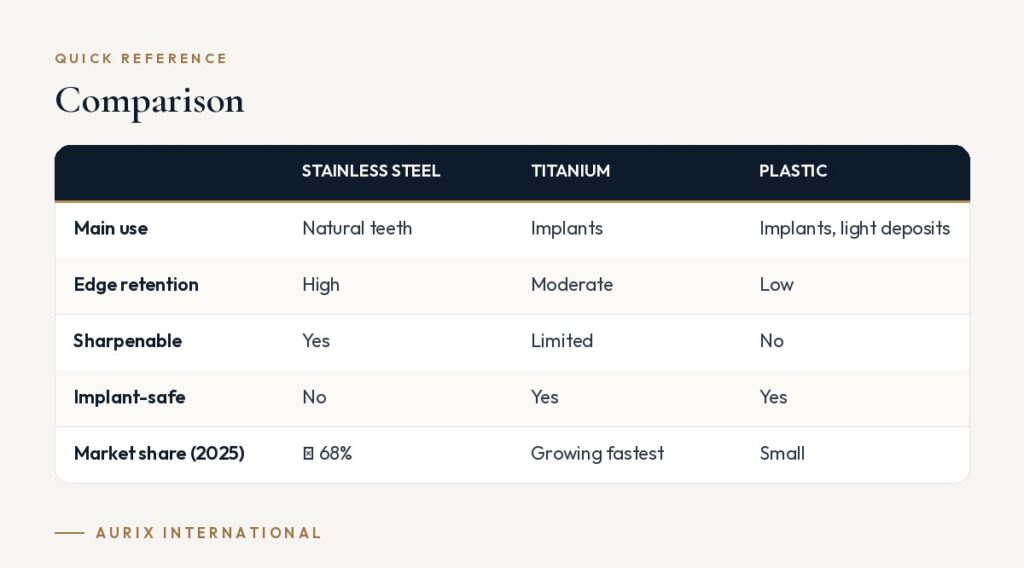
Comparison
| Stainless steel | Titanium | Plastic | |
|---|---|---|---|
| Main use | Natural teeth | Implants | Implants, light deposits |
| Edge retention | High | Moderate | Low |
| Sharpenable | Yes | Limited | No |
| Implant-safe | No | Yes | Yes |
| Market share (2025) | ≈ 68% | Growing fastest | Small |
Why heat treatment matters more than the label
Two stainless curettes from the same grade can perform very differently. Under-hardened blades blunt quickly; over-hardened blades can chip. Passivation strengthens corrosion resistance. Ask suppliers about grades, hardening and passivation. See stainless steel grades explained.
What to buy
- Stainless Graceys for natural teeth — the core of every set.
- Implant-safe curettes (titanium or plastic) for implant patients.
- Spares of high-use stainless patterns for sharpening rotation.
How material affects sharpening
Harder stainless blades take longer to sharpen but hold their edge longer between sharpenings. Softer blades sharpen quickly but blunt quickly too, so they need more frequent attention — and lose blade width faster over time. Titanium implant curettes are generally sharpened lightly, if at all, and replaced when they no longer perform. Understanding this trade-off helps teams plan sharpening schedules and spares.
Material checklist for buyers
- Ask which stainless grade is used for the blade.
- Confirm hardening, tempering and passivation after finishing.
- Check corrosion resistance by running samples through your normal sterilisation for several weeks.
- Keep implant-safe curettes clearly separated from stainless instruments.
- Buy stainless curettes from suppliers who can match grades for future replacements.
All curettes in our Gracey Curettes collection are made from surgical-grade stainless steel; ask us for specifications on any pattern.
Frequently asked questions
Can titanium curettes replace stainless steel?
No. They complement stainless curettes for implant maintenance.
Why do some stainless curettes rust?
Poor passivation, low-grade steel or reprocessing issues such as chlorides and poor water quality. See preventing rust.
Surgical-grade stainless steel Gracey curettes. Explore the Aurix range for clinics, schools and distributors. Shop the collection →
Sources: Mordor Intelligence; ISO 7153-1:2016.