Gracey curettes are area-specific instruments for scaling and root planing. Each pair is designed for particular teeth and surfaces. Once you understand the numbering, choosing the right one becomes automatic.
What makes a Gracey different
A Gracey curette has a rounded toe and a blade that is offset at about 70 degrees to the terminal shank. Only one edge of each blade is used — the lower, longer cutting edge. This design lets the blade adapt closely to the root surface inside the pocket.
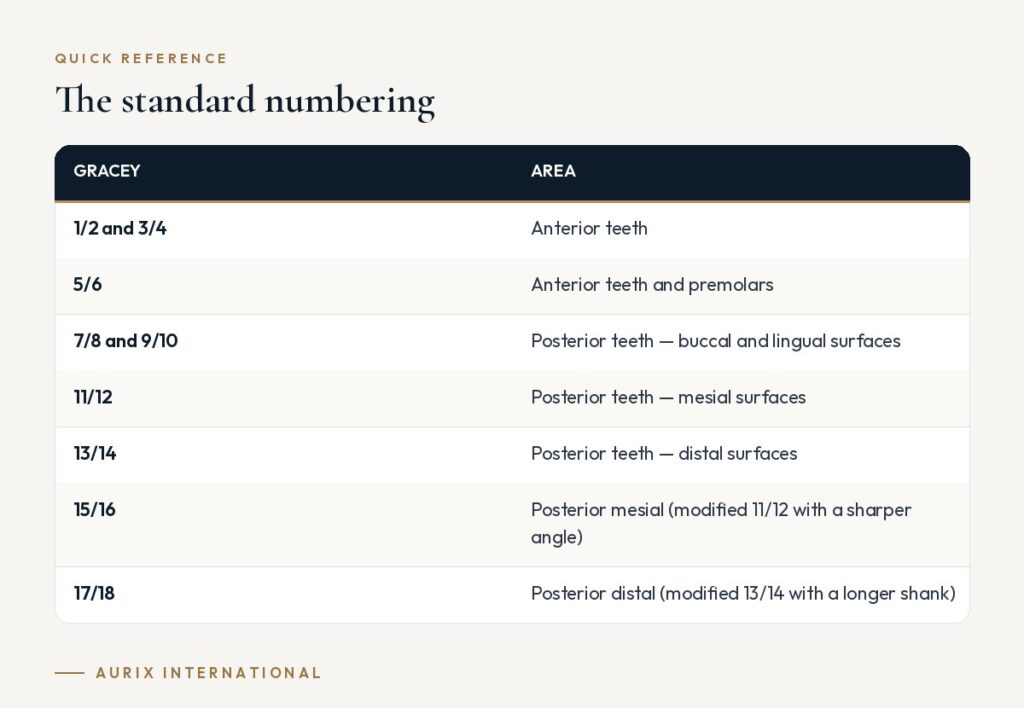
The standard numbering
| Gracey | Area |
|---|---|
| 1/2 and 3/4 | Anterior teeth |
| 5/6 | Anterior teeth and premolars |
| 7/8 and 9/10 | Posterior teeth — buccal and lingual surfaces |
| 11/12 | Posterior teeth — mesial surfaces |
| 13/14 | Posterior teeth — distal surfaces |
| 15/16 | Posterior mesial (modified 11/12 with a sharper angle) |
| 17/18 | Posterior distal (modified 13/14 with a longer shank) |
A simple rule of thumb
- Lower numbers for the front of the mouth.
- Higher numbers for the back.
- 11/12 — mesial; 13/14 — distal. Remember “M before D”.
Which ones do you really need?
Many hygienists work most of the mouth with four instruments: 5/6, 7/8, 11/12 and 13/14. A full set of seven or more gives better access in deep pockets and complex anatomy.
Shank variations
- Standard — for most pockets.
- Extended (after-five) — longer terminal shank for pockets deeper than 5 mm.
- Mini blades — shorter blades for narrow pockets and furcations.
Technique reminder
Keep the terminal shank parallel to the surface being scaled. If the shank is parallel, the correct cutting edge is automatically in contact with the root.
Care
Curettes must be sharp to work well. See our guide to sharpening curettes and scalers.
Aurix International offers Gracey curette sets. Contact us for available configurations.