Suturing is the final step of most surgical procedures, and the one most often delayed by a missing instrument. A dedicated suturing kit means everything needed to close is already on the tray. Here is what to include in a typical 14-piece kit.
Core instruments
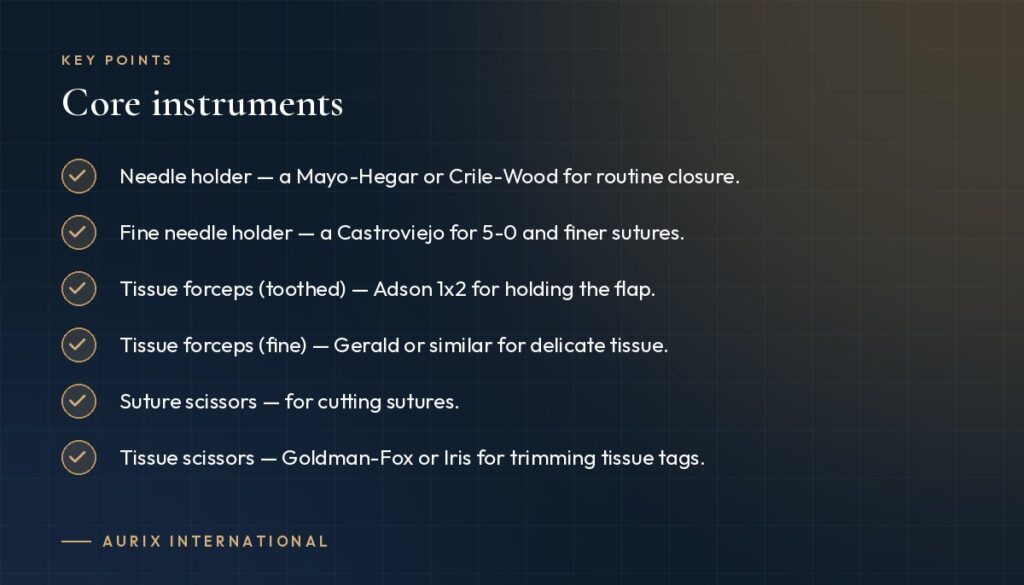
- Needle holder — a Mayo-Hegar or Crile-Wood for routine closure.
- Fine needle holder — a Castroviejo for 5-0 and finer sutures.
- Tissue forceps (toothed) — Adson 1×2 for holding the flap.
- Tissue forceps (fine) — Gerald or similar for delicate tissue.
- Suture scissors — for cutting sutures.
- Tissue scissors — Goldman-Fox or Iris for trimming tissue tags.
- Scalpel handle — for releasing incisions or final trimming.
- Periosteal elevator — to reposition flaps.
- Retractor — Minnesota or similar.
- Mouth mirror — for visibility and retraction.
- College pliers — for gauze and small items.
- Haemostat — for clamping small vessels or holding tissue.
- Suture removal scissors — for follow-up visits.
- Cassette — to keep everything together through reprocessing.
Arranging the cassette
Place instruments in the order of use: retraction and elevation first, then tissue forceps, needle holders and scissors. Keep fine instruments in protected slots so their tips do not touch heavier instruments.
Choosing suture-compatible instruments
Match your needle holders to the sutures you use most. If you mainly close with 4-0, a Crile-Wood is ideal; if you do periodontal plastic surgery with 6-0, include a Castroviejo.
Keeping the kit complete
- Use a printed kit list or photo in the sterilisation area.
- Check the kit against the list before wrapping.
- Replace worn instruments promptly so the kit is always ready.
Pre-assembled or custom?
A pre-assembled suturing kit is the fastest way to standardise across rooms. If you prefer particular patterns, build your own in our custom kits service, with a quote typically within 48 hours.