

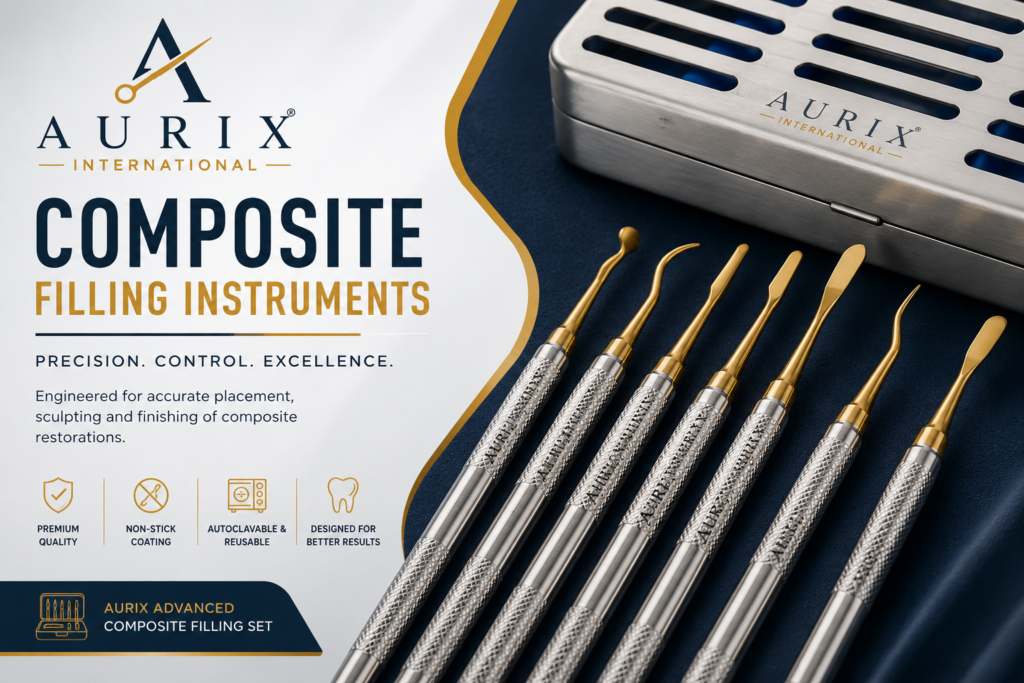

Composite restorations are among the most common procedures in modern restorative dentistry. While the quality of the composite material is important, the instruments used to place, adapt, shape, and finish it also play an important role in the clinical workflow.
A suitable composite filling instrument set can help dentists work with greater control during direct restorations. However, there is no single instrument set that is ideal for every clinician. The right selection depends on the type of restorations performed, the dentist’s technique, the tooth being treated, and the level of anatomical detail required.
What Are Composite Filling Instruments?
Composite filling instruments are dental tools designed to handle resin-based restorative materials. They can be used during different stages of a restoration, including:
- Placing composite into the prepared cavity
- Adapting material against cavity walls
- Sculpting tooth anatomy
- Removing excess composite
- Creating grooves, ridges, and contours
- Refining margins and surfaces
- Supporting finishing procedures
These instruments differ from general filling instruments because their working ends are often designed specifically for composite manipulation. Smooth surfaces and specialized coatings may help reduce material adhesion during placement and sculpting.
Why Instrument Selection Matters
Composite placement is usually performed incrementally. Each layer must be adapted and shaped before the material is light-cured. Instrument selection can therefore influence precision, visibility, comfort, and efficiency.
A well-selected instrument may help a dentist:
- Place small increments more accurately
- Adapt composite to difficult areas
- Reduce excess material
- Shape anatomical features
- Reach interproximal and posterior areas
- Minimize interruptions during treatment
- Maintain a consistent restorative technique
Instrument selection does not replace clinical knowledge or proper isolation. Instead, it supports the dentist’s technique and allows restorative material to be handled more predictably.
Common Types of Composite Instruments
Composite Placement Instruments
Placement instruments are used to carry composite from the dispensing device to the tooth. They are particularly useful when applying small increments and positioning material in specific areas.
Spatulas
Spatulas are used to spread and contour composite. Different shapes may be useful for anterior layering, proximal surfaces, facial contours, and posterior restorations.
Pluggers
A plugger is primarily used to adapt or condense composite into the prepared area. It can help press material against cavity walls and improve adaptation between increments.
Carvers
Carvers help remove excess composite and define tooth anatomy. They may be used to create grooves, ridges, marginal ridges, and other contours.
Burnishers
Burnishers have rounded working ends and are commonly used to smooth, adapt, or refine restorative material.
Ceramic Instruments
Ceramic working ends are used by some clinicians for composite sculpting and contouring. Their smooth surface may provide a different handling experience compared with conventional metal instruments.
Examination Instruments
Mirrors, explorers, tweezers, and other supporting instruments are not used exclusively for composite placement, but they remain important for visualization, checking margins, and handling materials during restorative procedures.
What Is a Non-Stick Composite Instrument?
A non-stick composite instrument is designed to reduce the amount of resin that adheres to its working surface. This can make composite placement and sculpting smoother.
However, “non-stick” does not mean that composite will never adhere. The result can depend on several factors, including:
- Composite viscosity
- Material temperature
- Instrument cleanliness
- Surface condition
- Pressure applied during sculpting
- Contact with bonding agents or other materials
- Shape and finish of the working end
A clean, smooth, well-maintained instrument generally provides more predictable handling than an instrument covered with hardened composite or damaged by abrasive cleaning.
Why Do Some Composite Instruments Have Gold Tips?
Gold-colored instrument tips are often associated with specialized coatings, such as titanium nitride or similar surface treatments. These coatings may provide a hard, smooth surface and may help reduce composite adhesion.
However, color alone does not prove the coating type. Dental professionals should check the manufacturer’s technical documentation for information about:
- Coating material
- Intended use
- Resistance to wear
- Cleaning compatibility
- Sterilization compatibility
- Replacement recommendations
Anterior vs. Posterior Composite Instruments
The best instrument shape often depends on the treatment area.
Anterior Restorations
Anterior restorations usually require detailed control over shape, translucency, line angles, and surface anatomy. Fine or narrow working ends may be useful for:
- Incisal edges
- Interproximal areas
- Facial contours
- Line angles
- Veneer-related procedures
- Layer transitions
Posterior Restorations
Posterior restorations often require instruments that support adaptation and occlusal anatomy. Broader or differently shaped tips may be useful for:
- Cavity adaptation
- Cusps
- Marginal ridges
- Occlusal grooves
- Proximal contours
- Incremental placement
There is no universal rule that one instrument shape is best for every anterior or posterior procedure. Dentists should select instruments according to their technique and the anatomy they need to reproduce.
How Many Instruments Are Needed?
The number of instruments required depends on the procedure and the dentist’s workflow.
A basic setup may include:
- One or more composite placement instruments
- A plugger or condenser
- A carver
- A burnisher
- A mirror
- An explorer
- Tweezers
- Finishing and polishing instruments
A more comprehensive setup may include multiple tip geometries for anterior and posterior work, layering, anatomical sculpting, proximal adaptation, and finishing.
A larger kit is not automatically better. Additional instruments are useful when they match the clinician’s procedures and are regularly used.
How to Choose a Composite Filling Set
Before purchasing a composite filling instrument set, consider the following questions.
What Procedures Do You Perform?
A dentist who mainly performs small posterior restorations may need a different selection from a cosmetic dentist who performs anterior layering and veneer procedures.
Do You Need Specialized Working Ends?
If your technique involves detailed anatomical sculpting or complex layering, compare the shapes, sizes, and angles of the working ends.
Is the Surface Suitable for Your Materials?
Different composite materials may behave differently. When possible, evaluate instruments with the types of composite commonly used in your practice.
Is the Set Compatible With Your Sterilization System?
Check the manufacturer’s instructions for cleaning, packaging, sterilization temperature, drying, and maintenance.
Can Individual Instruments Be Replaced?
Replacement availability is important. A complete set becomes less practical if a damaged or missing instrument cannot be replaced.
Is the Set Organized for Daily Use?
A tray or organized layout can make preparation easier, but organization should not be the only reason to choose a kit.
Cleaning and Sterilization
Follow the manufacturer’s instructions for cleaning and sterilization. General maintenance principles include:
- Remove composite residue before it hardens whenever possible.
- Use cleaning products compatible with the instrument material and coating.
- Avoid abrasive methods that may scratch working ends.
- Inspect instruments for corrosion, cracks, loose components, or coating damage.
- Package instruments according to the clinic’s sterilization protocol.
- Use a validated sterilization cycle.
- Store sterilized instruments in a clean, protected environment.
Do not assume that every dental instrument is autoclavable. Always verify the instructions for the specific product and model.
Reusable vs. Disposable Instruments
Reusable instruments can be cleaned, sterilized, inspected, and used again when the manufacturer classifies them for reuse. They may be economical for regular clinical work, but they require proper maintenance.
Disposable instruments may be convenient in selected situations, but they create recurring costs and additional waste. The choice depends on infection-control requirements, clinic policy, instrument design, and manufacturer instructions.
When a Complete Composite Filling Set May Be Helpful
A complete set may be useful when:
- A clinic is establishing a restorative department
- Several dentists need a standardized setup
- A teaching institution requires multiple instrument types
- A dentist wants to replace an inconsistent collection of instruments
- The set contains working ends that match the dentist’s clinical techniques
Buying individual instruments may be more appropriate when:
- The dentist already owns a suitable basic setup
- Only one or two instruments need replacement
- The clinician has highly specific instrument preferences
- The complete set includes items that will rarely be used
Aurix Composite Filling Sets
Aurix International offers composite instrumentation systems designed for dental professionals looking for organized solutions for restorative procedures.
The current Aurix product range includes the Aurix Basic Composite Filling Kit Gold and the Aurix Advanced Composite Filling Set.
The Aurix Advanced Composite Filling Set is positioned as a comprehensive composite instrumentation system, bringing together composite and ceramic instruments, burnishers, filling instruments, examination tools, support instruments, and a sterilization tray.
For dentists comparing complete composite instrument systems, the most important considerations should remain the exact instrument configuration, working-end design, surface characteristics, clinical requirements, sterilization instructions, replacement availability, and overall value.
Explore the available composite filling solutions from Aurix International to compare the configuration that best matches your restorative workflow.
Questions to Ask Before Buying
Before selecting any composite filling instrument set, ask the supplier:
- What instruments are included?
- What are the working-end dimensions?
- What materials and coatings are used?
- Are the instruments reusable?
- Are they autoclavable?
- Which sterilization cycles are approved?
- Are replacement instruments available?
- Can instruments be purchased individually?
- Is a custom set available?
- What warranty documentation is provided?
- Are regulatory documents available where required?
- What are the delivery time, return policy, and import charges?
Final Thoughts
The best composite filling instrument set is not necessarily the largest or most expensive one. It is the set that provides the working-end shapes, surface characteristics, handling comfort, and maintenance requirements that match the dentist’s clinical workflow.
Understanding the function of each instrument helps dental professionals make better purchasing decisions. Whether choosing individual instruments or a complete kit, prioritize clinical suitability, surface quality, sterilization compatibility, durability, and replacement support.
Aurix International focuses on providing dental and surgical instrumentation solutions for healthcare professionals, clinics, distributors, and private-label brands worldwide, with an emphasis on dependable sourcing and professional service.
Educational Note
This article provides general information about composite instruments. It does not replace formal dental training, the manufacturer’s instructions for use, or the infection-control protocols applicable in your practice.
