The periodontal probe is the basic diagnostic instrument in periodontics. It measures pocket depths, attachment levels and bleeding on probing. Accurate readings depend on choosing a probe with markings that suit your charting system.
Common probe types
Williams probe
Marked at 1, 2, 3, 5, 7, 8, 9 and 10 mm. The gaps at 4 and 6 mm make readings easy to see at a glance.
UNC-15 probe
Marked at every millimetre up to 15 mm, with colour bands at 5, 10 and 15 mm. Popular for detailed charting and deep pockets.
WHO (CPITN) probe
Has a 0.5 mm ball tip and a colour band from 3.5 to 5.5 mm. Used for community periodontal screening and the Basic Periodontal Examination.
Marquis probe
Colour-coded in 3 mm bands (3, 6, 9, 12 mm), making readings quick to estimate.
Nabers probe
A curved probe designed to detect and measure furcation involvement on multi-rooted teeth.
Choosing a probe
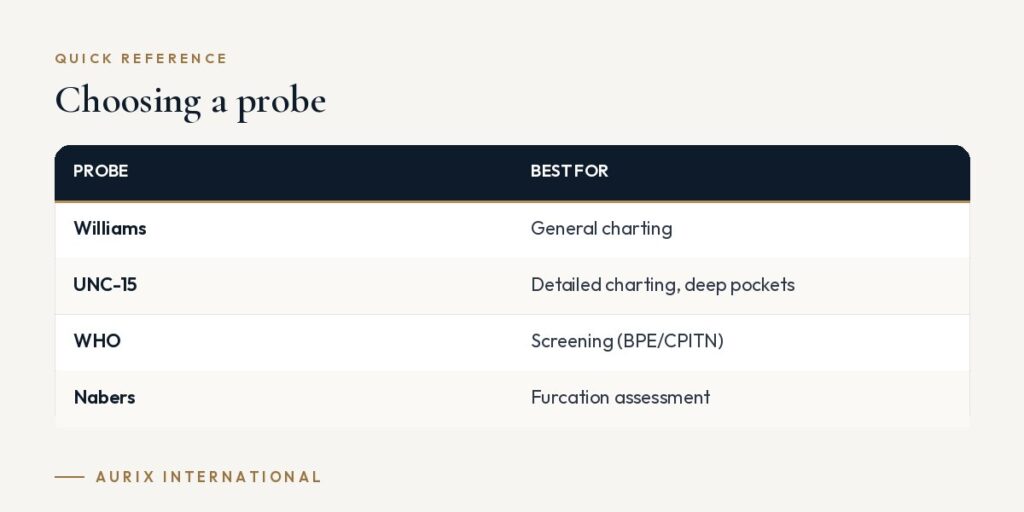
| Probe | Best for |
|---|---|
| Williams | General charting |
| UNC-15 | Detailed charting, deep pockets |
| WHO | Screening (BPE/CPITN) |
| Nabers | Furcation assessment |
Probing technique
- Insert the probe parallel to the long axis of the tooth.
- Use light pressure (about 20–25 g) until you feel resistance.
- Walk the probe around the tooth in small steps.
- Record six sites per tooth for full charting.
Care
Markings can fade with repeated sterilisation. Check probes regularly and replace any with worn markings or bent tips, as both lead to inaccurate readings.
Periodontal probes are included in Aurix diagnostic and periodontal kits. Ask us which markings are available.