
Forecasts put the Gracey curette market on track to grow from about USD 50 million in 2026 to about USD 80 million by 2031 (Mordor Intelligence). Forecasts are not guarantees. This article sets out the base case, what could push growth higher or lower, and what to watch.
Key takeaways
- Base case: about 9.8% annual growth to 2031.
- Upside: faster Asia-Pacific growth, implant care, education expansion.
- Downside: price deflation, supply disruption, faster shift to ultrasonics.
- Specialised patterns and titanium likely outpace the overall market.

The base case
Mordor Intelligence projects about 9.8% CAGR from 2026 to 2031, consistent with other forecasts of 9.7–10.1%. Drivers include periodontal disease prevalence, hygiene workforce growth and innovation.
Upside scenario
- Faster expansion of dental care and education in Asia-Pacific.
- Rapid growth in implant maintenance and titanium instruments.
- Greater adoption of comprehensive sets and specialised patterns.
- Increased preventive and periodontal care awareness.
Downside scenario
- Price deflation from low-cost supply reducing market value even as volumes grow.
- Supply chain disruptions affecting availability.
- Faster shift of debridement to ultrasonic instrumentation.
- Economic pressures reducing elective dental spending.
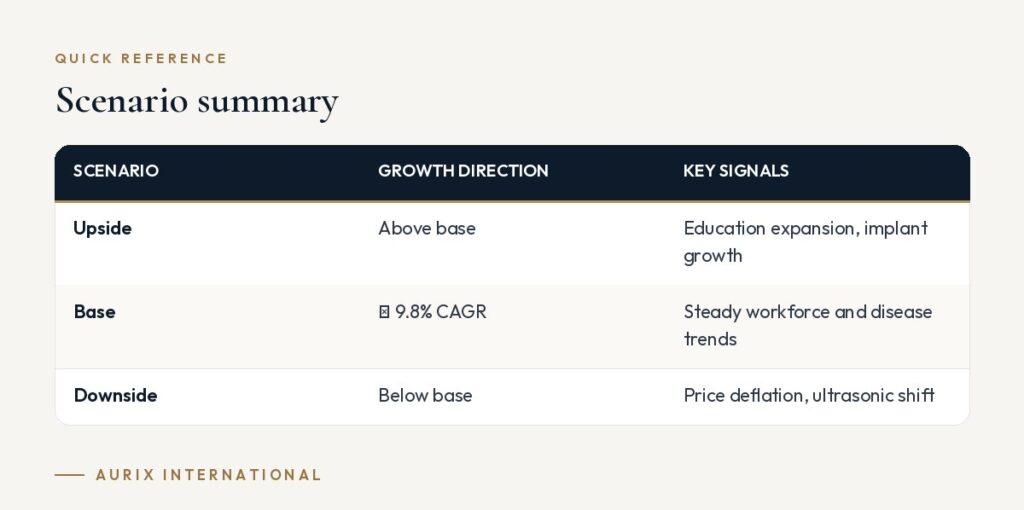
Scenario summary
| Scenario | Growth direction | Key signals |
|---|---|---|
| Upside | Above base | Education expansion, implant growth |
| Base | ≈ 9.8% CAGR | Steady workforce and disease trends |
| Downside | Below base | Price deflation, ultrasonic shift |
Signals to watch
- Hygienist workforce and school enrolment data.
- Implant placement volumes.
- Pricing trends for imported instruments.
- New blade, shank and material innovations.
What it means for you
- Clinics: expect broad choice; prioritise quality evidence and ergonomics.
- Distributors: invest in sets, specialised patterns and private label.
- Schools: plan for growing cohorts and consistent supply.
Strategic moves for distributors
- Expand into extended-shank, mini-blade and implant-safe ranges.
- Offer sets in cassettes and custom kits.
- Build private-label lines in fast-growing regions.
- Partner with schools to build long-term loyalty.
Strategic moves for clinics
- Standardise sets and keep spares for sharpening rotation.
- Upgrade handles to reduce hygienist fatigue.
- Add implant-safe instruments as implant patients increase.
- Review suppliers annually as the market evolves.
Whatever the scenario, reliable instruments remain essential — see our Gracey Curettes collection.
Three scenarios to 2031
| Scenario | What happens | Effect on buyers |
|---|---|---|
| Base case | Growth close to the published 9–10% a year | Wider choice, steady prices for standard patterns |
| Faster growth | Rapid expansion of clinics and schools in Asia-Pacific and more implant patients | More specialised patterns and kits, stronger demand for private label |
| Slower growth | Tighter clinic budgets or faster switching to power instrumentation | More price competition, greater need to check quality |
In every scenario, Gracey curettes remain standard equipment in hygiene and periodontal care. The difference is mainly in how fast specialised patterns and value-focused suppliers gain share.
Frequently asked questions
How big will the Gracey curette market be in 2031?
About USD 80 million on Mordor Intelligence’s base case.
Which segments will grow fastest?
Micro/mini variants and titanium curettes, according to Mordor.
Grow with the market. Wholesale and private-label Gracey curettes from Aurix. Explore the collection →
Sources: Mordor Intelligence; Transparency Market Research. Forecasts are third-party estimates.