
Within the periodontal instrument market, Gracey curettes and universal curettes serve overlapping but distinct roles. Understanding the differences helps clinics build balanced sets and helps distributors position their ranges within the Gracey curette market.
Key takeaways
- Graceys are area-specific with one cutting edge and a 70° offset blade.
- Universals have two cutting edges and a 90° blade.
- Graceys excel in deep pockets; universals in versatility.
- Most hygiene sets combine both.
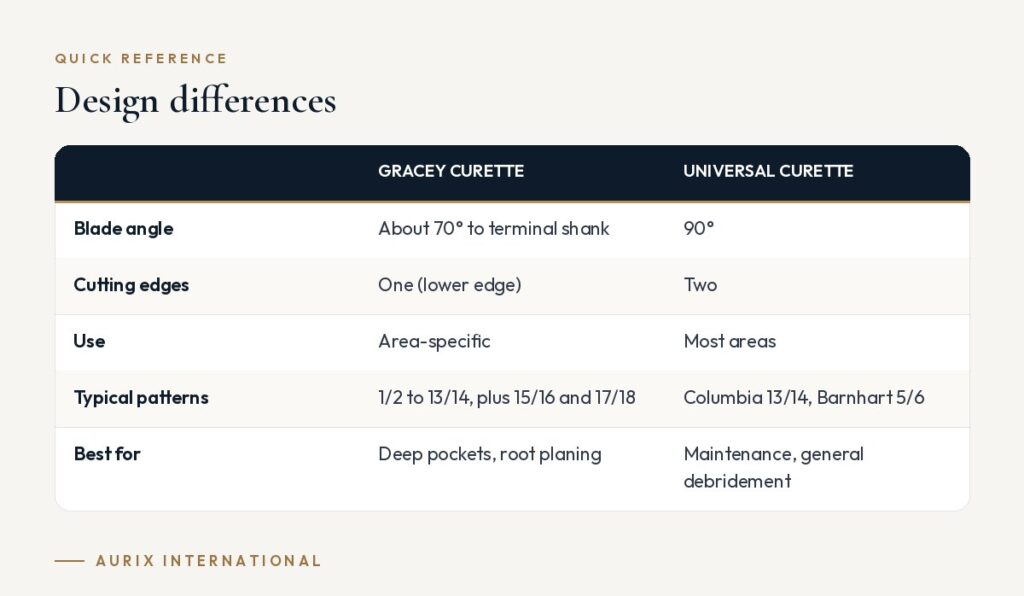
Design differences
| Gracey curette | Universal curette | |
|---|---|---|
| Blade angle | About 70° to terminal shank | 90° |
| Cutting edges | One (lower edge) | Two |
| Use | Area-specific | Most areas |
| Typical patterns | 1/2 to 13/14, plus 15/16 and 17/18 | Columbia 13/14, Barnhart 5/6 |
| Best for | Deep pockets, root planing | Maintenance, general debridement |
Strengths of Gracey curettes
- Superior adaptation to root surfaces in deep pockets.
- Access to furcations and root concavities with specialised variants.
- Correct cutting edge automatically engaged when the terminal shank is parallel to the surface.
Strengths of universal curettes
- One instrument for many sites.
- Fewer instruments to buy and reprocess.
- Easier for beginners.
How they fit in the market
Graceys form the core of periodontal therapy sets, which is why they are tracked as a distinct market segment growing at close to 10% a year (Mordor Intelligence). Universal curettes are part of the broader dental hand instrument market, which analysts estimate at several billion dollars growing at roughly 5–7% a year.
Building a combined set
| Instrument | Role |
|---|---|
| Columbia 13/14 universal | General debridement |
| Gracey 5/6 | Anteriors and premolars |
| Gracey 7/8 | Posterior buccal and lingual |
| Gracey 11/12 | Posterior mesial |
| Gracey 13/14 | Posterior distal |
Read more in universal vs area-specific curettes.
Technique differences
With a Gracey curette, the clinician positions the terminal shank parallel to the surface being instrumented; the offset blade then presents the correct cutting edge automatically. With a universal curette, the face of the blade is positioned at the correct angle to the surface and either edge can be used by changing hand position. Graceys therefore demand more instrument selection but simplify adaptation, while universals demand less selection but more angulation control.
Cost and stock implications
A practice using mainly universal curettes stocks fewer instruments, while a practice relying on Graceys needs more patterns and spares. In return, Graceys usually deliver better results in deep pockets. Most practices find the best balance by combining one universal with a core Gracey set — compare patterns in our Gracey curettes range.
Frequently asked questions
Can universal curettes replace Graceys?
Not for deep pockets and thorough root planing.
Which should a new hygienist buy first?
A universal curette plus core Graceys 5/6, 7/8, 11/12 and 13/14.
Complete your hygiene set. Explore Gracey curettes from Aurix. Browse the collection →
Sources: Mordor Intelligence; Research and Markets: dental hand instruments.